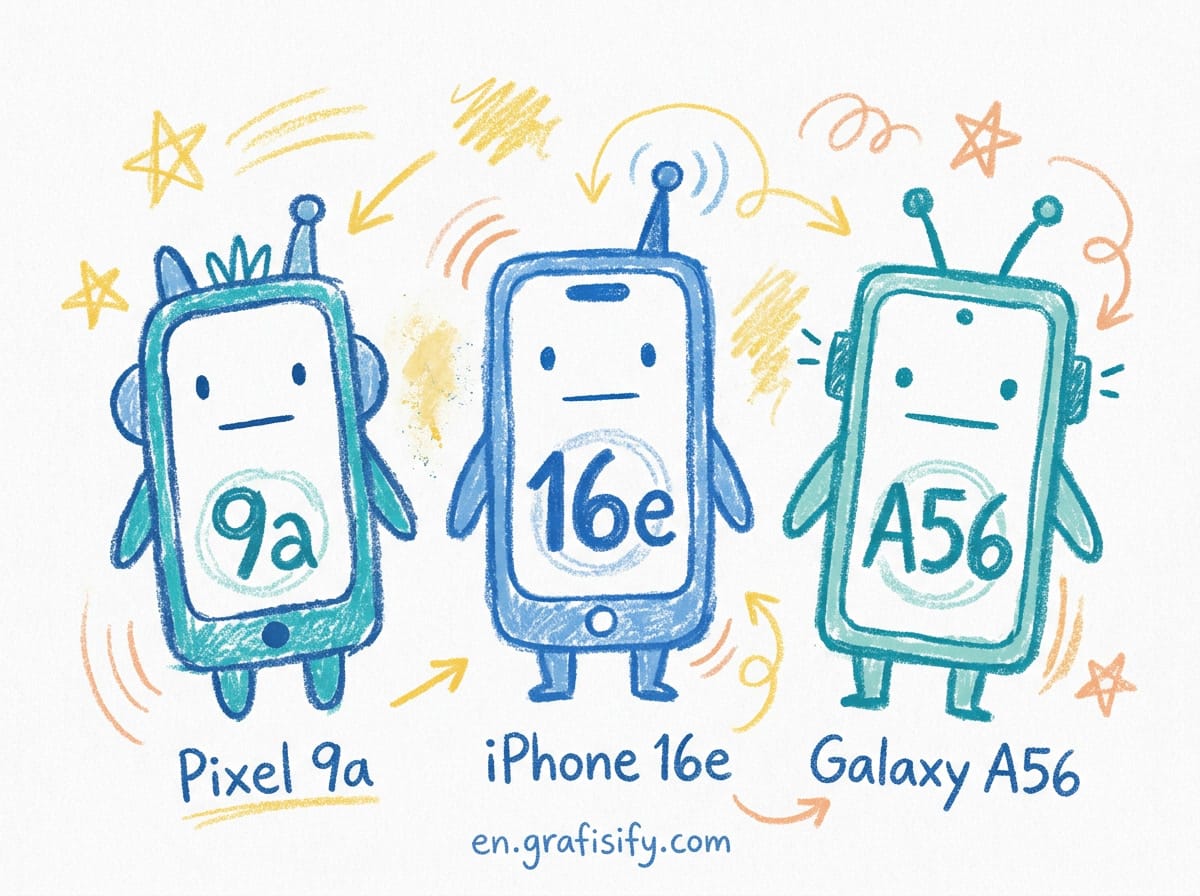
Pixel 9a vs iPhone 16e vs Galaxy A56: Which to Buy
The Verdict
Pick the Galaxy A56 if you want the most phone for the least money: a 6.7 inch 120Hz AMOLED screen, a 5,000mAh battery with 45W charging, and six years of updates at $449. Choose the Pixel 9a if camera quality and clean software matter most, and you can live with weaker gaming performance for $499. Buy the iPhone 16e only if you are locked into iOS and want the fastest processor of the three, but know you pay $599 for a 60Hz screen and the smallest battery here.
Why These Three Phones Compete
The sub-$600 phone category used to mean compromise. In 2025 and 2026 that changed. Google, Apple, and Samsung each ship a device that strips flagship pricing while keeping the parts people notice: the screen, the main camera, and the update promise. The Pixel 9a, iPhone 16e, and Galaxy A56 all sit in this band, which makes them the natural comparison for anyone who refuses to spend $1,000 on a phone.
Each one takes a different path to the same goal. Google leans on computational photography and seven years of software support. Apple puts its A18 chip, the same silicon family found in far pricier iPhones, into a $599 body. Samsung answers with a bigger screen, faster charging, and the most flexible SIM setup of the group. None of them is simply “the cheap version” of a flagship. They are distinct products with distinct tradeoffs.

Specs Compared Head to Head
The table below lines up the numbers that actually affect daily use. Prices are US launch figures; street prices drop with promotions.
| Spec | Google Pixel 9a | Apple iPhone 16e | Samsung Galaxy A56 |
|---|---|---|---|
| Price (launch) | $499 | $599 | $449 |
| Display | 6.3 inch OLED, 120Hz | 6.1 inch OLED, 60Hz | 6.7 inch AMOLED, 120Hz |
| Processor | Tensor G4 (Samsung 4nm) | A18 (TSMC 3nm) | Exynos 1580 (Samsung 4nm) |
| RAM | 8GB | 8GB | 8GB or 12GB |
| Main camera | 48MP + 13MP ultrawide | 48MP single | 50MP + 12MP ultrawide + 5MP macro |
| Battery | 5,100mAh | ~4,000mAh | 5,000mAh |
| Charging | 23W wired, wireless | ~20W wired, wireless | 45W wired, no wireless |
| Software support | 7 years | ~6 years | 6 years |
| Key extra | Gemini built in | Fastest CPU | Dual physical SIM or eSIM |
Performance: Speed vs Sustained Load
Benchmark numbers tell a clear story about raw power. The iPhone 16e’s A18 chip dominates single-core tests, nearly doubling the Pixel 9a’s score in GeekBench 6, because Apple’s custom CPU cores beat Arm Cortex designs in short bursts. The Galaxy S24 FE (a close sibling to the A56’s class) closes the multi-core gap. For everyday scrolling, messaging, and web browsing, all three feel smooth.
The catch shows up under sustained load. The Pixel 9a throttles hard during long gaming sessions, so the Galaxy A56 actually renders more frames per second in extended play even though its chip looks slower on paper. The iPhone 16e holds the single-core crown but gives up much of its graphics headroom and runs warm in longer sessions. If you edit video or play demanding games daily, the A56’s cooling headroom and the iPhone’s raw CPU both beat the Pixel. For normal use, you will not notice the gap.

One detail worth noting: RAM matters for longevity. All three ship with at least 8GB, which is enough to keep many apps resident in memory at once. The Galaxy A56’s 12GB option helps if you juggle heavy multitasking, like editing video while keeping a dozen browser tabs open. The Pixel’s Tensor G4 is the oldest design of the three, built on a 4nm process that trails the A18’s 3nm efficiency, which is why it warms up and steps down clock speeds sooner under pressure.
Cameras: Pixel Leads, iPhone Close, Samsung Versatile
Google’s Pixel 9a produces the most reliable photos of the three. Its 48MP main sensor with computational processing delivers clean daylight shots and strong night imagery, and the 13MP ultrawide is genuinely usable. In side-by-side camera tests the Pixel repeatedly edged the iPhone 16e, which relies on a single 48MP lens with no ultrawide at all. That missing second lens hurts the iPhone for group shots and landscapes.
The Galaxy A56 brings a 50MP main, a 12MP ultrawide, and a 5MP macro lens. Its main camera is dependable rather than class-leading, but the extra lenses give it the most shooting flexibility. Samsung also communicates clearly which AI features run on device versus in the cloud, and lets you disable cloud processing entirely. If photography is your priority, read our guide to choosing a smartphone for photography before deciding.


Battery and Charging: A Clear Split
The iPhone 16e is the weak link here. Its roughly 4,000mAh cell trails both Android rivals, and reviewers consistently note shorter endurance than the Galaxy and Pixel. The Pixel 9a packs a 5,100mAh battery and sips power efficiently, giving the best real-world mileage of the trio in light use. The Galaxy A56 sits at 5,000mAh with the fastest fill: 45W wired charging beats the Pixel’s 23W and the iPhone’s ~20W by a wide margin.
Tradeoffs exist. The Pixel and iPhone both support wireless charging; the Galaxy A56 does not. The A56 charges fastest but makes you plug in. If you want to set the phone down on a pad at night, the Pixel or iPhone fits that habit. If you want to go from empty to full during a coffee break, the Galaxy wins outright.

Software Support and SIM Flexibility
All three promise long update cycles, which was unthinkable in this price band a few years ago. The Pixel 9a leads with seven years of OS and security updates. The iPhone 16e and Galaxy A56 both commit to around six years. That means any of these phones will still receive security patches well into the early 2030s. Our breakdown of Android vs iPhone update timelines covers what those promises look like in practice.
On connectivity, the Galaxy A56 stands apart. Depending on region it supports two physical nano SIMs, two eSIMs, or a mix, which matters if you travel or keep work and personal lines separate. The Pixel 9a offers one nano SIM plus one eSIM. The iPhone 16e is eSIM-only in the US, which simplifies things but removes the physical SIM fallback some users want. If dual SIM flexibility is a requirement, the Samsung is the safe pick.
Display and Refresh Rate
Screen quality separates the winners from the also-ran in this group. The Galaxy A56’s 6.7 inch 120Hz AMOLED is the largest and smoothest panel, good for video and scrolling. The Pixel 9a’s 6.3 inch 120Hz OLED is smaller but equally fluid. The iPhone 16e’s 6.1 inch OLED is sharp and color-accurate yet locked at 60Hz, which feels noticeably less smooth next to the other two. For a phone launched at $599 in 2025, a 60Hz panel is the iPhone’s weakest spec on paper.
High refresh rate matters more than marketing suggests. Once you use a 120Hz screen, 60Hz scrolling reads as slightly stuttering. If smooth motion is part of why you enjoy a phone, rule the iPhone 16e out early. Our explainer on 60Hz vs 120Hz walks through the difference in plain terms.
Which One Should You Actually Buy
Match the phone to the constraint that matters most to you.
Choose the Galaxy A56 if you want maximum value: lowest price, biggest screen, fastest charging, and the most SIM options. It is the all-rounder, and its only real downsides are no wireless charging and a camera that is good rather than great.
Choose the Pixel 9a if photography and clean software lead your list. It takes the best photos here, ships seven years of updates, and bakes Gemini into the system for on-device help. Accept weaker gaming and slower charging as the price of that camera.
Choose the iPhone 16e if you are committed to iOS and want the fastest processor in the comparison for future-proofing. Pay more for less screen smoothness and the smallest battery, and give up the ultrawide camera. For most Android-curious buyers, the other two are the better deal.
Still deciding between a budget phone and a flagship? Our budget vs flagship decision guide lays out when spending double actually pays off. And if you travel internationally, check our eSIM vs physical SIM comparison before you commit to a SIM layout.
Price and Real-World Value
Launch prices tell only part of the story. All three phones drop with routine promotions, and the Galaxy A56 in particular falls well below its $449 sticker during sales events. The Pixel 9a holds value better because Google updates it the longest, so the per-year cost works out lower than the cheaper Samsung over a seven-year window. The iPhone 16e depreciates fastest among the three but keeps the strongest resale demand thanks to the iOS installed base. Factor in carrier trade-in offers, which often cut $100 or more, and the effective gap between these phones shrinks further. Budget for a case and a screen protector either way, since none of the three ships with one in the box.
Final Thoughts
The Pixel 9a, iPhone 16e, and Galaxy A56 prove that $450 to $600 now buys a phone you can keep for six or seven years without feeling punished. The Galaxy A56 is the value champion, the Pixel 9a is the camera pick, and the iPhone 16e is the iOS tax for those who will not leave Apple. None of them is a mistake. Pick by screen smoothness, camera priority, and ecosystem, and you will be happy with any of the three. If you want help narrowing it down further, our budget vs flagship guide explains when the upgrade is worth the extra money.

Irfan is a Creative Tech Strategist and the founder of Grafisify. He spends his days testing the latest AI design tools and breaking down complex tech into actionable guides for creators. When he’s not writing, he’s experimenting with generative art or optimizing digital workflows.
You might also like






 Artificial Intelligent
 Design & Creative
 Freelance
 Gadgets & Gear
 Insights
 Laptop
 Reviews
 Smartphone
 Tech Guides
 Vibe Coding