Unlocked Phone Carrier Compatibility Guide (BYOD, Carrier Policies, Band Requirements)

Unlocked Phone Carrier Compatibility Guide (BYOD, Carrier Policies, Band Requirements)
Quick verdict: This Unlocked Phone Carrier Compatibility Guide is a five-minute preflight check. An unlocked phone lets you switch carriers, but “unlocked” and “compatible” mean different things. You need the right lock status and the right network bands to get full service. Verify both before buying or switching.
I’ve helped three friends navigate carrier switches this year alone, and the same confusion keeps coming up. If you are comparing phone tiers, read our budget vs flagship smartphone guide too. People buy an “unlocked” phone from Amazon or Swappa, bring it to a new carrier, and discover calls drop or 5G won’t connect. The phone was unlocked. But it wasn’t compatible. Let me show you how to get both right the first time.
Unlocked Phone Carrier Compatibility Guide: What Is an Unlocked Phone and Why It Matters
An unlocked phone is not locked to a specific carrier’s network. You can use it with any provider that supports its technology. A carrier-locked phone, by contrast, is programmed to refuse service from competing networks until the lock is removed.
“Unlocked” tells you only that the carrier lock is gone. It says nothing about whether the phone will work well on your new network. A fully unlocked phone can lack the specific 4G LTE or 5G bands your carrier depends on. That’s when you get “no service” in places where a friend’s phone shows full bars.

Three things determine whether a phone works on a given network in 2026: the carrier lock status, the hardware band support, and the VoLTE/IMS certification. Missing any one of them means the phone won’t work as expected. Why do so many unlocked phones fail these checks? Because most buyers only check the lock status and assume everything else follows. These three factors together determine your real-world experience.
Unlocked Phone Carrier Compatibility Guide: The Two Non-Negotiable Checks
Before you switch carriers or buy a phone, you need to confirm two things. Both are equally important. Skip one and you risk being stuck with a device that technically works but gives you a terrible experience.
Check 1: Carrier lock status. Is the phone actually unlocked? You can check this in your phone’s settings. On iPhone, go to Settings > General > About and look for “Carrier Lock.” It should say “No SIM restrictions.” On Android, the path varies by manufacturer but is usually under Settings > Connections > Mobile Networks or Settings > About Phone > Status. A SIM swap test is also reliable: borrow a friend’s SIM from a different carrier and see if it connects.
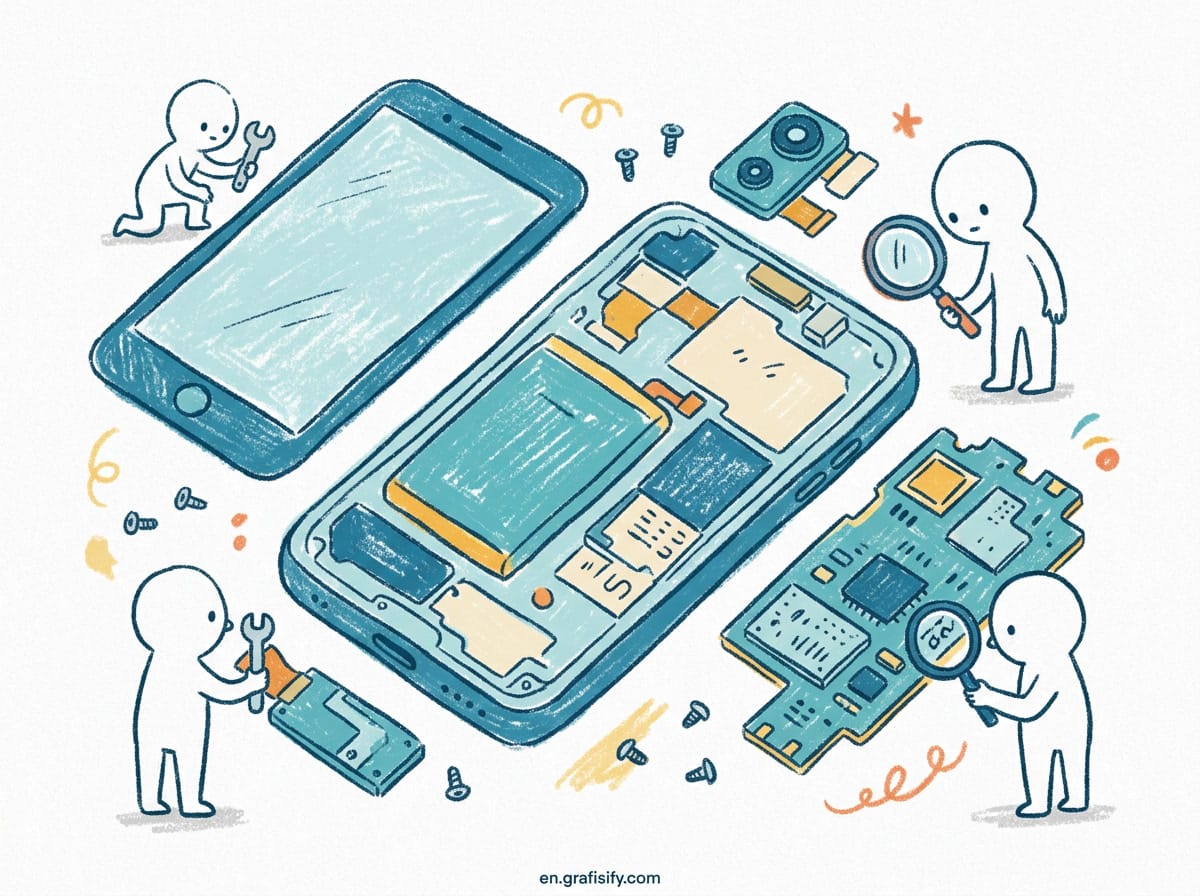
Check 2: Network band compatibility. Every carrier uses a specific set of frequency bands for 4G LTE and 5G. Your phone must support the bands your carrier relies on in your area. This is where most unlocked phones fail. International models, in particular, often lack key US bands like Band 71 (T-Mobile’s long-range 5G) or n77 (Verizon’s mid-band 5G).
You can look up your phone’s exact model number and compare it against the carrier’s band requirements. The model number matters. The US variant of a Samsung phone is different from the international one, and they support different bands. More on that in the buying section below.
Unlocked Phone Carrier Compatibility Guide: How to Check If Your Phone Is Unlocked
Here are three ways to check your phone’s lock status. Use the simplest one first.

Method 1: Settings check. On iPhone, navigate to Settings > General > About. The “Carrier Lock” entry will show “No SIM restrictions” if unlocked, or a specific carrier name if locked. On Samsung Galaxy phones, go to Settings > Connections > Mobile Networks > Network Lock. Other Android brands place this under Settings > About Phone > Status or offer a dedicated SIM card lock setting.
Method 2. The SIM swap test. Borrow a SIM card from a friend on a different carrier. Pop it in. If the phone activates and shows signal within 30 seconds, it’s unlocked. If it displays “SIM not supported” or “Invalid SIM,” it’s carrier-locked. This is the most practical test and works regardless of phone brand.
Method 3. IMEI check. Dial *#06# to display your IMEI number, then visit the carrier’s unlock status page. The Unlocked Phone Carrier Compatibility Guide rule is simple: start with the carrier you are leaving. T-Mobile explains its BYOD checks, AT&T has a device unlock portal, and Verizon reports status through My Verizon. Third-party databases can help, but the carrier owns the lock record.
| Method | iPhone | Android | Reliability |
|---|---|---|---|
| Settings | Settings > General > About > Carrier Lock | Settings > Connections > Network Lock | High |
| SIM swap | Insert different carrier SIM | Insert different carrier SIM | Highest |
| IMEI portal | Carrier unlock website | Carrier unlock website | High (slow) |
Unlocked Phone Carrier Compatibility Guide Deep Dive: US Carrier Band Requirements
Each carrier relies on a different combination of frequencies. A phone might work great on T-Mobile but struggle on Verizon because it lacks Verizon’s key bands. Here’s what each carrier needs in 2026.
Verizon depends on bands 2, 4, 5, 13, and 66 for LTE coverage. Its 5G network runs on n77 (C-band) for mid-band speed and mmWave (n260, n261) for ultra-fast urban pockets. Band 13 is Verizon’s long-range backbone: without it, coverage drops significantly outside cities. Most international phones lack band 13.
AT&T uses bands 2, 4, 5, 12, 14, 30, and 66 for LTE. Band 14 is FirstNet spectrum that AT&T also uses for general coverage in rural areas. Does your phone support these? That depends entirely on the model variant. Its 5G relies on n77 for mid-band and mmWave in dense venues. Band 12 is critical for rural AT&T coverage: similar to Verizon’s band 13 role.
T-Mobile is the most demanding carrier for band support. Its LTE runs on bands 2, 4, 12, 66, and 71. Band 71 (600 MHz) is T-Mobile’s superpower: it provides long-range 5G coverage that reaches far beyond what Verizon and AT&T can do with their current spectrum. For 5G, T-Mobile uses n41 (mid-band UC) and n71 (extended range). Without band 71, a phone will miss T-Mobile’s best coverage in suburban and rural areas.
| Carrier | Key LTE Bands | Key 5G Bands | Critical Band |
|---|---|---|---|
| Verizon | 2, 4, 5, 13, 66 | n77, n260, n261 | Band 13 |
| AT&T | 2, 4, 5, 12, 14, 30, 66 | n77, n260, n261 | Band 12 / 14 |
| T-Mobile | 2, 4, 12, 66, 71 | n41, n71, n261 | Band 71 / n71 |
The safest choice in this Unlocked Phone Carrier Compatibility Guide supports all three carriers’ critical bands. That’s usually a US model sold by a carrier or a factory-unlocked US variant. International variants often omit band 13, band 71, or both. They may work in cities, then lose coverage in suburban and rural areas.
Unlocked Phone Carrier Compatibility Guide: Pros and Cons of BYOD vs Carrier Financing
Should you bring your own phone to a carrier or finance one through them? Here’s a balanced look.
BYOD pros: Lower monthly costs: MVNO plans run $15 to $40 per month compared to $70 to $90 for postpaid. No installment payments or credit checks. You own the phone outright from day one. Switch carriers whenever you want with zero friction.
BYOD cons: You pay the full phone cost upfront. Some carrier options (like Verizon’s Wi-Fi Calling on non-Verizon devices) may not work. Visual voicemail can be hit or miss on MVNOs. And IMEI compatibility checks fail more often than they should, especially for phones bought outside the US.
Carrier financing pros: Spread the phone cost over 24 or 36 months with zero interest. Wi-Fi Calling, visual voicemail, and carrier-certified 5G usually work out of the box. Trade-in deals can cut hundreds from the phone price.
Carrier financing cons: You’re tied to the deal. Leaving early means paying the remaining balance, and the phone may stay locked until it qualifies for release. Over 36 months, “zero interest” still means paying full retail price.
My take after comparing these options for years: BYOD on an MVNO saves the most money, but only if the phone fits the network. Wrong bands or an unsuitable international variant can wipe out the savings when service becomes unreliable. That is why this Unlocked Phone Carrier Compatibility Guide puts the carrier choice before the phone choice.
Unlocked Phone Carrier Compatibility Guide: How to Choose the Right Unlocked Phone
This Unlocked Phone Carrier Compatibility Guide reverses the order used by most buying guides. Those guides start with the processor, camera, and screen, then check the carrier at the end. Start with the network instead.
Step 1: Pick your carrier first. If you’re staying with Verizon, your phone needs band 13. If you’re switching to T-Mobile, band 71 is non-negotiable. AT&T customers should verify band 12 and band 14 support. Your carrier choice determines which phones are even worth considering.
Step 2: Choose a US model. Always buy the US variant. The model number tells you everything. For Samsung, US models end in U1 (factory unlocked) or U (carrier branded). International models end in B, E, or N. Avoid these if you’re using a US carrier. For iPhones, the US model number is A28xx series. The international A30xx models lack mmWave and some key LTE bands.
Step 3: Verify with the carrier’s IMEI checker. Before you buy, run the IMEI through the carrier’s BYOD compatibility tool. Verizon’s, AT&T’s, and T-Mobile’s tools report whether the phone is compatible and supports options such as Wi-Fi Calling and HD Voice. AT&T’s BYOD page has a straightforward IMEI checker that also shows VoLTE compatibility.
Step 4: Watch for these red flags. What makes a phone incompatible even after it is unlocked? Missing carrier certification is one answer. Some imported Xiaomi, Oppo, and Vivo models lack US certification. OnePlus and Nothing support varies by model and carrier. Refurbished phones can also carry blacklisted IMEIs from unpaid financing, so check the IMEI history before buying used.
Step 5: Consider eSIM compatibility. All three major carriers support eSIM activation on compatible unlocked phones. US iPhones from the iPhone 14 onward use eSIM without a physical SIM tray. Many recent Android flagships support dual SIM through eSIM plus a physical SIM. If dual SIM matters, verify the exact model on the carrier’s compatibility list.
Unlocked Phone Carrier Compatibility Guide: MVNO Compatibility and Plan Options
MVNOs (Mobile Virtual Network Operators) resell access to the big three networks at lower prices. They’re the biggest reason to go unlocked. The savings are substantial. But not all MVNOs work the same way with unlocked phones.
Verizon-based MVNOs (Visible, US Mobile Warp, Straight Talk) are the strictest about device compatibility. They require phones with Verizon’s full band set including band 13 and VoLTE certification. International phones almost never pass their IMEI check. Visible in particular is known for rejecting phones that technically have the right bands but aren’t in Verizon’s database.
T-Mobile-based MVNOs (Mint Mobile, Metro by T-Mobile, Google Fi, US Mobile GSM) tend to accept a wider range of devices. Many international phones connect, though models without band 71 lose important coverage. Google Fi’s current US service uses T-Mobile, while international roaming depends on supported partner networks. Check the exact model rather than assuming every imported phone will behave the same.
AT&T-based MVNOs (Cricket Wireless, Straight Talk AT&T) fall in the middle. They’re stricter than T-Mobile MVNOs but more lenient than Verizon ones. Cricket’s device compatibility list is shorter than AT&T postpaid’s, but most unlocked US-model phones pass their check.
| MVNO | Parent Network | Starts At | Device Strictness |
|---|---|---|---|
| Visible | Verizon | $25/mo | Strict |
| Mint Mobile | T-Mobile | $15/mo | Flexible |
| Cricket | AT&T | $30/mo | Moderate |
| Google Fi | T-Mobile + others | $20/mo | Flexible |
| US Mobile | Verizon or T-Mobile | $15/mo | Varies by network |
Final Thoughts
The unlocked phone market gives you freedom. But freedom without verification is just a gamble. Check the lock status. Confirm the bands. Verify with the carrier’s IMEI tool. That’s three steps that take less than five minutes total and save you the headache of a phone that won’t connect when you need it most.
Start with your carrier. Then find the phone that supports it well. Buy a US model, skip the international variant unless you travel constantly, and run every IMEI check before you hand over your money. That sequence alone prevents 90% of compatibility problems I see people run into.
How much can BYOD save? Moving from an $80 postpaid plan to a $30 MVNO plan leaves roughly $1,200 in your pocket over two years, before phone promotions and taxes. Use this Unlocked Phone Carrier Compatibility Guide to confirm the bands first. One compatibility mistake can erase much of that gain.
Choose the unlocked path. Just verify before you commit.

Irfan is a Creative Tech Strategist and the founder of Grafisify. He spends his days testing the latest AI design tools and breaking down complex tech into actionable guides for creators. When he’s not writing, he’s experimenting with generative art or optimizing digital workflows.



 Artificial Intelligent
 Design & Creative
 Freelance
 Gadgets & Gear
 Insights
 Laptop
 Reviews
 Smartphone
 Tech Guides
 Vibe Coding