How to Set Your Freelance Rates: A Complete Guide to Pricing Your Work
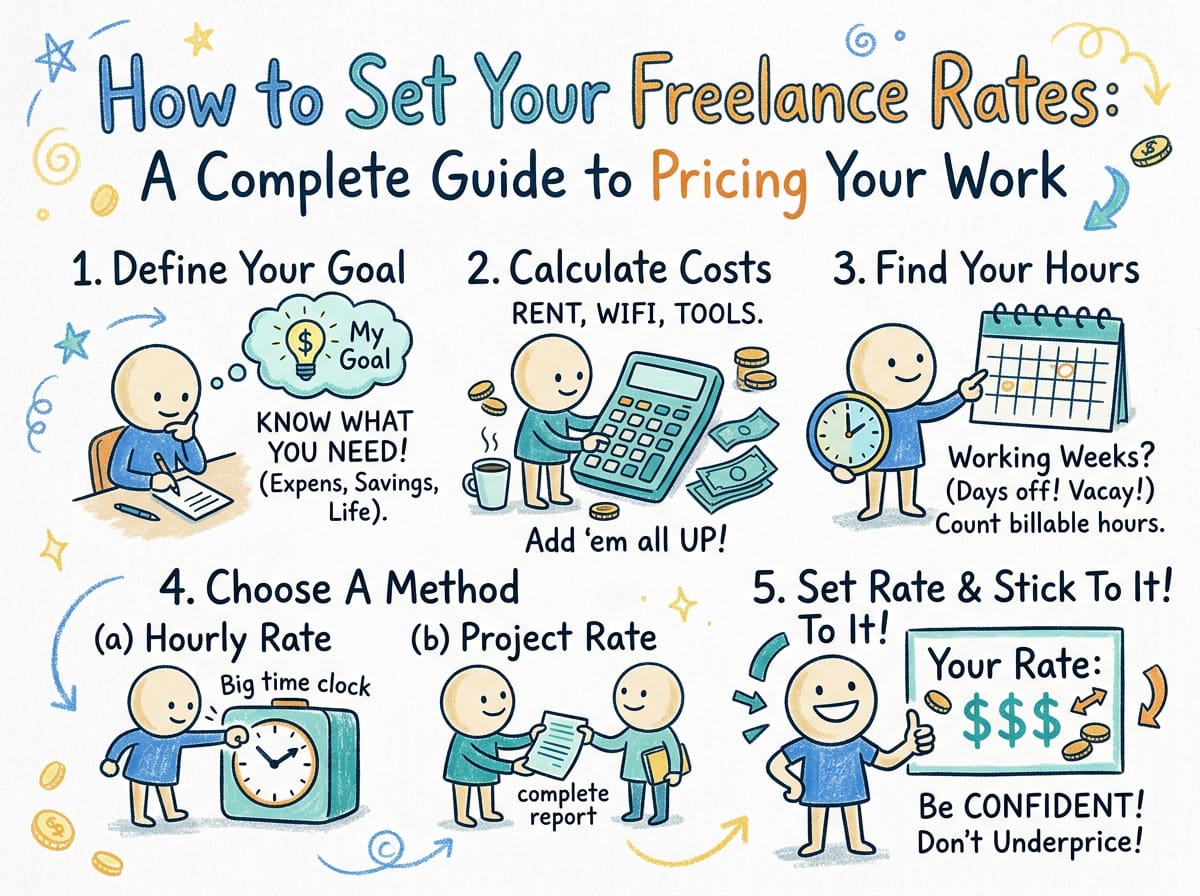
Pricing your work is the single most terrifying thing you’ll do as a freelancer. Not the creative work. Not the client pitches. The moment you have to say a number out loud.
Get it wrong and you’re either working for peanuts or scaring away every decent client. Get it right and you build a sustainable business that funds your lifestyle, not just your rent.
This guide walks you through everything you need to set your freelance rates with confidence. No guesswork. No Imposter Syndrome. Just a repeatable system you can use today.
Why Most Freelancers Underprice (And Why It Hurts More Than You Think)
You already know the feeling. A prospect asks for your rates and your stomach drops. You throw out a number that’s lower than you deserve, hoping they’ll say yes. They do. And then you hate yourself for leaving money on the table.
The psychology behind underpricing is brutal. Imposter Syndrome whispers that you’re not good enough. Fear of rejection convinces you a low rate is better than no rate. And the scarcity mindset tells you clients are rare, so you should grab whatever you can get.
But underpricing doesn’t just hurt your bank account. It attracts the wrong clients. When you charge too little, you attract people who see price as the only deciding factor. These clients are demanding, slow to pay, and quick to complain. They don’t value your expertise, they value your discount.
There’s also the math gap. Many freelancers make the mistake of dividing their old salary by 2080 work hours and calling it a day. That’s a disaster. As an employee, you got paid for meetings, training, and downtime. As a freelancer, you eat every single hour you can’t bill. The salary conversion trap crushes your margins before you even start.

Let’s fix that right now.
Your Freelance Rates Floor Formula: Calculate Your Minimum Viable Rate
Your freelance rate has a floor. A number you never go below. Not for a friend, not for a portfolio piece, not for a “big opportunity.” That floor is calculated using cold, hard numbers.
Start with your annual income target. This is the take-home pay you want, not the revenue you think you should make. Be honest. If you need $80,000 to cover your life and feel secure, start there.

Now add your business expenses. Software subscriptions, hardware upgrades, internet, co-working space, health insurance, retirement contributions. Most freelancers underestimate this by about 20%. Add at least 15 to 25% on top of your target income to cover real costs.
Then add your self-employment tax. In the US, that’s roughly 15.3% for Social Security and Medicare. As a W2 employee, your employer paid half. Now you pay it all. Factor it in or watch your real earnings shrink.
The Billable Hours Trap
Here’s where most people make a critical mistake. They assume they’ll bill 40 hours a week. They won’t. You won’t.
A freelancer is lucky to bill 60% of their total working hours. The rest goes to proposals, emails, accounting, marketing, client calls, and admin. If you work 40 hours a week for 48 weeks a year, that’s 1,920 total hours. At 60% billable, you have just 1,152 hours to earn your living.
That changes everything.
Here’s the real math for an $80,000 target:
Target take-home: $80,000
Business expenses (20%): $16,000
Self-employment tax (~15%): $12,000
Subtotal needed: $108,000
Billable hours per year: 1,152
Minimum hourly rate: $94/hour
If you were using the salary conversion trap, you’d have said $38/hour. That’s a $56/hour gap. And that’s the difference between thriving and burning out.
Use this formula today. Know your floor. Never go below it.
Accounting for Self-Employment Tax and Overhead
Don’t treat taxes and overhead as an afterthought. They are real costs that eat your gross revenue. Set aside 25 to 30% of every payment for taxes. Put it in a separate account and pretend it doesn’t exist.
Overhead isn’t just software. It’s the time you spend learning new tools, the courses you take, the marketing you do, the accountant you pay. Add a buffer of 10 to 15% to your floor rate to absorb these hidden costs.
When you calculate your freelance rates with all factors included, you stop reacting to low offers and start making strategic decisions.
Three Freelance Rates Pricing Models and When to Use Each
Your pricing model should match the work, not your comfort zone. Here are the three main approaches and exactly when to use them.
Hourly Pricing: Best for Ongoing, Vague-Scope Work
Hourly makes sense when you don’t know how long something will take. Maintenance work, ongoing support, retainer clients with shifting priorities. It’s also a good starting point if you’re new to freelancing and need data on how long tasks actually take.
The downside is obvious: you cap your income. There are only so many hours in a day. And clients who watch the clock tend to micromanage your time. Use hourly for the first month with a new client, then switch to a retainer or project rate once the scope clarifies.
Track everything. Use a time tracker. Know your effective hourly rate for every project. That data is gold.
Project-Based Pricing: Best for Defined Deliverables
If you know exactly what the client gets, charge by the project. A website redesign. A logo package. A 10-page white paper. Clients love this because they know the cost upfront and you love it because efficiency boosts your effective hourly rate.
The trick is scoping correctly. Break the project into phases. Define what’s included and what’s extra. Write it down. Get approval in writing before you start.
Project pricing also removes the hourly penalty for being fast. If you deliver in 5 hours what used to take you 10, you double your effective rate. That’s the goal.
Value-Based Pricing: The Ceiling-Breaker for Experienced Freelancers
This is where freelance rates stop being about time and start being about impact. Value-based pricing means you charge based on the value the client receives, not the hours you work.
A client who will make $100,000 from a new landing page doesn’t care if it took you 10 hours or 30 hours. They care about the outcome. Your rate should reflect a fraction of that value. Charge $5,000 for a page that generates $100,000 in sales. Both of you win.
Value-based pricing requires confidence and results data. Start with project pricing and transition to value as you prove your worth. It’s the only model where your income potential is truly unlimited.
How to Research Market Rates Without Second-Guessing Yourself
You need market data, but you don’t need to let it become a ceiling. Research to inform your floor, not to limit your potential.
Start with the Upwork rate calculator and their annual skills index. It gives you real data based on thousands of freelancers. Look at rates for your specific skill, not general categories. A WordPress developer and a React developer are not the same.
Check Freelancers Union rate calculator for localized data. The cost of living in San Francisco is not the same as Austin or Boise. Adjust your expectations based on your geography and the geography of your clients.
Use the 1.5x rule when comparing to employee salaries. A full-time employee costs an employer roughly 1.3 to 1.5 times their salary after benefits, payroll tax, and overhead. If a job pays $70,000, the equivalent freelance rate should be around $105,000 in annual income. That’s about $91/hour at 1,152 billable hours.
Don’t compare yourself to low bidders on platforms. They are not your competition. Your competition is the professional who delivers results, communicates clearly, and charges accordingly.
The Psychology of Communicating Your Rate to Clients
How you say your rate matters more than the number itself. Confidence is contagious. Hesitation raises red flags.
Lead with project price, not hourly rate. Say “This project is $3,500” not “My hourly rate is $110.” The first makes the client think about value. The second makes them think about time. When they think about time, they start nitpicking hours.
Never apologize for your rate. Don’t say “I know this is a bit high” or “I’m flexible on price.” Apologizing tells the client you’re uncertain. They will push back. State your rate like it’s a fact. Because it is.
Use the silence technique. After you state your rate, stop talking. Don’t fill the silence with explanations, justifications, or discounts. The client needs a moment to process. If you speak first, you lose leverage. Let them sit with the number.
Handling “Can you do it for less?” is a skill. Don’t say yes immediately. Ask “Which part of the scope would you like to adjust to meet a lower budget?” This shifts the conversation from discount to trade-off. If they can’t reduce scope, you don’t reduce price. Your freelance rates are not negotiable by default.
When and How to Raise Your Rates
Raising rates is uncomfortable. It’s also necessary. If you’re not raising your rates at least once a year, you’re losing money to inflation and your own growth.
Signs It’s Time to Raise
You’re fully booked and turning away work. You’ve gained certifications or skills since your last rate. Your clients are getting better results than before. The market has shifted and your niche is in higher demand. You feel resentful when you invoice because you know you’re worth more.
If three or more of these are true, it’s time.
Use the confidence anchor method. Before you raise rates, land a new client at the higher rate. This anchors your confidence because you know the market will pay it. Then roll out the increase to existing clients.
Giving Notice to Existing Clients
Give 45 to 60 days notice. This is respectful and gives clients time to budget. Send a short, professional email. No long explanations. Just the new rate, the effective date, and a thank you for their partnership.
Here’s a rate increase script that works:
“Subject: Update on my freelance rates
Hi [Client Name],
I wanted to let you know that effective [date 60 days out], my rates will be increasing to [new rate]. This reflects the continued growth in my skills and the results I’m delivering for clients like you.
I value our partnership and wanted to give you plenty of notice. If you’d like to lock in your current rate for one more project before the change, just let me know.
Thanks for understanding.
[Your Name]”
Most clients will accept it without pushback. The ones who don’t were likely to leave anyway. That’s fine. Better to have fewer clients paying well than many clients paying poorly.
Common Pricing Mistakes Even Experienced Freelancers Make
Even veteran freelancers slip up. Here are the most common errors and how to avoid them.
Scope creep without a buffer. You quoted a flat rate for a website. Then the client asks for “just one more page” and “a few small changes.” Next thing you know, you’ve worked 20 extra hours for free. Build a buffer into your project price for small revisions. Define what “small” means in your contract. Anything beyond that gets a change order.
Not charging for revisions. Two rounds of revisions included. Anything after that is billable. Write this into every proposal. Clients will test your boundaries if you don’t set them.
Platform fees eating your margin. Upwork charges 20% on the first $500 with a client. Freelancer.com takes a cut. If you’re pricing the same as you would direct, you’re losing 10 to 20% of your income. Add the platform fee to your rate when working through these channels.
Forgetting to factor in client communication time. Emails, Slack messages, phone calls, status meetings. It all adds up. A client who requires daily check-ins costs you more than one who trusts you to deliver. Factor communication time into your project estimate. If you don’t, you’re working for free during those calls.
Track every single minute you spend on a client, including communication, then compare it to your invoice. You’ll be shocked at the gap. Close it with better scoping and higher freelance rates.
Build Your Personal Rate Card
Your internal rate card is not for clients. It’s for you. It keeps you disciplined and consistent.
Start with your floor rate from the formula above. That’s your hourly minimum. Then build tiers.
Standard rate: Your baseline for most projects.
Premium rate: For rush jobs, complex work, or high-value clients.
Discount rate: For non-profits or long-term retainers (only if you choose to offer this).
Add rush fee premiums. Need the project in half the time? Charge 1.5x to 2x your standard rate. Clients who need speed pay for it. Don’t feel bad about this. It compensates you for the disruption to your schedule.
Define retainer tiers. A 10-hour retainer at X rate. A 20-hour retainer at a slightly discounted rate per hour because the consistency is valuable to you. Set minimum monthly retainers so you don’t get nickel-and-dimed with small tasks.
Review your rate card annually. Schedule a recurring calendar reminder for the same date every year. Inflation, your skill growth, and market demand all shift. Your rates should too.
Your First Step Today
You don’t need to fix everything at once. You just need to know your floor and set your intention.
Take 30 minutes today. Open a spreadsheet. Calculate your minimum viable rate using the formula above. Write it down. Memorize it. Never quote below it again.
Then pick one client you’re currently undervaluing and raise your rate on their next project.
Pricing is a skill, not a fixed number. It gets easier with practice. Every time you state your rate with confidence, you build a stronger business. Every time you walk away from a low offer, you make room for a better one.
I’ve been through this myself. The first time I raised my rates I was terrified. I lost one client and gained three better ones at the higher price. The math works. Trust the process.
Your freelance rates are a reflection of the value you deliver. Don’t discount your worth. Charge it with pride. For more on building your freelance business, check out our Freelance Productivity Guide for tips on structuring your workday.
Calculate your rate today and start building the freelance business you deserve.

Irfan is a Creative Tech Strategist and the founder of Grafisify. He spends his days testing the latest AI design tools and breaking down complex tech into actionable guides for creators. When he’s not writing, he’s experimenting with generative art or optimizing digital workflows.
You might also like




 Artificial Intelligent
 Design & Creative
 Freelance
 Gadgets & Gear
 Insights
 Laptop
 Reviews
 Smartphone
 Tech Guides
 Vibe Coding