Freelance Contracts and Invoicing: A Complete Guide for Independent Designers

Freelance Contracts and Invoicing: A Complete Guide for Independent Designers
Quick Verdict: Most freelancers don’t get underpaid because their skill is low. They get underpaid because their contract doesn’t protect them and their invoice system is reactive instead of proactive. A well-structured contract with a 50% deposit clause, a Net-14 payment term, and a clear late-fee policy is the difference between running a business and running a charity.
Let’s be honest for a second. Nobody became a freelance designer because they love paperwork. You got into this for the creative freedom, the flexible schedule, and the satisfaction of building something with your own hands. But here is the cold truth: every hour you spend chasing unpaid invoices is an hour you aren’t designing. And every project that spirals into scope creep without a change order is money you’re giving away for free.
After spending years working with freelance designers across different markets, I’ve seen the same pattern repeat. The ones who thrive aren’t necessarily the most talented. They are the ones who treat contracts and invoicing as infrastructure, not overhead. This guide covers exactly what you need to set up a system that protects your income, your time, and your creative work.
Freelance Contracts and Invoicing: What Are the Essential Components?
At its core, a freelance contract is a risk-management tool. It aligns expectations between you and your client before any work begins. The most effective contracts include eight essential clauses, and most freelancers only include the first two. The ones they skip are the ones that matter when something goes wrong.

The Scope of Work (SOW)
Everything starts here. If there’s no written scope, there’s no project. Your SOW should list every deliverable on its own line with quantities, formats, and specifications. What is the exact number of logo variations? How many pages in the brand guide? What file formats are you delivering? Here is the trick: also list what is not included. A brief exclusion clause prevents the common assumption that “one homepage design” means the client also gets a full website build.
Payment Terms That Actually Protect You
Your payment terms should cover four things: the total fee, the payment schedule, the due date after invoicing, and the consequence for late payment. The most effective structure for projects over $1,000 is 50 percent upfront on contract signing and 50 percent on delivery. For projects over $5,000, break it into three milestones: 30 percent upfront, 30 percent at midpoint, 40 percent on completion. This structure is the industry standard recommended by the AIGA for design professionals.
Intellectual Property and Ownership
This is the clause most designers get wrong. Under US copyright law, you own the work by default unless a written agreement transfers those rights. That sounds good in theory, but in practice it creates confusion. Your contract should specify exactly when IP transfers to the client, and that transfer must be tied to full payment. Standard wording: “All intellectual property rights in the deliverables shall transfer to the client upon receipt of full payment.” This ensures you keep leverage if the client doesn’t pay.
Revision Limits
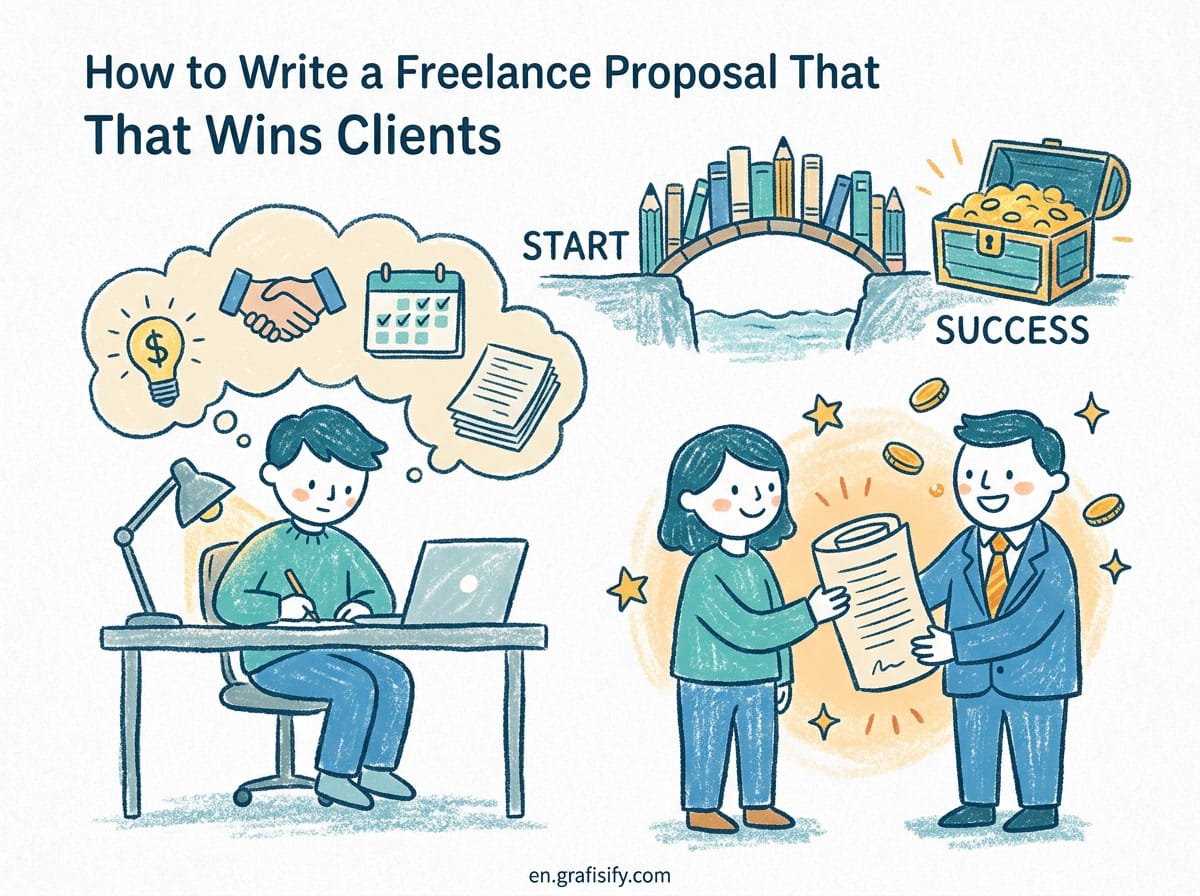
Without a revision clause, you are offering unlimited labor for a fixed price. That’s not a contract. It’s a buffet. Include the number of revision rounds (typically two), define what counts as one round, and specify the hourly rate for additional revisions. Separate revisions from scope changes: a revision is feedback on existing deliverables, while a scope change adds new deliverables requiring a separate change order and additional fee.
| Contract Clause | Why It Matters | Common Mistake |
|---|---|---|
| Scope of Work | Defines exactly what you deliver | Leaving deliverables vague |
| Payment Terms | Sets amount, schedule, and consequences | No late fee clause |
| IP Ownership | Transfers rights on full payment | Giving away rights before payment |
| Revision Limits | Caps included revisions | Unlimited rounds for fixed price |
| Change Orders | Turns scope creep into paid work | No written change process |
| Kill Fee | Protects you if client cancels | Zero compensation for terminated work |
| Late Fee Policy | Incentivizes on-time payment | Not disclosed on the invoice |
Freelance Contracts and Invoicing: How to Structure Your Payment System

A good contract gets you halfway there. A good invoicing system closes the loop. Here is what actually works, based on industry research and real freelancer data.
Invoice on Delivery Day
The single biggest predictor of how fast an invoice gets paid is how fast it was sent. Research from the Freelancers Union shows that invoices sent the same day work is delivered get paid roughly twice as fast as invoices sent a week later. The psychology is straightforward: your client is still thinking about your project, their satisfaction is at its peak, and the urgency to close it out is real. Wait a week and the project mentally archives. The invoice joins the backlog of every other expense.

Net-14 Is Your Best Default
Net-15 or Net-14 days gives the client enough time to process payment without letting the invoice sit for a month. Research from Pact shows that Net-30 is common for corporate clients, but shorter terms correlate strongly with faster payment. For small projects under $500, “due on receipt” with a direct payment link is even better.
The Deposit That Filters Non-Payers
Requiring a 50 percent deposit isn’t aggressive. It’s professional. Clients who pay upfront are invested. They respond to emails faster, provide feedback promptly, and are far less likely to ghost mid-project. The sunk-cost effect works in your favor. If the client pushes back on the deposit, reduce the percentage rather than eliminate it. A 25 percent deposit is dramatically better than zero, both for cash flow and as a commitment signal.
Late Fee: The Silent Motivator
A late fee you never disclosed cannot legally be enforced. Print it on every invoice, even if you never plan to charge it. The standard rate in commercial contracts is 1.5 percent per month, which equals 18 percent annually. Courts in the US typically uphold rates in this range as reasonable liquidated damages. Its primary purpose is psychological: clients pay invoices with visible late-fee terms faster than invoices without them, even when the fee is never actually applied.
Automated Follow-Ups
Most late invoices aren’t malicious. The client got busy, the email got buried, or the invoice is sitting in someone’s approval queue. A structured follow-up sequence solves 90 percent of late payment issues. Send a friendly pre-due reminder three days before the due date. Follow up the day it’s due. Then at day 3, day 7, and day 14 past due with progressively firmer language. Modern invoicing tools like Stripe Invoicing or FreshBooks automate this entire sequence.
Pros and Cons of Professional Contracts and Invoicing
Setting up a proper contract and invoicing system takes upfront effort. Here is the honest trade-off.
Pros: You eliminate the mental overhead of wondering when you’ll get paid. You filter out clients who were never serious. You have legal leverage if something goes wrong. You project professionalism, which justifies higher rates. Your cash flow becomes predictable, which lets you plan your workload better.
Cons: Some clients will push back on deposits or late fees, and you may lose a few prospects. You need to maintain templates and update them as your services evolve. If you use milestone billing, you need to track progress against payment triggers. The first time you enforce a late fee might feel uncomfortable, but that discomfort fades fast after the first check clears.
What most guides miss is the compounding effect. One well-structured contract saves you hours of back-and-forth. Over a year of consistent work, that adds up to days of reclaimed time. I’ve watched designers double their effective hourly rate just by eliminating the unpaid overhead of chasing payments.
Freelance Contracts and Invoicing: How to Choose Between Tools
You don’t need expensive software to start. Here is a practical decision framework based on your project volume.
If you handle fewer than five projects per month, a simple Google Doc contract template plus PayPal invoices works fine. The key is having the template, not the tool. At five to fifteen projects, upgrade to a dedicated invoicing platform like FreshBooks or Stripe Invoicing. Both let you set up recurring invoices, automatic payment reminders, and direct payment links. Above fifteen projects, consider a full client-management platform like Bonsai or HoneyBook that combines contracts, invoices, and project tracking in one system.
The mistake freelancers make is over-engineering this. Start with a single contract template and a single invoicing workflow. Use them for three months, collect feedback from your own experience, and iterate. Don’t buy a platform until you’ve outgrown the manual process.

Frequently Asked Questions: Freelance Contracts and Invoicing
What if a client refuses to sign a contract?
Don’t start work. A client who refuses to sign a contract is telling you they want the flexibility to change terms later. If they are a large enterprise with procurement policies that require their own template, review their terms carefully and negotiate the key clauses: payment terms, late fees, and IP ownership tied to full payment.
How do I handle a client who pays late consistently?
Increase your upfront deposit to 75 percent for their next project. Shorten your payment terms from Net-15 to Net-7. Set up automatic reminders three days before the due date. If they still pay late, it’s not a process problem. It’s a client problem. Raise your rates or stop working with them. Your time is worth more than chasing invoices.
Can I charge late fees retroactively?
No. Not unless your signed contract included a late fee clause from the start. Late fees must be disclosed and agreed upon before the work begins. If your current client doesn’t have a late fee in their contract, you can’t add one retroactively. But you can absolutely include it in the next contract you send them.

Final Thoughts: Are Freelance Contracts and Invoicing Worth the Effort?
Here is the short answer: yes, absolutely. Not because contracts are legally thrilling. They aren’t. But because every clause you include and every invoice you send on time is a signal to your client that you run a real business. That signal changes how clients treat you. It changes how they prioritize your payment. And over time, it changes the quality of clients you attract.
The designers who earn the most aren’t the ones with the best portfolios. They are the ones with the best systems. Set up your contract. Get your deposit. Send your invoice the same day you deliver. And if you are still figuring out what to charge, check out our guide to setting freelance rates to complete your financial toolkit. Watch what happens.

Irfan is a Creative Tech Strategist and the founder of Grafisify. He spends his days testing the latest AI design tools and breaking down complex tech into actionable guides for creators. When he’s not writing, he’s experimenting with generative art or optimizing digital workflows.





 Artificial Intelligent
 Design & Creative
 Freelance
 Gadgets & Gear
 Insights
 Laptop
 Reviews
 Smartphone
 Tech Guides
 Vibe Coding