Samsung Galaxy S26 Pixel 11 iPhone 17 Comparison: Which Phone Has the Best AI Features?
Samsung Galaxy S26 Pixel 11 iPhone 17 Comparison: Which Phone Has the Best AI Features?
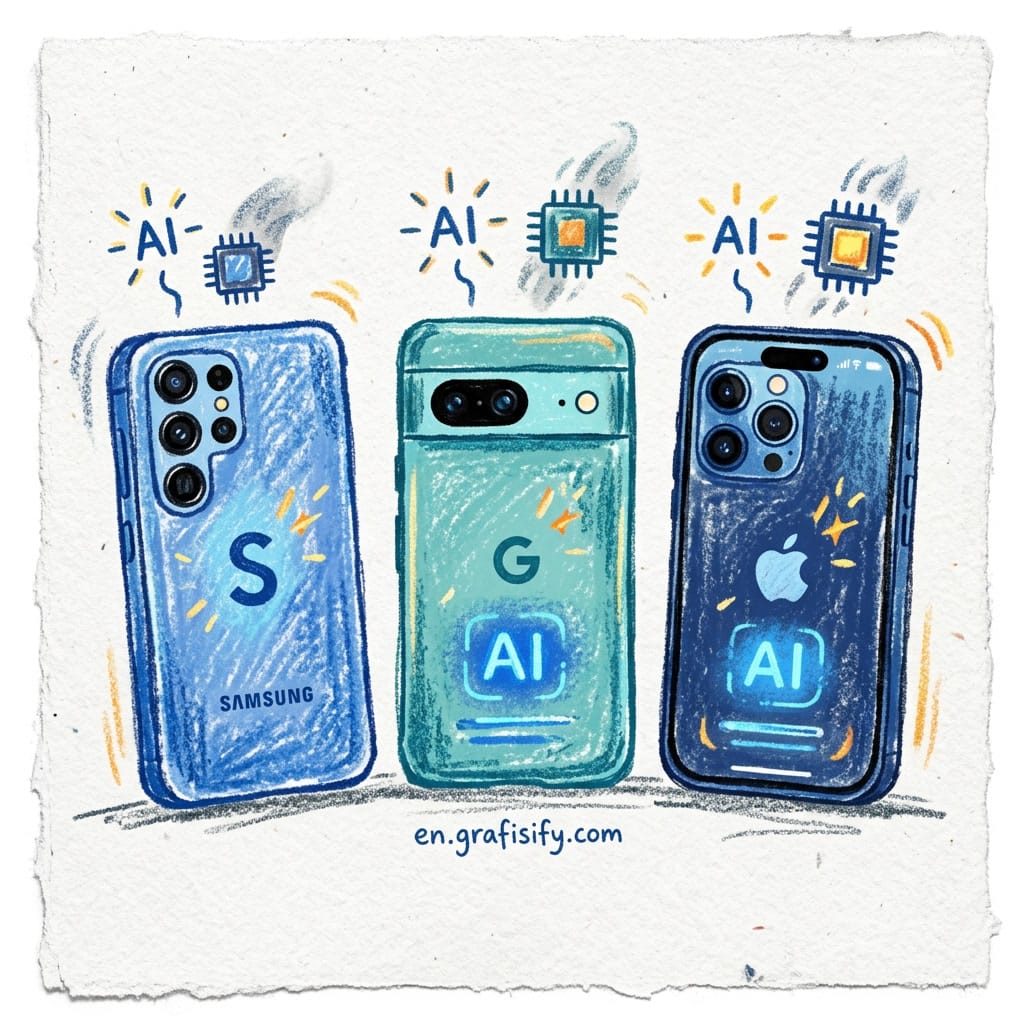
Quick Verdict: Each of the three flagship phones takes a very different approach to AI. This galaxy s26 pixel 11 iphone 17 comparison breaks down every AI feature that matters. Samsung’s Galaxy S26 packs the most features, Google’s Pixel 11 prioritizes on-device processing and privacy, and Apple’s iPhone 17 Pro focuses on deep system integration with strict hardware requirements. There is no single winner. Your choice depends on which AI philosophy matches how you actually use a phone. This comparison breaks down every AI feature that matters on the Samsung Galaxy S26, Pixel 11, and iPhone 17 so you can decide with real information, not marketing claims.
The three biggest phone makers took completely different paths to AI in 2026. Samsung crammed its Galaxy S26 with more AI features than any phone before it. Google designed the Pixel 11 around the idea that AI should run locally, not in the cloud. Apple split its lineup: the iPhone 17 Pro gets latest on-device AI, while the standard iPhone 17 misses out on the most powerful features entirely.
I spent time testing each approach across three flagship phones. This galaxy s26 pixel 11 iphone 17 comparison gave me a clearer picture than any spec sheet ever could. Here is what I found. The differences go much deeper than numbers suggest.
This is Part 2 of our smartphone AI series. Read Part 1: Smartphone AI Features Guide: What Actually Works and What’s Just Hype for the foundation on which AI features matter day to day.
Samsung Galaxy S26 Pixel 11 iPhone 17 Comparison: Three Different AI Philosophies
Before comparing specific features, you need to understand how differently these three companies think about AI on phones. It shapes everything downstream.
Samsung’s approach is feature density. The Galaxy S26 runs One UI 8.5 with over a dozen AI capabilities baked into the interface. Now Nudge watches your screen and suggests actions based on context. AI Select lets you grab anything on screen and edit, translate, or restyle it. Object Restoration fills in missing parts of photos realistically. Audio Eraser processes entirely on-device. The Exynos 2600 chip delivers up to 113% higher NPU performance than last year, with the entire AI stack running on a 2nm process, according to GSMArena’s hands-on review. Samsung wants you to feel AI everywhere, even if some features are more demo-worthy than daily-useful.
Google’s philosophy is the opposite. The Pixel 11 runs on the Tensor G6, also built on a 2nm process, but Google doesn’t chase feature count. Instead, the focus is on doing fewer things exceptionally well, with most processing happening on-device through the Private Compute Core. Ultra Low Light Video runs locally without cloud upload. Speak-to-Tweak edits photos by voice command. Video Relight adjusts lighting in recorded video using the Cinematic Rendering Engine. These are fewer features than Samsung offers, but each one solves a real problem.

Apple takes a tiered approach. The iPhone 17 Pro and iPhone Air ship with 12GB of RAM and get Apple’s most powerful on-device foundation model. MacRumors reports that the standard iPhone 17 is excluded from these advanced AI features. The standard iPhone 17, stuck at 8GB, is locked out of the advanced features entirely. Apple’s partnership with Google on Gemini models means Apple Intelligence now runs partly on Apple’s own silicon and partly through Private Cloud Compute with Gemini integration. The new Siri AI is genuinely conversational and can search across your messages, emails, and photos in natural language. But the hardware split means you have to pay more to get the full experience.
How the AI Features Compare: Camera, Productivity, and Creative Tools

Let us break down how each phone performs across the three categories that actually matter for daily use.
AI Camera and Photo Editing
This is where the differences are most visible. Samsung’s Galaxy S26 uses a hybrid approach: most edits run on-device, but some heavy processing goes to the cloud. Object removal works in about one second, and the aggressive algorithm handles complex backgrounds well. The new Object Restoration feature can reconstruct half-eaten objects convincingly. But the results sometimes look over-processed, with artificial smoothness in the filled areas.

Google’s Pixel 11 Magic Editor 3.0 takes a more conservative approach. Edits take three to five seconds, and the results look more natural. Google prioritizes on-device processing through the Private Compute Core, so your photos never leave the phone. The Speak-to-Tweak feature is surprisingly useful: saying “make this brighter” or “reduce the saturation” actually works, and the voice control makes photo editing feel less tedious on a small screen. Ultra Low Light Video captures clear footage in near-darkness (5 to 10 lux) entirely on-device. DigitBin’s coverage of leaked Pixel 11 documents confirms this runs on the Tensor G6’s nano-TPU without cloud dependency.
Apple’s iPhone 17 Pro relies on the new Image Playground, which creates photorealistic imagery from text descriptions. Deep Fusion and Smart HDR continue to produce consistent, natural-looking photos. But Apple’s camera AI is less dramatic than the competition. You get reliable results rather than flashy transformations. The Video Relight feature adjusts lighting in recorded footage, but it’s more subtle than Google’s implementation.
Winner for camera AI: Google Pixel 11 for on-device processing and natural results. Samsung for speed and feature quantity. Apple for consistency.

AI for Daily Productivity
Samsung’s Galaxy S26 leads here by volume. Now Nudge monitors your screen and suggests actions. If a friend texts you a meeting time, a nudge appears offering to add it to your calendar. Circle to Search now identifies multiple items in one go, circle an outfit and it identifies the shirt, pants, and shoes individually. Call Screening transcribes and identifies callers automatically. The AI Select tool lets you grab anything on screen, translate it, and paste it elsewhere. These features work well individually, but the sheer number of them means most users will discover only a fraction.
Google’s Pixel 11 runs Android 17 with Gemini Intelligence built in. The key difference is that Gemini acts as an AI agent capable of executing complex multi-step automations. You can say “schedule a dinner for Friday at 7 PM and text the link to my partner” and the phone handles it end to end. The call screening has been the best in class for years, and the Pixel 11 keeps that lead. You can also create custom home screen widgets by describing what you want in natural language.
Apple’s iPhone 17 Pro brings the new Siri AI, which is a major leap over previous Siri versions. It can search across messages, emails, and photos in natural language. “Find that email about the Madrid trip from last month” actually works now. The dictation features are the most advanced Apple has shipped, with expressive voice options. But the limitation is clear: only the Pro and Air models get the most powerful on-device model. Standard iPhone 17 owners get a lesser experience.
Winner for productivity: Pixel 11 for Gemini’s agent-like automation. Galaxy S26 for raw feature count. iPhone 17 Pro for deep system integration (if you pay for Pro).
AI Creative Tools and Content Generation
Samsung offers the most creative features: sketch-to-image, text-based image editing (tell the AI “change this sunny afternoon to a rainy one” and it does it), and ProScaler AI that sharpens low-res videos in real time. These are fun to use but match the pattern from Part 1: impressive first impression, occasional practical use.
Google’s Pixel 11 offers fewer creative features but executes them better. The sketch-to-image works well. The Video Relight feature adjusts lighting in existing footage convincingly. And the on-device health tracking (sleep apnea detection, fall detection running locally) is a genuinely novel category that neither Samsung nor Apple matches.
Apple’s Image Playground creates photorealistic images from descriptions. The new Siri AI can generate text, rewrite content, and summarize documents. Apple’s approach is more restrained: fewer creative tools, but the ones that exist are deeply integrated into iOS 27 rather than feeling like standalone apps.
Winner for creative: Samsung for quantity. Use case quality is still debatable across all three.
Pros and Cons of Each Phone’s AI Approach

Samsung Galaxy S26 Pros: Most AI features of any phone, fastest processing (about 1 second for most edits), One UI integrates AI throughout the OS, seven years of software support. Cons: Some features still feel like party tricks, hybrid cloud processing means privacy trade-offs, feature overload makes discovery difficult, Now Nudge is unreliable in testing.
Google Pixel 11 Pros: Best on-device AI philosophy (privacy-first), Magic Editor 3.0 produces the most natural results, Gemini Intelligence enables true agent-like automation, Ultra Low Light Video is genuinely impressive. Cons: Fewer total AI features than Samsung, Tensor G6 still lags behind Snapdragon in raw CPU performance, some features are still in leak/unconfirmed status, slower processing speed (3-5 seconds per edit).
Apple iPhone 17 Pro Pros: Deep system integration (AI feels native, not bolted-on), Siri AI is finally competitive, privacy-hardened on-device processing, consistent photo results without over-processing. Cons: Best AI requires 12GB RAM (Pro or Air only), standard iPhone 17 owners get cut-off features, fewer creative AI tools than competitors, Apple’s walled garden limits third-party AI integration.
Samsung Galaxy S26 Pixel 11 iPhone 17 Comparison: How to Choose Based on AI
Here is a practical framework. Forget the marketing. Match the AI philosophy to your actual needs.
Choose the Samsung Galaxy S26 if: You want the most AI features available today and enjoy tinkering with new tools. The Galaxy S26 is like a Swiss Army knife for AI. You will find features you did not know you needed. But you’ll also ignore most of them after the first week. If that trade-off sounds fine, the S26 delivers the broadest AI experience.
Choose the Google Pixel 11 if: Privacy matters to you and you prefer quality over quantity. The Pixel 11 does fewer things, but each one is well-executed. The on-device processing philosophy means your data stays on your phone. Gemini Intelligence is the most capable AI assistant of the three. If you value clean software and actual utility over feature checklists, this is the one.
Choose the iPhone 17 Pro if: You are already in the Apple ecosystem and want AI that integrates seamlessly across your devices. The new Siri AI is genuinely useful for cross-app tasks. But be warned: you need the Pro or Air model to get the full AI experience. The standard iPhone 17 feels like a compromise. If you’re buying new, pay for 12GB of RAM.
| Comparison Point | Samsung Galaxy S26 | Google Pixel 11 | iPhone 17 Pro |
|---|---|---|---|
| AI Chip | Exynos 2600 (2nm) | Tensor G6 (2nm) | A19 (3nm) |
| NPU Boost vs Prev Gen | +113% | Significant (exact TBA) | Moderate |
| AI Features Count | Highest | Medium | Medium (Pro only) |
| Processing Location | Hybrid (device + cloud) | Mostly on-device | On-device + Private Cloud |
| Privacy Approach | Moderate | Best (Private Compute Core) | Strong |
| Photo Editing AI | Fast (1s), aggressive | Natural (3-5s), conservative | Reliable, subtle |
| AI Assistant | Now Nudge / Bixby AI | Gemini Intelligence | Siri AI |
| On-Device AI Requirement | All models | All models | 12GB RAM (Pro/Air only) |
| Software Updates | 7 years | 5-7 years | 5+ years |
| Starting Price (Est.) | $799 | $699 | $999 (Pro) |
Frequently Asked Questions About Galaxy S26 Pixel 11 iPhone 17 Comparison
Which phone has the best on-device AI features?
Google’s Pixel 11 leads in on-device AI. The Tensor G6 chip runs most AI tasks locally through the Private Compute Core, meaning your photos and data never leave the phone. Samsung’s Galaxy S26 uses a hybrid approach (some on-device, some cloud). Apple’s iPhone 17 Pro does on-device processing too, but the most powerful features require 12GB of RAM, which only the Pro and Air models have.
Does Samsung Galaxy S26 have more AI features than iPhone 17 Pro?
Yes, Samsung packs more AI features into the Galaxy S26 than any other phone. You get Now Nudge, AI Select, Object Restoration, Circle to Search with multi-item recognition, ProScaler AI upscaling, and Audio Eraser. Apple focuses on fewer, deeper-integrated features through Apple Intelligence and the new Siri AI. More features does not always mean better experience, though. Samsung’s advantage is quantity; Apple’s is polish.
Is the Pixel 11 worth waiting for if I need AI for photo editing?
If photo editing is your priority, yes. The Pixel 11 Magic Editor 3.0 produces the most natural-looking results, with on-device processing that keeps your photos private. The Speak-to-Tweak feature lets you edit by voice command. That said, the Galaxy S26 is faster (1 second per edit vs 3-5 seconds on Pixel) and the iPhone 17 Pro produces the most consistent results. If you buy now, the Galaxy S26 is available today. The Pixel 11 launches later in 2026.

Final Thoughts: Which Flagship Phone Should You Buy for AI?
The honest answer depends on what you value. Samsung gives you the most AI features, but many of them will sit unused after the novelty wears off. Google gives you fewer features that work better, with a privacy-first approach that actually respects your data. Apple gives you deep system integration, but only if you buy the right model.
If I had to pick one for daily AI use, it would be the Pixel 11. But that is the thing about comparing these three flagships: there isn’t one right answer. The on-device philosophy, Gemini’s agent-like capabilities, and the natural photo editing results create a cohesive experience that feels designed, not assembled. Samsung’s S26 is a close second if you enjoy exploring new features. The iPhone 17 Pro is the best choice for ecosystem loyalists who want AI that works across their Mac, iPad, and Apple Watch.
One thing is clear: the smartphone AI comparison field in 2026 is more about philosophy than specs. The best phone for you is the one whose AI values match your own. Read our Part 1 guide for a refresher on which features actually matter, then use this comparison to pick your brand.
Have you used AI features on any of these phones? Which approach do you prefer: Samsung’s everything-included strategy, Google’s privacy-first focus, or Apple’s ecosystem play?

Irfan is a Creative Tech Strategist and the founder of Grafisify. He spends his days testing the latest AI design tools and breaking down complex tech into actionable guides for creators. When he’s not writing, he’s experimenting with generative art or optimizing digital workflows.
You might also like




 Artificial Intelligent
 Design & Creative
 Freelance
 Gadgets & Gear
 Insights
 Laptop
 Reviews
 Smartphone
 Tech Guides
 Vibe Coding