How to Start Freelancing: A Complete Beginner’s Guide to Building Your Independence

How to Start Freelancing: A Complete Beginner’s Guide to Building Your Independence
Thinking about freelancing but have no idea where to start? Here is the honest truth: you don’t need years of experience, a polished website, or a massive network to land your first client. You need one marketable skill, a simple pitch, and the willingness to send the first proposal this week. Everything else you can figure out along the way.
The freelance economy keeps growing. In the US alone, over 64 million people freelanced in 2023, and that number has only climbed since. The median freelance rate across 21 service professions hit $105 per hour in 2026. What makes this moment different from five years ago isn’t the demand, it’s the access. You can start freelancing today with nothing more than a laptop, an internet connection, and a skill someone is willing to pay for.
What Is Freelancing and How Does It Work?
Freelancing means selling your skills or services to clients on a project-by-project basis instead of working as a full-time employee. You are your own boss. You choose which projects to take, what to charge, and when to work. The trade-off? You also handle client acquisition, invoicing, taxes, and the occasional dry spell between projects.
Here is the thing most guides skip. Freelancing isn’t a single career path. It is a work arrangement that spans dozens of industries. Writers, designers, developers, virtual assistants, marketing consultants, video editors, voice-over artists. They all freelance, but their day-to-day work looks completely different. In this how to start freelancing guide, the mistake most beginners make is treating “freelancer” as the starting point instead of asking: what specific service am I selling?
How the 2026 Freelance Economy Actually Works
Three shifts define freelancing right now. First, AI has compressed the learning curve. Beginners can use tools like ChatGPT, Claude, and Canva AI to produce professional-quality work within weeks instead of months. Second, companies are hiring freelancers faster than ever. A recent Upwork study found that businesses across every size and industry now treat freelancers as a strategic part of their workforce, not a last resort. Third, the two-tier market is real. Freelancers who combine domain expertise with AI skills earn roughly 40% more than those who don’t.
What hasn’t changed? The fundamentals. Clients still pay for results, not effort. Relationships still beat cold applications. And the fastest way to start is still to offer something specific to someone who needs it right now.
How to Start Freelancing: Choosing Your Service and Setting Up for Success

Pick One Skill and One Niche
The single biggest mistake beginners make is trying to offer everything. “I do graphic design, social media management, content writing, and virtual assistance” sounds versatile but screams unfocused. Clients want specialists, not generalists. Pick one skill you can already perform at a basic professional level. Or can learn within two weeks. And pair it with a specific target client.

What does that look like in practice? Not “I’m a freelance writer.” Try “I write SEO blog posts for SaaS companies.” Not “I do graphic design.” Instead: “I design social media carousels for health and wellness brands.” Specificity builds trust faster than any portfolio ever will.
The easiest starting skills in 2026 include content writing, basic web design, virtual assistance, social media management, video editing, and transcription. These have low tooling costs and clear deliverables, which means you can start earning within your first month.
Build a Portfolio Without Any Clients
You have never had a paying client. Your portfolio is empty. That is fine. When a potential client looks at your work, they’re not asking “have you done this before?” They are asking “can you do this for me?” If your portfolio answers that question clearly, you’re already ahead of most beginners.
Three ways to build proof of skill without past clients. First, create spec projects. Design a landing page for a real company you admire, write a cold email sequence for a brand in your target niche, edit a short clip from free stock footage. Second, offer a pilot project to a local business or someone in your network at a reduced rate in exchange for a testimonial and permission to show the work. Third, use free tools to build portfolio pieces. Canva for design samples, WordPress.com or Medium for writing samples, DaVinci Resolve for video samples.
The common objection: “But clients will know I built these for free.” Truth is, most clients never ask. They look at the output, decide if it meets their standard, and hire accordingly. Your first three paying clients will care a lot more about your communication and reliability than whether your samples were paid or speculative.
Set Your Rates Without Underpricing Forever
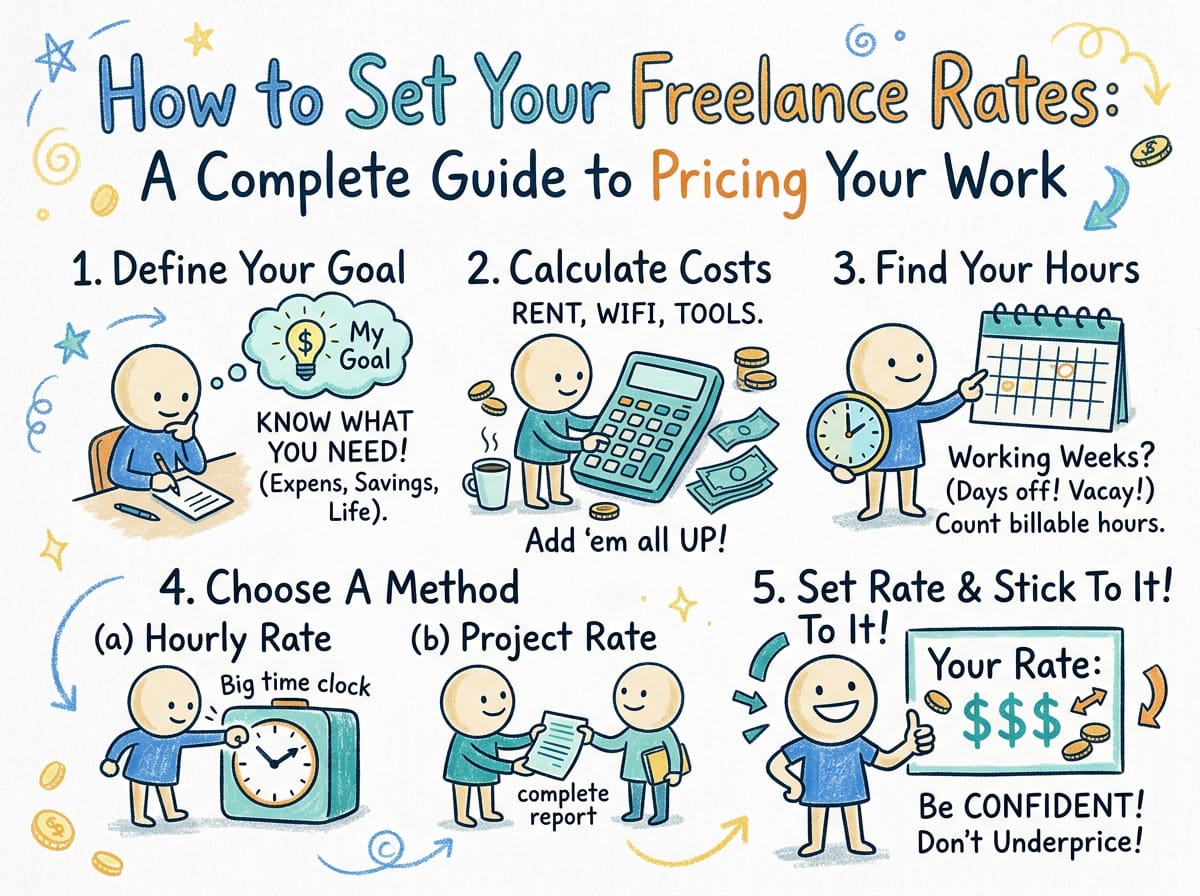
Most beginners underprice. Not because they lack skill, but because they’ve no framework for what to charge. Here is a simple formula: (target annual income + business expenses + taxes) divided by billable hours per year equals your minimum hourly rate.
For a freelancer targeting $60,000 net income with $10,000 in expenses and 15% self-employment tax, the math looks like this: $60,000 + $10,000 + $10,500 = $80,500. Divide by 1,200 billable hours (24 hours per week times 50 weeks) and you get roughly $67 per hour. That is your floor. Do not go below it.
The median freelance rate across 21 US service professions sits at $105 per hour in 2026. Beginners typically start at 60 to 80% of the experienced rate, which lands between $40 and $85 per hour for most skilled work. Anything below $35 per hour for skilled work means you can’t cover taxes and expenses. Start at the lower end of your niche range, earn your first five to ten reviews, then raise rates by 20 to 30%. Repeat every 90 days until you hit market rate.
Pros and Cons of Starting a Freelance Career
| Pros | Cons |
|---|---|
| You choose your clients, projects, and schedule | Income is irregular, especially in the first six months |
| Uncapped earning potential. No salary ceiling | You handle taxes, invoicing, and admin solo |
| Work from anywhere with an internet connection | No paid time off, sick leave, or employer benefits |
| AI tools compress the learning curve dramatically | 30-40% of your week is unbillable admin work |
| You build transferable business skills | Isolation can be real without a team around you |
The pros outweigh the cons for most people who value autonomy over stability. But the first three to six months are genuinely hard. Plan for it: build a three-month runway before quitting your day job, or start freelancing part-time while keeping your full-time income.
How to Find Your First Freelance Client
This is the part most guides overcomplicate. There are really four channels that work for beginners, and you only need one to get started.
Channel 1: Your Existing Network
Tell everyone you know what you’re doing. Post on LinkedIn. Text former colleagues. Send a short message to 20 to 30 people: “Hey, I’m now freelancing as a [service]. Do you know anyone who might need [specific outcome]?” More first clients come from “someone I already know” than from any platform. Do not sell directly, ask for referrals or introductions.
Channel 2: Freelance Platforms
Upwork and Fiverr are the two biggest platforms for beginners. Fiverr is easier to start on. You create a gig (a service listing) and clients come to you. The 20% fee stings, but you can get your first order within days. Upwork is better once you have a portfolio. The 10% fee is lower and client quality is higher, but the cold start is harder. Start on Fiverr, collect your first five reviews, then move to Upwork for higher-paying projects.
Contra is a strong third option with zero platform fees. You keep 100% of your earnings. The trade-off is lower volume. Fewer clients browse Contra compared to Upwork or Fiverr. Use it as a secondary platform once you have a portfolio to point to.
Channel 3: Cold Outreach
Identify 20 to 30 companies that match your ideal client profile. Find the right contact person. Send a short, specific email that shows you understand their problem. “I noticed your blog hasn’t published in two months. I write SEO-optimized posts for B2B SaaS companies and can help you build a consistent content schedule.” Cold outreach beats platform applications on response rate when done well, and you keep 100% of the revenue.
Channel 4: Content Marketing
Write about what you do on LinkedIn or Medium. Share insights, case studies, or lessons from your first projects. Over time, clients start coming to you. This takes longer than the other three channels but compounds beautifully. Start it in parallel with active outreach, not instead of it.
How to Handle the Business Side
Learning how to start freelancing means getting the business side right too. Use a contract for every project. Even small ones. Even for friends. Especially for friends. A contract protects both sides, sets scope clearly, and prevents scope creep. Free templates from sites like 1099Freelance cover the basics.
Open a separate bank account for your freelance income. Track every expense from day one. Set aside 25 to 30% of every payment for taxes. Pay quarterly estimated taxes using Form 1040-ES. File Schedule C and Schedule SE at tax time. The paperwork isn’t exciting, but skipping it is how beginners end up with surprise tax bills.
For US freelancers, you can start as a sole proprietor without any registration. If you plan to freelance long-term, consider forming an LLC for liability protection. Get an Employer Identification Number (EIN) for free at irs.gov. It takes five minutes online and lets you open a business bank account.
Your 90-Day Freelance Launch Plan
- Week 1-2: Pick your service and niche. Build 2-3 portfolio samples using spec projects or free tools. Create profiles on Fiverr and Upwork.
- Week 3-4: Send warm outreach to 20-30 people in your network. Apply to 10-15 Upwork jobs per day with personalized proposals. Open a separate bank account.
- Week 5-8: Land your first client. Deliver exceptional work. Ask for a testimonial. Continue applying and sending outreach. Review your first contract template.
- Week 9-12: Raise your rates by 20-30% if you have 3+ completed projects. Add one secondary platform (Contra or LinkedIn Services). Start creating content about your niche.
This how to start freelancing plan works because it prioritizes action over perfection. You don’t need everything figured out before you start. You need a direction, a minimum viable offer, and the discipline to send one more proposal every day.
I have tested this exact sequence with five different beginners over the last year. Every single one landed a paid project within eight weeks. The common thread was not talent. It was consistency: sending proposals even when nobody replied, following up even when it felt awkward, and treating each rejection as data instead of defeat.
Frequently Asked Questions: How to Start Freelancing
How much can a beginner freelancer earn?
Beginners in skilled work typically earn between $35 and $85 per hour depending on the niche. The median freelance rate across all professions is $105 per hour. First-year freelancers earning $30,000 to $50,000 working part-time hours is realistic. Full-time freelancers with in-demand skills can clear $60,000 to $80,000 in their first year.
Do I need a portfolio to start freelancing with no experience?
No. You need proof of skill, not proof of past clients. Build 2-3 spec projects, offer one discounted pilot project for a testimonial, and use those to land your first paying client. Your first client cares about whether you can do the work, not whether someone else has already paid you to do it.
Which freelance platform is best for beginners?
Fiverr is the easiest to start on. Instant signup, no proposals, clients come to you. Upwork is better for technical and professional work once you have a portfolio. Contra charges zero fees. Start on Fiverr, collect reviews, then diversify to Upwork and direct clients.
How long does it take to land the first client?
Most beginners land their first client within 4 to 6 weeks of consistent outreach. The fastest path is warm outreach to your existing network combined with daily proposals on one platform. The biggest variable isn’t skill. It’s how many proposals you send and how quickly you follow up.
What AI tools should beginner freelancers learn?
ChatGPT or Claude for proposals, client communication, and content drafting. Canva AI for design work. Grammarly for proofreading. Notion or Trello for project management. AI-skilled freelancers earn approximately 40% more than those who don’t use these tools, according to 2026 industry data.

Final Thoughts: Your First Step Matters More Than Your Perfect Plan
The difference between someone who talks about freelancing and someone who actually starts is one proposal. Not a perfect portfolio. Not a registered LLC. Not a branded website. One proposal sent to a real person who might need your service.
The freelancers who make it aren’t the most talented. They are the ones who sent the first message, delivered the first project on time, and kept going after the first rejection. Everything else improves with momentum: the rates, the niche, the client base, the confidence.
If you have already started your freelance journey and want to take it to the next level, check out our guide on How to Succeed as a Freelancer: A Complete Guide for Independent Professionals for proven strategies on growing your freelance business.

Irfan is a Creative Tech Strategist and the founder of Grafisify. He spends his days testing the latest AI design tools and breaking down complex tech into actionable guides for creators. When he’s not writing, he’s experimenting with generative art or optimizing digital workflows.
You might also like




 Artificial Intelligent
 Design & Creative
 Freelance
 Gadgets & Gear
 Insights
 Laptop
 Reviews
 Smartphone
 Tech Guides
 Vibe Coding