Microsoft Just Dropped Fara-7B: The On-Device AI Agent That Could Finally Kill the ‘Chatbot’ Era
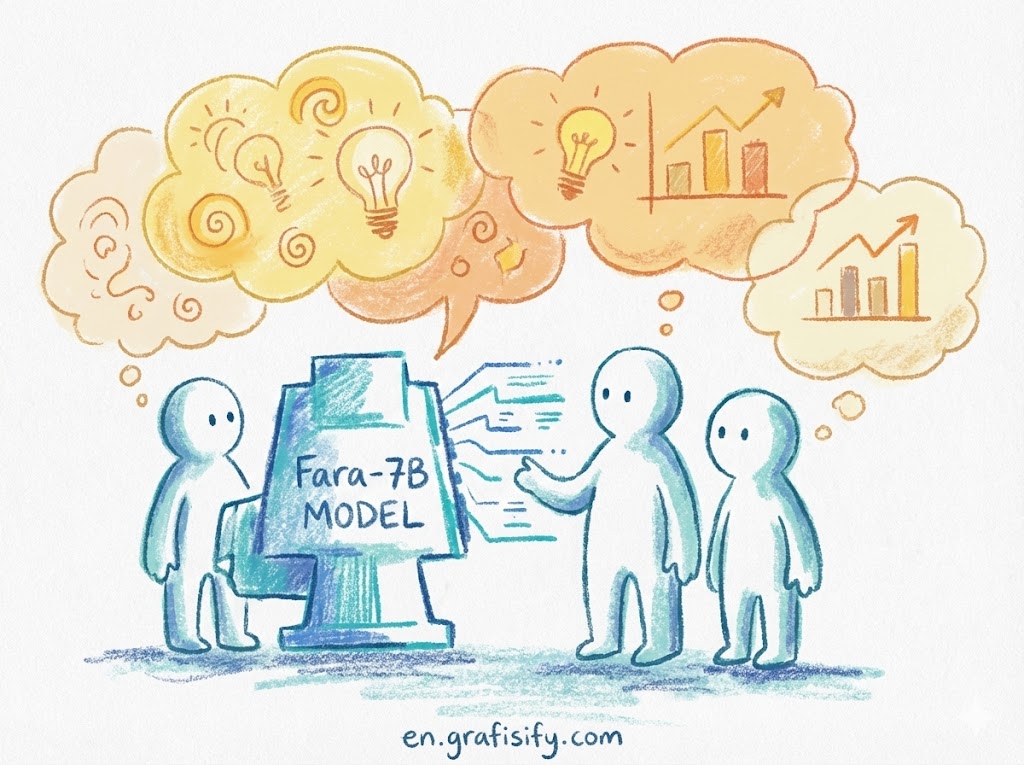
For the last two years, the AI industry has been obsessed with size. Bigger parameters, massive data centers, and trillion-token training runs. But while the giants were fighting over who has the biggest brain in the cloud, Microsoft quietly doubled down on a different philosophy: it’s not about how much the model knows; it’s about what it can do—and whether it can do it on your laptop without leaking your credit card data.
Enter Fara-7B.
Announced today by Microsoft Research, Fara-7B isn’t just another Small Language Model (SLM) to throw onto the pile with Llama or Mistral. It is a dedicated Computer Use Agent (CUA) designed to navigate the web, click buttons, type text, and execute complex workflows essentially driving your PC like a human would.
Here is the kicker: It does this with only 7 billion parameters, meaning it can run locally on-device (specifically optimized for Copilot+ PCs). This is a direct shot across the bow at Anthropic’s “Computer Use” API and OpenAI’s rumored “Operator,” both of which rely heavily on massive cloud compute.
If you have been waiting for the moment AI shifts from “generating text” to “doing work,” this is it. Here is the deep dive into why Fara-7B changes the landscape for developers and power users alike.
The Core Breakdown: Not Just a Chatbot, A Digital Operator
To understand why Fara-7B matters, you have to understand the limitation of current LLMs. If you ask ChatGPT to “buy me a ticket to the movies,” it effectively hallucinates a plan or writes code to do it. It doesn’t actually go to the website and click the buttons unless it has a specific API integration.
Fara-7B is built differently. It utilizes a vision-first approach.
Visual Perception vs. The “Accessibility Tree”
Most previous attempts at web agents tried to cheat. They would read the HTML code (the DOM or accessibility tree) to find a button labeled “Submit.” The problem? Modern web apps are messy. Accessibility tags are often missing or broken, confusing the AI.
Fara-7B operates more like a human eye. It visually perceives the webpage via screenshots. It predicts direct coordinates (x, y) for clicks and handles typing inputs. It doesn’t need to parse the underlying code; it just needs to see the interface.
“Fara-7B operates by visually perceiving a webpage and takes actions like scrolling, typing, and clicking on directly predicted coordinates. It does not rely on separate models to parse the screen… thus uses the same modalities as humans to interact with the computer.” — Microsoft Research Team
The Efficiency Play
In the world of AI agents, latency is the enemy. If an agent takes 10 seconds to “think” before every mouse click, the user experience is dead on arrival.
Microsoft built Fara-7B on top of the Qwen2.5-VL-7B base, optimizing it for the new NPU (Neural Processing Unit) architecture found in Windows 11 Copilot+ PCs. The result is a model that isn’t just capable; it’s economically viable. According to Microsoft’s benchmarks, Fara-7B completes tasks with significantly fewer steps than competitors like UI-TARS-1.5-7B (averaging ~16 steps vs. ~41 steps).
The “Secret Sauce”: A Synthetic Data Pipeline
The biggest bottleneck in training AI to use computers has been data. How do you teach a neural network to navigate Amazon or book a flight on Expedia? Recording millions of hours of humans clicking mouses is prohibitively expensive and creates privacy nightmares.

Microsoft’s solution was to manufacture the data. They utilized a novel synthetic data generation pipeline built on their Magentic-One framework.

The Three-Stage Training Process
- Task Proposal: The system scrapes public URLs and “seeds” tasks. For example, if it finds a restaurant menu, it generates a task like “Find the price of the calamari and book a table for two.”
- Multi-Agent Solving: This is the fascinating part. Microsoft used a “teacher” system composed of multiple larger agents (an Orchestrator, a WebSurfer, and a UserSimulator) to solve these tasks perfectly. They recorded these “trajectories” (the path to the solution).
- Distillation: They took 145,000 of these perfect, machine-generated trajectories and “distilled” that knowledge down into the compact Fara-7B model.
This proof-of-concept demonstrates that small models can punch way above their weight class if the training data is high-quality and specific enough. They didn’t even use Reinforcement Learning (RL) to achieve these results—this is purely Supervised Fine-Tuning (SFT), which suggests there is still massive room for improvement.

Context: The “Agentic AI” War is Heating Up
To frame this release properly, we need to look at the broader chessboard. 2023 was the year of the Chatbot. 2024 was the year of Multimodal integration. 2025 is shaping up to be the year of Actionable Agents.
Just weeks ago, Anthropic released their “Computer Use” capability for Claude 3.5 Sonnet. It was impressive, but it had two major flaws: it was slow, and it was expensive because it required sending screenshots to the cloud constantly.
Microsoft is flanking them with Fara-7B by focusing on Local Inference. By releasing the model weights on Hugging Face (MIT License), Microsoft is essentially democratizing the “agentic” layer of the AI stack. They are betting that developers would rather run a free, fast, local model for navigation tasks than pay per token to an API provider.
Benchmarks and Reality Checks
Let’s talk numbers, but take them with a grain of salt (as one always should with vendor-supplied benchmarks).

On the WebVoyager benchmark, a standard for testing web agents, Fara-7B scored a 73.5% success rate. For context, OpenAI’s GPT-4o (prompted specifically for computer use) scored around 70.9%.
The fact that a 7-billion parameter model is edging out, or even matching, frontier-class models that are 100x larger is a testament to the specialized training pipeline. However, Microsoft admits the model still suffers from common AI pitfalls: hallucinations and getting stuck in loops on complex, dynamic websites.
Expert Analysis: The Privacy & Security Implication
The most significant aspect of Fara-7B isn’t technical—it’s privacy.
When you ask an AI to “log into my bank and download my statement,” you are traversing a massive trust gap. If that agent is running in the cloud, your credentials or session cookies are theoretically exposed to the server processing the request.
On-device execution changes the calculus completely.
“Fara-7B’s small size now makes it possible to run CUA models directly on devices,” the research team noted. “This results in reduced latency and improved privacy, as user data remains local.”
The “Critical Point” Safety Net
One feature that stands out in the technical report is the concept of Critical Points. The model is trained to recognize high-stakes moments—like clicking “Purchase,” “Send Email,” or “Delete.”
When Fara-7B hits one of these points, it freezes. It is hard-coded (via training behavior) to stop and ask the human user for explicit confirmation. This “Human-in-the-Loop” design is non-negotiable for autonomous agents. Without it, you risk an AI accidentally buying 500 sponges on Amazon because it misunderstood a query.
“Upon reaching a Critical Point, Fara-7B should respond by informing the user it cannot proceed without their consent.”
This safety mechanism, combined with the sandboxed environment recommendations, suggests Microsoft is keenly aware of the liability issues surrounding autonomous agents.
Future Outlook: What This Means for Developers
So, where do we go from here?
For developers, Fara-7B is a sandbox for the future of UI automation. We are likely looking at the death of traditional, brittle web scrapers (like Selenium or Puppeteer scripts that break every time a div class changes). Instead, developers will start integrating vision-based agents that can adapt to UI changes dynamically.
Here is what to watch for in the next 6 to 12 months:
- Hybrid Architectures: We will see apps that use Fara-7B for navigation (low cost, fast) and call out to GPT-5 or Claude 4 for heavy cognitive lifting (reasoning, creative writing) only when necessary.
- The Browser Wars 2.0: With Magentic-UI, Microsoft is hinting at a browser that browses for you. Expect deep integration into Edge soon.
- Fine-Tuning Explosions: Since the weights are open, expect the open-source community to fine-tune Fara specifically for distinct verticals—Medical-Fara for filling out EHR forms, or Crypto-Fara for navigating DeFi exchanges.
Microsoft has put the ball in the developers’ court. The tools to build a true Jarvis-like assistant that lives on your laptop are now available, free, and surprisingly competent. The question is no longer “can AI use my computer?” It’s “what will you let it do?”
You can download Fara-7B right now on Hugging Face or access it via Microsoft Foundry.
Tagged with:
AI AgentsComputer Use AgentCopilot+ PCMagentic-UIMicrosoft ResearchOn-device AIQwen2.5-VLSLMSmall Language ModelsWeb Automation
Irfan is a Creative Tech Strategist and the founder of Grafisify. He spends his days testing the latest AI design tools and breaking down complex tech into actionable guides for creators. When he’s not writing, he’s experimenting with generative art or optimizing digital workflows.
You might also like



 Artificial Intelligent
 Design & Creative
 Freelance
 Gadgets & Gear
 Insights
 Laptop
 Reviews
 Smartphone
 Tech Guides
 Vibe Coding