Fiverr Gig Search Ranking: What the Algorithm Measures
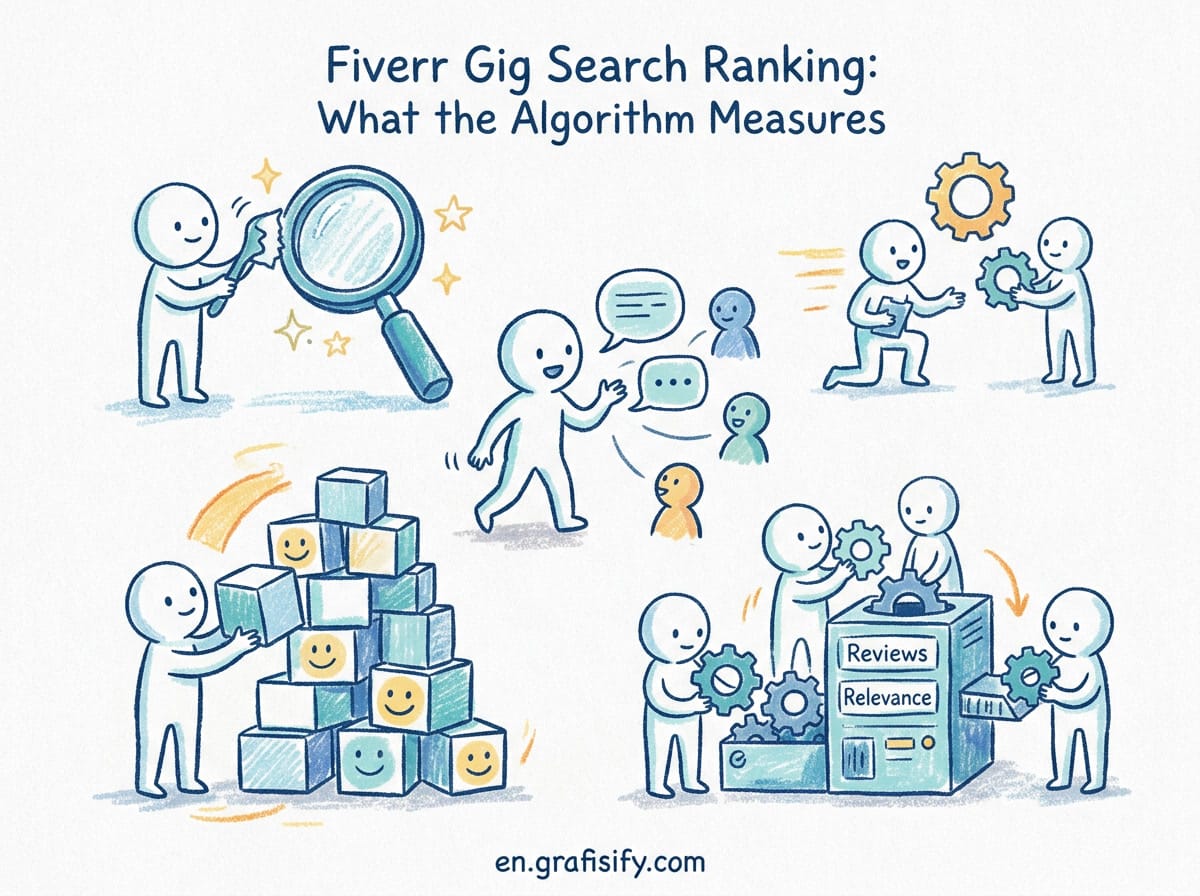
Quick Verdict: What Actually Moves Your Gig in Fiverr Search
If your Fiverr gig isn’t appearing in search results for relevant buyer queries, your pricing and work quality won’t save you. You’re simply invisible. Unlike Google, where backlinks and domain authority drive rankings, Fiverr’s search algorithm operates primarily on performance metrics generated by buyer interactions with your listing. Conversion rate, response speed, order completion, and recent buyer feedback dictate your placement. Sellers who optimize for buyer action rather than keyword stuffing consistently control the top rows of search results.
The Two Core Dimensions of Fiverr’s Search Algorithm
Fiverr evaluates every published gig across two distinct stages: topical relevance and performance conversion. Relevance determines whether your gig qualifies to appear for a specific search query. Performance determines how high up the search results page your gig sits once it qualifies.
Relevance relies heavily on your gig title, category selection, and search tags. When a buyer searches for “Python automation script,” the algorithm scans gig metadata to filter out irrelevant offerings. However, relevance is merely a binary filter. Once your gig passes the relevance check, performance metrics dictate your exact positioning.
Because Fiverr earns a commission on every completed order, its algorithm prioritizes listings that generate completed transactions and satisfied repeat clients. The algorithm continuously runs micro-experiments. When buyers click your thumbnail and place an order, your visibility increases. When buyers view your listing and navigate away without ordering, your ranking drops.

Key Metrics Measured by Fiverr’s Success Score
Fiverr replaced legacy level criteria with a comprehensive metrics system centered on the Success Score. Rated from 1 to 10 for each individual gig, this composite metric directly impacts search placement across the marketplace.
| Metric Signal | What It Measures | Search Impact Level |
|---|---|---|
| Click-Through Rate (CTR) | Percentage of search impressions that result in gig clicks | High |
| Conversion Rate | Percentage of gig page views that turn into paid orders | Very High |
| Response Rate & Speed | Percentage of first buyer messages answered within 24 hours | High |
| Order Completion Rate | Percentage of started orders delivered without cancellation | High |
| Private Buyer Feedback | Post-delivery rating collected privately from buyers | Very High |
When I analyzed performance data across my own client work and seller onboarding projects, I noticed that private buyer feedback carries far more weight than public star ratings. A gig with five-star public reviews can still experience ranking drops if private feedback surveys report communication frictions, scope misunderstandings, or minor delivery delays.

Diagnosing Gig Performance Through Analytics
Fiverr provides a detailed analytics dashboard for individual gigs. Instead of making random changes to your gig title or description, check your metrics weekly to identify the specific stage where your conversion funnel breaks.

1. High Impressions with Low Clicks (Low CTR)
If your gig appears in search results thousands of times but receives few clicks, your keyword relevance is fine. The problem lies in your visual presentation or positioning. Buyers see your listing alongside competitors and choose not to click.
To fix low CTR, audit your primary thumbnail image, package pricing preview, and gig title. Ensure your thumbnail uses high-contrast text, clean visual hierarchy, and clear proof of work. Avoid cluttered graphic templates that blend into the search grid background. Use professional sample images that immediately communicate your niche focus.
2. High Clicks with Low Orders (Low Conversion Rate)
If buyers click your gig but leave without ordering, your page fails to build sufficient trust or clarify your offer. This is a sales page problem rather than an algorithmic penalty.

Review your gig description for clarity. I frequently advise sellers to replace long blocks of prose with concise bullet points detailing deliverables, scope boundaries, and revision terms. Clear communication here prevents misaligned expectations before the buyer sends an inquiry.
If you’re communicating with clients off-platform or managing multiple inbound leads across channels, practicing async updates to build client trust helps set clear expectations before project kickoff.
3. Low Impressions across All Keywords
When impressions drop to near zero, your gig has either lost keyword relevance or suffered an algorithmic suppression due to performance penalties like late deliveries or buyer cancellations.

Verify that your gig tags complement your title instead of duplicating the exact same phrases. Use secondary keyword variations in your tags to capture long-tail search queries. Check that your selected subcategory matches buyer intent precisely.
How Response Time and Cancellations Affect Ranking
Fiverr tracks your response rate and response time on all first incoming messages. Responding within one hour maintains your search standing, while letting messages sit unanswered for hours causes measurable drops in gig distribution. The algorithm monitors your communication patterns over a 90-day sliding window.
Similarly, order cancellations deal immediate damage to your seller metrics. Even a mutual cancellation initiated because a buyer placed an order by mistake signals to the algorithm that the transaction failed. To minimize buyer errors, use structured requirement forms that force buyers to provide necessary project assets before an order marks as active.
When sending proposals or responding to initial buyer inquiries on any freelance platform, using a battle-tested approach like cold email strategies that get replies ensures your messaging remains concise, targeted, and professional from the start.
Understanding Category Rotation and Recency Signals
Fiverr dynamically rotates search positions to give new and modified gigs an evaluation window. When you publish a new gig or make significant updates, the algorithm grants a temporary visibility boost to test how buyers react to the listing.
If your gig receives orders and positive feedback during this test period, its higher placement stabilizes. If it receives impressions without clicks or orders, its position drops back down. This rotation mechanism explains why maintaining steady account activity is critical. Long periods of inactivity signal to the platform that your gig is dormant, causing a gradual reduction in organic search impressions.
When managing ongoing gig operations, sellers must balance workload capacity with response metrics. When an influx of buyers arrives, turning off gig availability entirely can freeze your recency signals. Instead, use gig limits or adjust delivery timelines to keep your gig active in search results while controlling active order volume.
As your gig establishes a track record and gains consistent orders, you can strategically adjust your positioning. Knowing when and how to raise your freelance rates allows you to increase earnings while maintaining conversion velocity.
For freelancers managing complex client deliverables or running automated tasks alongside their service offerings, setting up technical workflows like running AI workflows in isolated Docker containers provides reliable infrastructure for background tasks.

Optimizing Your Gig Packages for Conversion
The structure of your Basic, Standard, and Premium packages plays a central role in your conversion metrics. Buyers who click your listing inspect your pricing table within seconds. If your pricing structure is confusing or overly complex, potential buyers bounce back to search results, penalizing your conversion rate.
Structure your Basic package as an entry point with a narrow, unambiguous scope. This encourages cautious first-time buyers to initiate an order without high financial risk. Your Standard package should represent your most popular core service, offering full deliverable value. Your Premium package should target commercial clients who require fast turnarounds, source files, or extra revisions.
When buyers see clear distinctions between your tier options, they make faster purchasing decisions. This reduction in buyer friction raises your conversion rate, which feeds directly into Fiverr’s search positioning signals.
Managing Private Buyer Feedback and Client Experience
Many sellers focus exclusively on public star ratings, assuming five-star reviews guarantee algorithmic favor. However, Fiverr collects detailed private feedback from buyers after every completed order. Private surveys ask buyers about communication quality, value for money, and whether they would recommend the seller to colleagues.
I have observed gigs with 4.9-star public ratings lose search visibility because private ratings indicated inconsistent scope delivery. To protect your private feedback score, treat every order as a collaborative relationship. Provide proactive progress updates, address buyer concerns immediately, and never pressure clients for five-star public reviews.
Actionable Step-by-Step Optimization Strategy
Improving your position in Fiverr search requires systematically addressing your weakest metrics rather than guessing what the algorithm wants. Follow these targeted steps to optimize your listing for sustainable search visibility:
First, inspect your seller dashboard to determine whether your primary bottleneck is impressions, clicks, or conversions. Second, refine your gig title to target specific long-tail buyer queries rather than broad category keywords. Third, redesign your gig thumbnail to improve contrast and visual clarity in search grids. Fourth, implement rapid response habits by installing mobile notifications to keep your initial reply time under 60 minutes. Fifth, over-deliver on initial deadlines to build strong early signals across both public reviews and private buyer surveys.
For official documentation on marketplace guidelines and seller level criteria, consult the official Fiverr Help Center and review community discussions on the Fiverr Seller Community Forum. Additional seller optimization strategies are available in dedicated resources like the Fiverr Ranking Guide and comprehensive breakdown analysis at Zenlance Gig Optimization.
Summary: Sustaining Long-Term Search Visibility
Ranking high in Fiverr search isn’t a one-time configuration task. The algorithm continuously evaluates live buyer interactions, rewarding gigs that deliver high conversion rates, quick communication, and reliable order fulfillment. By reading your analytics dashboard accurately, isolating funnel drop-offs, and maintaining consistent seller activity, you build an organic search presence that attracts steady client inquiries week after week.

Irfan is a Creative Tech Strategist and the founder of Grafisify. He spends his days testing the latest AI design tools and breaking down complex tech into actionable guides for creators. When he’s not writing, he’s experimenting with generative art or optimizing digital workflows.





 Artificial Intelligent
 Design & Creative
 Freelance
 Gadgets & Gear
 Insights
 Laptop
 Reviews
 Smartphone
 Tech Guides
 Vibe Coding