Hall Effect Keyboards: Why Magnetic Switches Changed Gaming
For decades, every mechanical keyboard you bought worked on the same basic idea. A physical switch closed a circuit when you pressed down far enough, and the computer registered a keypress. Fast, reliable, but fixed. You could not change how far the key had to travel, and the key only understood two states: pressed or not pressed.
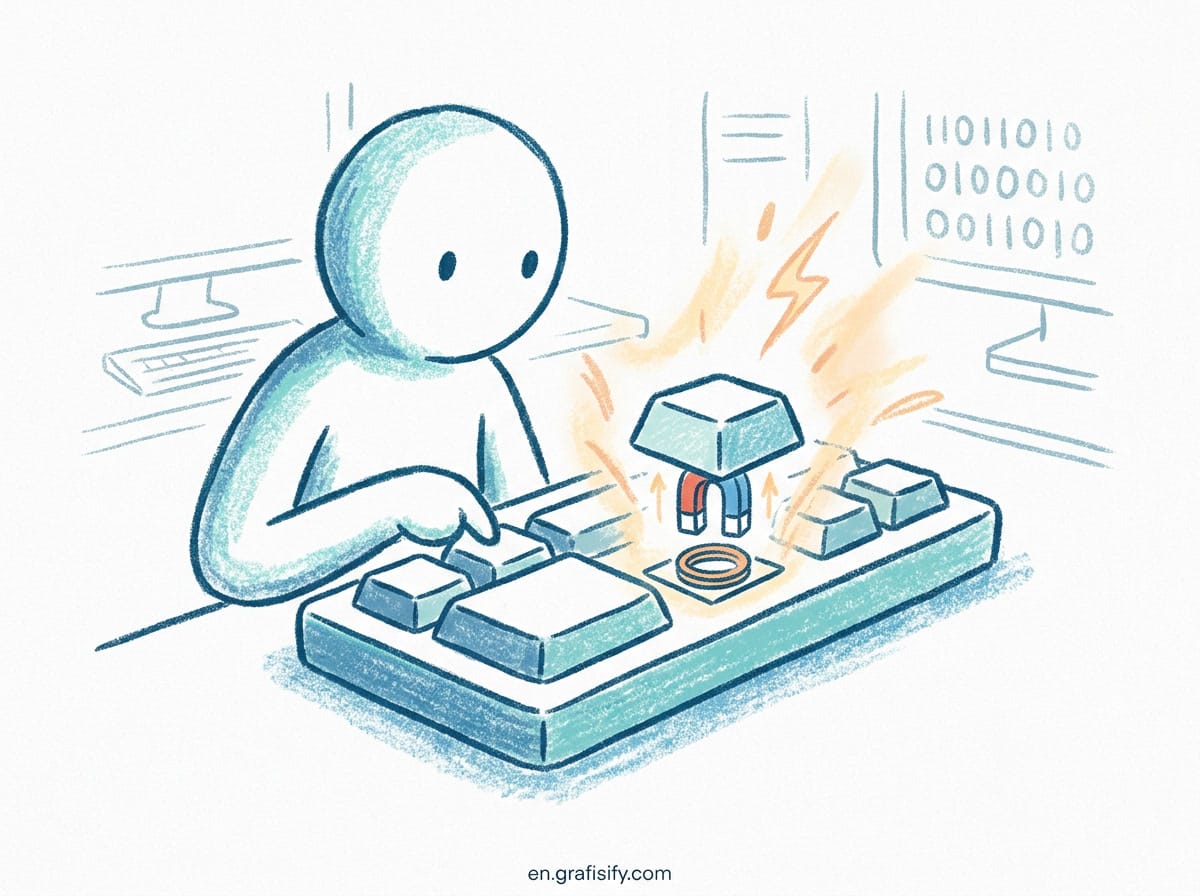
Hall Effect keyboards break that limit. Instead of a metal contact, they use a magnet and a sensor that measures the magnet’s exact position the whole time you press. The keyboard knows not just that you pressed, but how far you pressed and how fast you moved. That single change opened features that fixed switches can’t deliver.
What a Hall Effect Switch Actually Is
A Hall Effect sensor detects magnetic fields. In a keyboard switch, the moving stem carries a tiny magnet. As you press, the magnet moves closer to a sensor mounted on the PCB. The sensor reads the changing magnetic field and outputs a continuous signal, not an on-or-off click.
The first Hall Effect keyboards appeared back in 1968 with Honeywell’s giant switches. The idea is old. What changed is scale: today’s sensors are small integrated circuits, well shielded from interference, and cheap enough to put under every key. There is no physical contact between the moving part and the sensor, which removes switch bounce and lets the switch be hot-swappable.

Because there is no contact to wear out, Hall Effect switches routinely spec a 100 million click lifespan. Wooting’s Lekker switch, one of the first consumer analog Hall Effect switches, lists 100,000,000 clicks and a 0.03ms debounce. Compare that to typical mechanical switches rated at 50 million clicks, and the durability gap is real.

The Feature That Started It All: Rapid Trigger
Wooting introduced Rapid Trigger in 2019 on its Lekker Edition keyboard. Traditional switches use a fixed actuation point (say 2mm) and a fixed reset point. You must release past the reset point before the key can fire again. That lag between your finger motion and the register point is dead time.

Rapid Trigger removes the fixed reset. The keyboard activates the key the instant you start pressing and deactivates it the instant you start lifting, based on direction of motion rather than a fixed depth. In a shooter, that means your movement key re-fires the moment you tap, with no wait for a reset point. Wooting lets you set that sensitivity as tight as 0.1mm.
This is why competitive players adopted Hall Effect boards first. The advantage is not marketing; it is measurable input latency removed from every keystroke. In a game decided by tenths of a second, removing the reset wait on every tap adds up across a match.
Adjustable Actuation: One Switch, Many Feelings
With a fixed switch, the actuation point is baked into the hardware. A linear switch fires at a set depth and that is final. Hall Effect switches let you move that point anywhere across the full travel, often in 0.1mm steps. Wooting’s Lekker switch supports an actuation range of 0.1mm to 3.8mm.
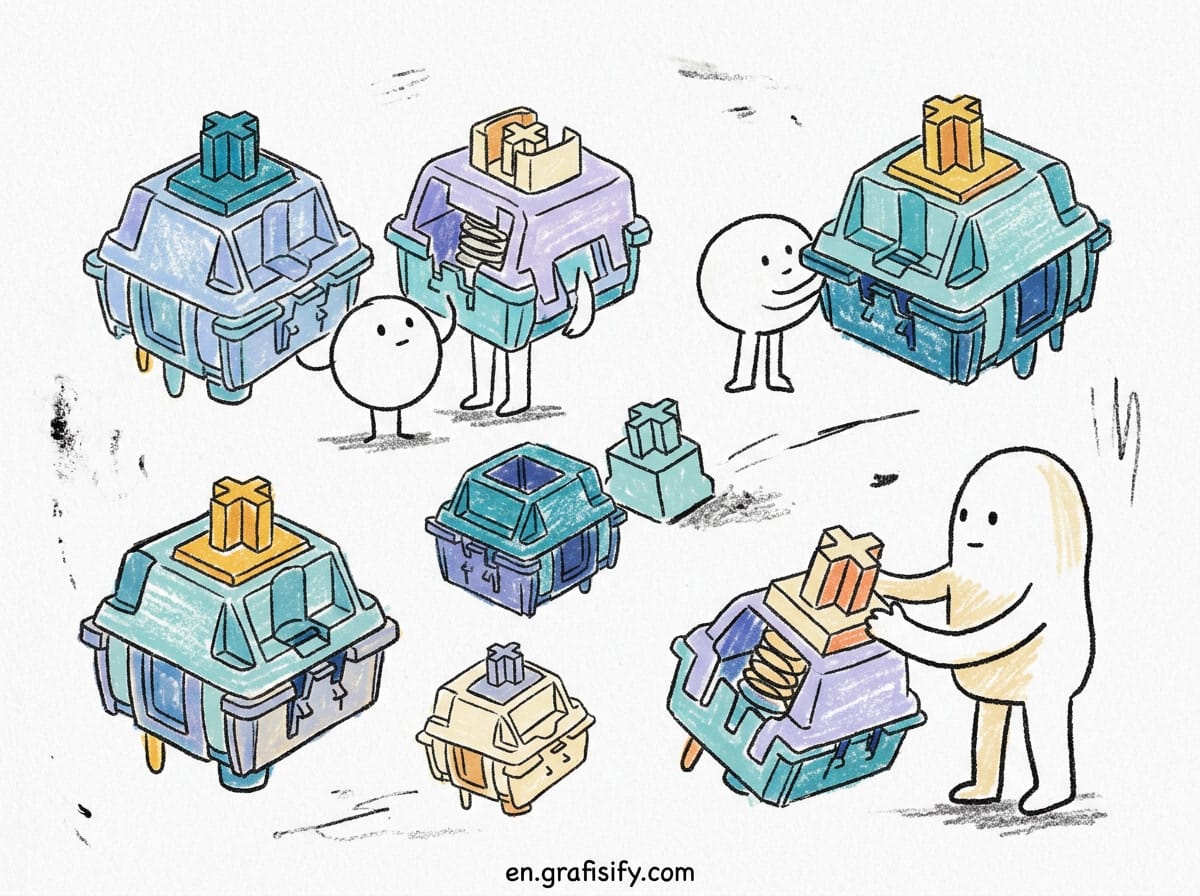
Practically, this means one keyboard serves every use. Set a shallow 0.8mm actuation for gaming where you want instant response. Push it to 2mm or 3mm for typing so you avoid accidental presses during long documents. You change the feel in software instead of buying a new board.
The same per-key control lets you assign two actions to one key at different depths. A light tap could walk; a full press could sprint. Games that once needed a controller for analog movement now get it from the keyboard. This depth-axis input is the part traditional switches physically cannot reproduce, because they only see one crossing event.
Hall Effect vs Traditional Mechanical Switches
The comparison comes down to what each type can and cannot do. Hall Effect is not automatically “better” for everyone, but the feature gap is wide.
| Feature | Traditional Mechanical | Hall Effect |
|---|---|---|
| Signal type | Binary (on or off) | Analog (continuous position) |
| Adjustable actuation | No, fixed by hardware | Yes, 0.1mm to full travel |
| Rapid Trigger | Not possible | Native, per-key |
| Switch bounce | Present, needs debounce | None, no contact |
| Typical lifespan | 50 million clicks | Up to 100 million clicks |
| Hot-swappable | Yes (on compatible boards) | Yes |
| Price | Wide range, budget options exist | Higher, fewer budget boards |
If you type all day and never play competitive games, a good traditional board still serves you well and costs less. The Hall Effect advantage matters most when you want adjustable feel or the fastest possible gaming input.
Boards Worth Knowing
Wooting remains the reference brand. The Wooting 60HE and the larger 80HE run the Lekker switch and the Wootility software that defined the category. NuPhy pulled Hall Effect into its low-profile line with the NuPhy Field75 HE, aimed at people who want a slimmer profile. Keychron entered with the Keychron K8 Max HE, bringing Hall Effect to a familiar 75% layout at a more approachable price.
The split in 2024 matters: Gateron and other switch makers began selling HE modules to board partners, so second-wave boards now use similar internals at lower prices. When you compare, judge the software first. A board with great hardware and poor tuning software gives you none of the benefits. Read the companion app’s feature list before you buy, not after.
Who Should Actually Buy One
Start with competitive gamers. Rapid Trigger and adjustable actuation are direct, repeatable advantages in fast games. If you play Valorant, CS, or rhythm games, the input gains are noticeable within a session.
Next, people who want one board for everything. The ability to tune actuation per profile means your gaming setup and your writing setup live on the same keyboard. That removes the desk clutter of owning two boards. Our ergonomic home office setup guide covers desk basics that matter before you invest in a premium board.
Finally, anyone tired of switch wear. The contactless design simply lasts longer and feels more consistent over time. If you burn through boards, the durability pays back.
If you are building a first mechanical keyboard on a tight budget, start with a standard board and learn what switch feel you like. Hall Effect is the upgrade, not the entry point. Our portable monitor guide shows the same lesson: match the gear to the specific task, not the average.
What to Check Before You Buy
Not every “magnetic” or “HE” board delivers the same experience. Check these points first.
Software support. Rapid Trigger and adjustable actuation only work if the firmware and companion app are solid. Wooting’s Wootility is the reference here, with per-key settings and continuous rapid trigger. A board with weak software wastes the hardware.
Key range and precision. Look for actuation adjustable in fine 0.1mm steps across most of the key travel. A board limited to a few preset depths gives you less control.
Per-key settings. The best boards let you set actuation and rapid trigger per key, so your WASD keys can differ from your typing keys. Our coding setup guide makes the same point: tune the tools you actually touch, not the ones you rarely use.
Build and layout. Hall Effect does not change fundamentals. A 60% board still lacks a numpad, and cheap keycaps still feel cheap. Judge the chassis the same way you would any keyboard.
Frequently Asked Questions
Do Hall Effect keyboards work with any game? Yes. They send standard keystrokes, so any game that reads a keyboard works. The analog features (Rapid Trigger, adjustable actuation) apply in every game, though they help fast games most.
Are Hall Effect switches loud? Noise depends on the switch and keycaps, not the sensing method. Most HE boards use linear-style switches and sound like any quiet linear board.
Can I use my own keycaps? Usually yes, as long as the switches use a standard stem profile. Check the board’s spec before buying exotic caps.
Is the durability claim real? The 100 million click figure comes from the contactless design having no wear point. Wooting publishes this for the Lekker switch, and it lines up with the physics of no metal-to-metal contact.
The Takeaway
Hall Effect keyboards did not just add a new switch type. They turned the keypress from a yes-or-no event into a continuous signal you control. Rapid Trigger removes input dead time, adjustable actuation lets one board fit every task, and the contactless design outlasts traditional switches.
The trade-off is price and a smaller selection. You pay more, and you commit to a brand’s software ecosystem. For competitive players and people who want a single do-everything board, that cost is worth it.
If you already own a mechanical board you like, there is no rush. But if you are buying next and gaming speed or per-key tuning matters to you, Hall Effect is the clear step forward. Start by testing one at a friend’s desk or a store, then decide whether the feel justifies the premium.
For deeper background on switch types, our coverage of mechanical keyboard switches and ergonomic mechanical keyboards explains the traditional side this technology builds on.

Irfan is a Creative Tech Strategist and the founder of Grafisify. He spends his days testing the latest AI design tools and breaking down complex tech into actionable guides for creators. When he’s not writing, he’s experimenting with generative art or optimizing digital workflows.





 Artificial Intelligent
 Design & Creative
 Freelance
 Gadgets & Gear
 Insights
 Laptop
 Reviews
 Smartphone
 Tech Guides
 Vibe Coding