RAM and SSD Prices Are Exploding in 2026 — Here’s Why (and What to Do)
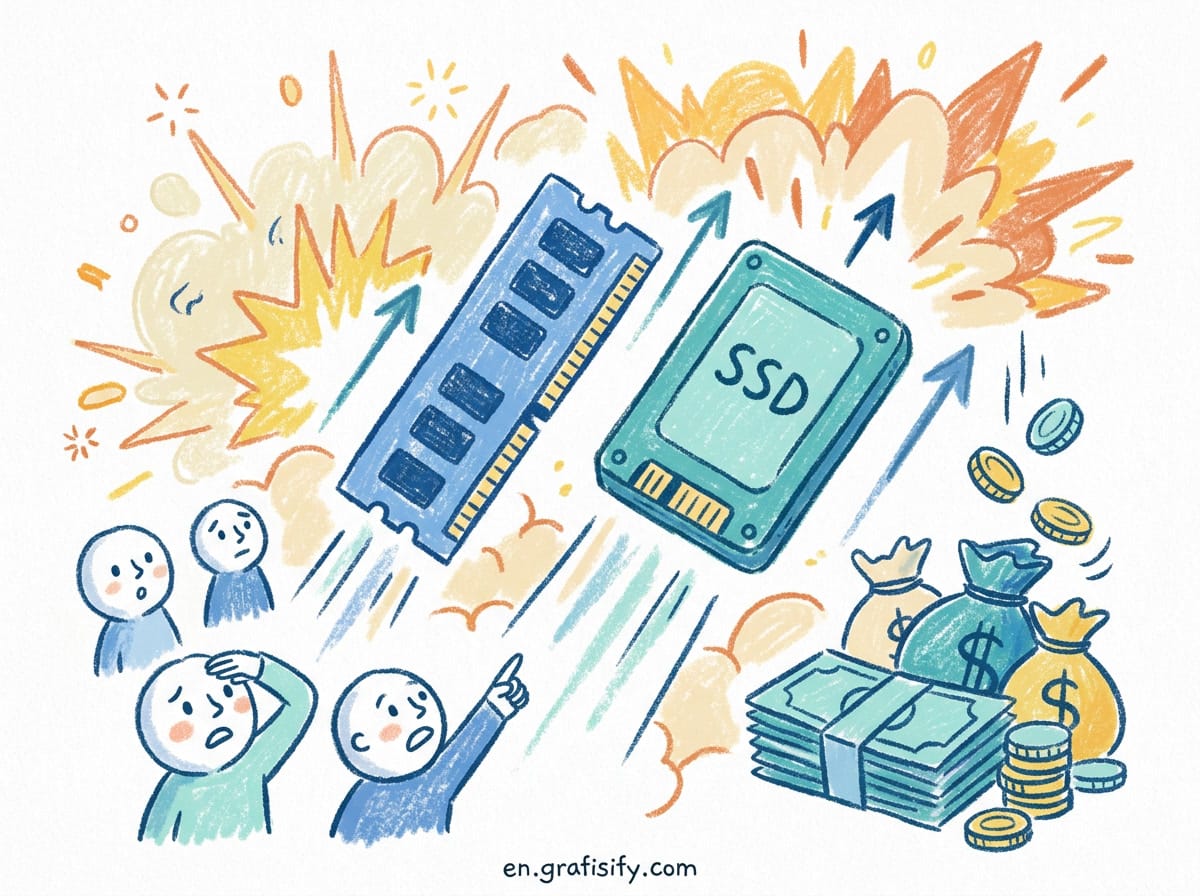
The PC hardware market is facing one of its most severe memory price shocks in recent history. If you’ve tried to build or upgrade a computer lately, you’ve probably noticed: DDR5 RAM kits cost more than entire budget CPUs, and SSDs that were once affordable are now commanding premium prices.
This isn’t a temporary blip. Industry analysts and memory manufacturers themselves are warning that the shortage could extend well into 2028. Here’s what’s happening, why it’s happening, and what you can do about it.
Just How Bad Are RAM and SSD Prices in 2026?
The numbers are staggering. According to TrendForce, conventional DRAM contract prices surged 55–60% quarter-over-quarter in Q1 2026 alone. PC DRAM — the DDR4 and DDR5 modules most consumers buy — saw even steeper increases of 105–110% QoQ, outpacing even server DRAM which rose 88–93% in the same period.
For NAND Flash, which powers SSDs, the picture is equally grim. Q1 2026 saw NAND prices rise 55–60% QoQ, with enterprise SSD pricing up 53–58% QoQ. And the trend shows no signs of slowing down.
Also Read:
In Germany, DDR5 memory prices have exploded to 448% of July 2025 levels — meaning what cost you $100 last year now costs $448. A 32GB DDR5 kit that was around €80 in mid-2025 now commands nearly €300 in many markets.
ADATA Chairman Chen Li-bai recently confirmed that memory manufacturers have announced DRAM contract prices will rise another 20–30% in Q3 2026, with NAND Flash prices increasing 35–40% in the same quarter. This follows a Q2 projection of 70–75% NAND price increases.
The AI Boom Is Eating the Memory Supply
The root cause is surprisingly simple: artificial intelligence.
Three companies dominate the global memory market — Samsung, SK Hynix, and Micron. Together, they control virtually all DRAM and NAND Flash production. And right now, they’re making a deliberate choice to prioritize AI memory over consumer products.
High Bandwidth Memory (HBM), the specialized memory used in NVIDIA’s AI accelerators, sells for 5–10x the margin of consumer DRAM or NAND. When NVIDIA is buying every HBM chip manufacturers can produce, the math becomes simple: allocate fabrication capacity to HBM, and let consumer memory supply shrink.
The result is a structural market shift. NAND wafer starts have flatlined or declined even as consumer demand for SSDs has grown. Samsung, SK Hynix, and Micron are reallocating production lines originally meant for consumer NAND to more profitable DRAM and HBM manufacturing.

As one industry analyst from NAND Research put it: “When manufacturers can sell HBM to NVIDIA at 5-10x the margin of consumer NAND, capital allocation decisions become obvious.”
Shortage Projected Until 2028
Perhaps the most concerning news comes from SK Group Chairman Chey Tae-won himself, who also chairs SK Hynix — one of the biggest beneficiaries of the memory price boom. He recently described current memory prices as “abnormal” and warned that AI chip demand could grow 60–100% next year.
Multiple industry sources, including Amble MarketPulse, project the DRAM shortage lasting until at least 2028. Mobile memory prices (eMMC/UFS) are forecast to rise 25–30% in Q1 2026, with LPDDR4X/5X increasing 30–35% — and that’s just the beginning.

For consumers, this means the days of cheap RAM and affordable SSDs are unlikely to return anytime soon. The structural shift toward AI memory allocation isn’t a temporary adjustment — it’s the new normal for the semiconductor industry.
What This Means for PC Builders
If you’re planning a new PC build or upgrade, here’s the practical impact:
- DDR5 RAM: A 32GB DDR5-6000 kit that cost $80–100 in mid-2025 now costs $250–350 depending on region. High-capacity kits (64GB+) are approaching $600–800.
- DDR4 RAM: Even last-gen DDR4 hasn’t been spared. With manufacturers prioritizing DDR5 and HBM production, DDR4 supply has tightened, pushing prices up 40–60% from 2025 levels.
- SATA SSDs: A 1TB SATA SSD that cost $50–60 in 2025 now sells for $100–150. Budget builds are feeling the pinch.
- NVMe SSDs: PCIe 4.0 and 5.0 drives have seen the steepest increases. A 1TB NVMe SSD that was $80–120 now costs $180–250. High-end 2TB models can exceed $400.
- Enterprise SSDs: Data center SSDs have risen 53–58% QoQ, and this cost is trickling down to cloud storage pricing and pre-built PC costs.
Should You Buy Now or Wait?
With prices projected to keep rising through Q3 2026 and likely into 2027, the conventional wisdom of “wait for prices to drop” no longer applies. Here’s our advice:
- If you need a build now: Buy your RAM and SSD as soon as possible. Waiting will likely mean paying 20–40% more in 3 months.
- Consider alternative brands: While Samsung, SK Hynix, and Micron dominate, brands like Kioxia, WD/SanDisk, and Chinese manufacturers YMTC and CXMT offer more competitive pricing — though their supply may also tighten.
- Buy in bulk: If you’re building multiple systems, buying RAM and SSD kits in bulk through distributors can still save 10–15% compared to retail.
- Don’t overspend on speed you don’t need: DDR5-6000 CL30 is the sweet spot for most users. Paying a premium for DDR5-8000+ or PCIe 5.0 SSDs may not deliver noticeable real-world benefits for most workloads.
What About the Used Market?
The secondhand market has also adjusted. Used DDR4 kits that sold for $30–40 in 2025 now fetch $60–80 on platforms like eBay and Facebook Marketplace. Used NVMe drives are selling at 70–80% of their new prices — unheard of in previous years.
For budget builders, buying used RAM and SSDs is now a legitimate strategy to save 30–40% compared to new, though you sacrifice warranty and wear-life guarantees on SSDs.
The Bigger Picture: A Structural Shift
What we’re witnessing isn’t just a supply chain hiccup. The AI boom has permanently reshaped the memory industry’s priorities. Manufacturers have discovered that selling high-margin AI memory to data centers is far more profitable than competing on thin margins in the consumer market.
SK Hynix chairman Chey Tae-won’s recent statement that “abnormal” memory prices should eventually moderate is the closest thing to a reassurance we have — but even he acknowledges AI chip demand could grow 60–100% next year, which would keep pressure on supply.
For consumers, the new reality is clear: cheap RAM and SSDs are a thing of the past, at least for the next 2–3 years. Plan your builds accordingly, buy when you can, and invest in quality components that will last.
Frequently Asked Questions
Will RAM prices ever go back to normal?
Industry analysts project the shortage lasting until at least 2028. Prices may stabilize after that, but returning to 2024–2025 levels is unlikely given the structural shift toward AI memory production.
Is DDR4 also affected?
Yes. Even though DDR4 is last-generation technology, manufacturers have reduced DDR4 production capacity to focus on DDR5 and HBM. DDR4 prices have risen 40–60% from 2025 levels.
Should I upgrade to DDR5 now or wait?
If you’re on DDR4, upgrading to DDR5 involves a new motherboard and potentially a new CPU — a costly proposition when RAM itself is expensive. Consider whether the real-world performance gains justify the cost, or wait until prices stabilize.
Are Chinese memory brands a good alternative?
YMTC (NAND) and CXMT (DRAM) offer more affordable alternatives to the Big Three. Performance is competitive for everyday use, though high-end enthusiasts may find Samsung/SK Hynix products faster. Availability outside China varies by region.

Irfan is a Creative Tech Strategist and the founder of Grafisify. He spends his days testing the latest AI design tools and breaking down complex tech into actionable guides for creators. When he’s not writing, he’s experimenting with generative art or optimizing digital workflows.
You might also like





 Artificial Intelligent
 Design & Creative
 Freelance
 Gadgets & Gear
 Insights
 Laptop
 Reviews
 Smartphone
 Tech Guides
 Vibe Coding