AI-Proof Remote Career Skills (5 That Keep You Hirable)
AI-Proof Remote Career Skills (5 That Keep You Hirable)
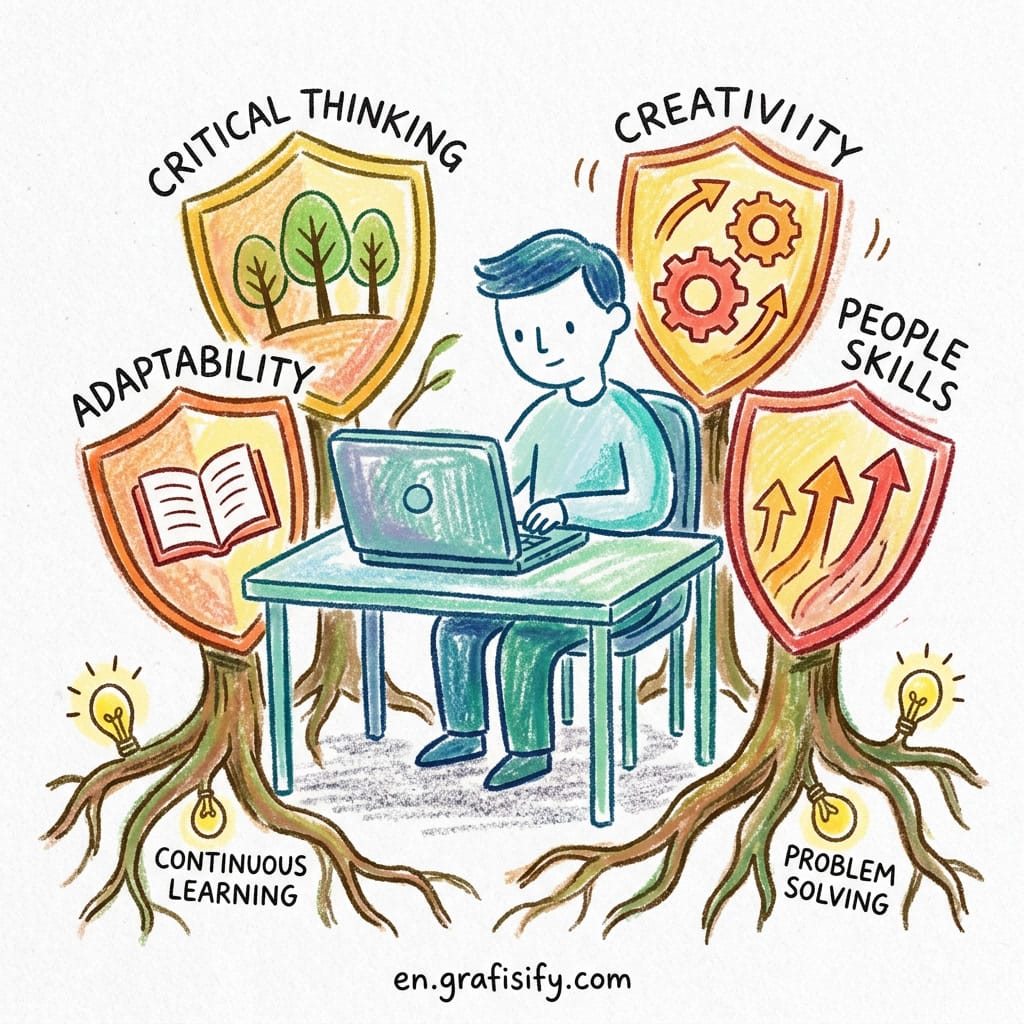
Quick verdict: The AI-Proof Remote Career Skills that matter most in an AI-driven remote job market are not the ones you think. Problem framing, AI workflow management, async communication, niche expertise, and client ownership. These five form a stack that AI tools can augment but not replace. You need all of them, not just one.
Every week there’s a new listicle. “5 skills to learn before AI takes over.” “7 AI-proof careers.” “The one skill you must master.” It’s exhausting, and most of it is wrong.
The World Economic Forum’s Future of Jobs Report 2025 projects that 92 million jobs will be displaced by AI while 170 million new ones emerge. That isn’t a net loss. It’s a structural shift. The question isn’t whether your current job survives. It’s whether you can prove you bring something AI cannot.
A 2025 NACE survey found that 70% of employers now use skills-based hiring practices. They don’t care about your degree or your years of experience. They care about what you can actually do. That shifts the game completely.
Here’s what actually works.
What Are AI-Proof Remote Career Skills?
Let me kill a myth right now. There’s no single skill that makes you immune to automation. “AI-proof” isn’t a property of one ability: it’s a property of how you combine them.
Think of it like a stool. One leg falls over. Three or four legs, and it stands on its own. The same logic applies to your career. If your entire value proposition is “I write SQL queries,” that’s one leg, and AI code generators are already chipping away at it. But if you combine SQL with stakeholder interviewing, data storytelling, and decision framing, the stack becomes something an AI can’t replicate.

Gartner’s latest research calls this the “AI workslop” problem. Companies are drowning in AI-generated content: code, copy, strategy documents that look good on the surface but fall apart under scrutiny. The people who thrive are the ones who can separate the workslop from the signal.
That requires a specific set of skills. Let me walk through each AI-Proof Remote Career Skill in detail. And before you ask: no, just knowing how to prompt an LLM isn’t enough. AI fluency alone won’t protect you because every other candidate can do the same thing. The real edge comes from stacking multiple skills together.
Deep Dive: AI-Proof Remote Career Skills (The Full Stack)

1. Problem Framing (What AI Cannot Fake)
AI is great at answering questions. It’s terrible at deciding which questions to ask.

Problem framing is the ability to take a vague business ask (“we need better engagement”) and turn it into a specific, solvable problem. “Engagement on our onboarding emails drops 40% after day three. Users who complete the tutorial stay 3x longer. We need to fix the day-three gap.” That’s framing. And it’s something no LLM can do reliably because it requires context, judgment, and the willingness to say no to bad ideas.
In practice, this means you spend less time executing and more time defining what execution looks like. You become the person who translates between business stakeholders and the tools (including AI tools) that do the work. That translation layer is your job security.
2. AI Workflow Management (From Tool User to System Builder)
Everyone knows how to prompt ChatGPT. That’s table stakes now. The skill that pays is building workflows around AI tools so they produce consistent, auditable results.

A single prompt gets you a rough draft. A well-designed AI workflow with context injection, output validation, human review gates, and feedback loops gets you production-ready output. The difference between the two is the difference between a novice and a professional.
I’ve seen this firsthand working with remote teams. The people who get the biggest productivity gains aren’t the ones who use AI the most. They’re the ones who build systems around AI. They set up templates, create review checklists, and know when to trust the output and when to throw it away.
3. Asynchronous Communication Mastery
Remote work runs on async communication. Email, Slack, project updates, Loom videos, Notion docs. If you can’t communicate clearly without a face-to-face meeting, you’re a bottleneck.
AI makes this worse. Tools like Granola and Otter.ai already transcribe, summarize, and distribute meeting notes. If your value was “I write good meeting recaps,” that value has evaporated. The new bar is writing that shapes decisions: status updates that actually unblock people, proposals that get signed off in one pass, feedback that changes behavior without causing friction.
The data backs this up. A 2026 remote work trends report from Troop Messenger shows async-first companies report 25% higher productivity than sync-heavy ones. The premium on clear written communication isn’t going away.
4. Niche Domain Expertise
Generalists are having a rough time. When AI can produce a passable blog post, a mediocre marketing plan, or a basic financial model, the middle of the market gets compressed. The value shifts to the edges: people who know something deeply enough that AI’s generic output is obviously wrong.
This doesn’t mean you need a PhD. It means you need a specific context that a general-purpose model doesn’t have. Maybe you know the compliance requirements for healthcare SaaS in three different EU countries. Maybe you understand the inventory dynamics of D2C brands selling on TikTok Shop. Maybe you’ve run 20+ paid ad campaigns for B2B SaaS and know exactly which metrics matter at each revenue stage.
That specific, contextual knowledge is your moat. AI can summarize general knowledge. It can’t replace what you know from doing this specific thing in this specific industry.
5. Trust-Based Client Ownership
Here’s the most underrated skill on this list. Clients and employers don’t just pay for output. They pay for certainty. They pay for someone who owns the outcome, catches problems before they escalate, communicates bad news early, and makes the right call when the instructions are ambiguous.
That’s trust. And it’s built through a track record of reliability, not through credentials or AI-generated proposals.
In a freelance economy where anyone can use AI to produce a decent deliverable, the differentiator is ownership. Who takes responsibility when things go wrong? Who proactively suggests a better approach instead of just doing what they were told? The person who does these things will always have work, regardless of what AI can or can’t do.
Pros and Cons of Building AI-Proof Remote Career Skills

Before you invest time in any skill stack, it helps to know the trade-offs.
| Pros | Cons |
|---|---|
| High demand across industries: these skills transfer | Takes 6-12 months of deliberate practice to build the stack |
| AI augments these skills instead of replacing them | Harder to measure than technical certifications |
| Pays premium rates: proven by freelancer rate data | Requires real-world reps you can’t shortcut with AI |
| Works for both employees and freelancers | Some skills (client ownership) need actual client exposure |
| Compounds over time: each skill makes the others stronger | No single course or certification teaches all five |
The cons are real. None of these skills come from a tutorial or a weekend workshop. They come from doing the work, making mistakes, and building the judgment that only experience provides.
How to Prove Your AI-Proof Remote Career Skills
Here’s where most advice on AI-Proof Remote Career Skills falls short. It tells you what skills to build but not how to prove you have them. In a market where 70% of employers check for proof, that gap costs you opportunities.
For problem framing: Write case studies. Don’t just list duties. Walk through a specific problem, your analysis, the options you rejected, and the outcome. Use the STAR method (Situation, Task, Action, Result) but add a section called “What I could have done differently.” That shows reflective thinking, which is a stronger signal than the story itself.
For AI workflow management: Build a portfolio of systems, not prompts. Share a GitHub repo with your prompt templates, validation scripts, and human-review checklists. Show the before and after. “This task used to take 4 hours. Now it takes 30 minutes with two review rounds.” That’s a provable claim.
For async communication: Your application itself is evidence. Write a cover letter that’s concise, structured, and makes a decision easy for the reader. Use clear subject lines. Link to relevant work. Show that you respect the reader’s time. If your application email is a wall of text, you’ve already failed this test.
For niche expertise: Publish. Write a blog post, record a Loom, post a thread on X. The simple act of putting your knowledge in public and defending it when people push back is demonstrable proof that you know your stuff. You don’t need a newsletter. One good post per month for six months is enough.
For trust and ownership: Collect testimonials. Not the generic “great to work with” kind. Specific ones. “Sarah caught a compliance issue that would have cost us $30K in fines. She flagged it before we even asked.” That type of testimonial is worth more than any certification.
Final Thoughts
The AI panic is real, but the response most people choose (learning to prompt better, chasing the next AI tool, trying to become technical overnight) misses the point. The tools change every quarter. The AI-Proof Remote Career Skills that make you irreplaceable are the ones AI can’t replicate because they’re fundamentally human.
Problem framing, AI workflow design, async communication, niche expertise, and client ownership. Build these five AI-Proof Remote Career Skills. Prove them with real evidence over a 90-day sprint: week 1-2 pick one skill to focus on, week 3-6 build proof (case study, portfolio piece, testimonial), week 7-12 repeat for the next skill. And ignore anyone who says there’s a shortcut.
Want to dig deeper? Read the WEF Future of Jobs Report for the macro picture. Check the NACE skills-based hiring survey for the data on how employers actually hire. And if you’re freelancing right now, test the rates with this insights guide on AI-proofing your freelance income.

Irfan is a Creative Tech Strategist and the founder of Grafisify. He spends his days testing the latest AI design tools and breaking down complex tech into actionable guides for creators. When he’s not writing, he’s experimenting with generative art or optimizing digital workflows.
You might also like
 Artificial Intelligent
 Design & Creative
 Freelance
 Gadgets & Gear
 Insights
 Laptop
 Reviews
 Smartphone
 Tech Guides
 Vibe Coding