Quarterly Estimated Taxes for Freelancers, Practical Guide (Safe Harbor, Calculations, Checklist)

Quarterly Estimated Taxes for Freelancers, Practical Guide (Safe Harbor, Calculations, Checklist)
If you freelance in the US and nobody’s withholding taxes from your paycheck, you’re responsible for paying the IRS on your own, every quarter.
Most new freelancers don’t realize this until they file their return and owe thousands in penalties. That’s the bad news. The good news: once you understand how quarterly estimated taxes actually work, you can set up a simple system that keeps you compliant and stress-free. This guide walks you through the mechanics, the math, the safe harbor rules, and the deadlines, with a real worked example using a $60K-a-year freelance income.
Sending the IRS a check every quarter isn’t optional. It’s a legal requirement under the IRS, and the penalty for ignoring it can cost you more than you’d expect.
According to IRS Topic 306, you must make estimated tax payments if you expect to owe $1,000 or more in tax for the year when withholding won’t cover it. For anyone who’s self-employed, that threshold is almost always crossed. If you’re looking for more freelance guides, check out Grafisify’s Freelance section.
What Are Quarterly Estimated Taxes?
Quarterly estimated taxes are advance payments toward your annual income tax and self-employment tax liability. The IRS doesn’t want to wait until April 15 of the next year to collect what you owe. So instead, it breaks your annual tax bill into four chunks and expects payment throughout the year. The concept is straightforward: estimate what you’ll earn, calculate the tax, and send a check (or electronic payment) every three months.
For freelancers, this is how the government gets its cut since there’s no employer running payroll. When you work a W-2 job, your employer withholds federal income tax, Social Security, and Medicare from each paycheck. The moment you go freelance, that safety net disappears.
You become the employer and the employee. That means covering both sides of Social Security and Medicare, plus all your income tax. Quarterly estimated taxes are simply the mechanism for doing that throughout the year instead of facing one enormous bill.

Quarterly Estimated Taxes for Freelancers: Understanding Self-Employment Tax
Self-employment tax is the freelancer’s version of FICA, and it hits harder than most people expect. FICA is the combined Social Security and Medicare tax that every working American pays. When you’re employed, you split it: your employer pays 7.65% and you pay 7.65% for a combined 15.3%.
As a freelancer, you pay the full 15.3% yourself. That’s 12.4% for Social Security (on the first $168,600 of net earnings) plus 2.9% for Medicare with no income cap.
There’s one silver lining. The IRS lets you deduct the employer-equivalent portion of your self-employment tax (half of 15.3%, or about 7.65%) from your net earnings when calculating your income tax. It doesn’t reduce your self-employment tax itself, but it does lower your adjusted gross income, which reduces the income tax portion of what you owe.
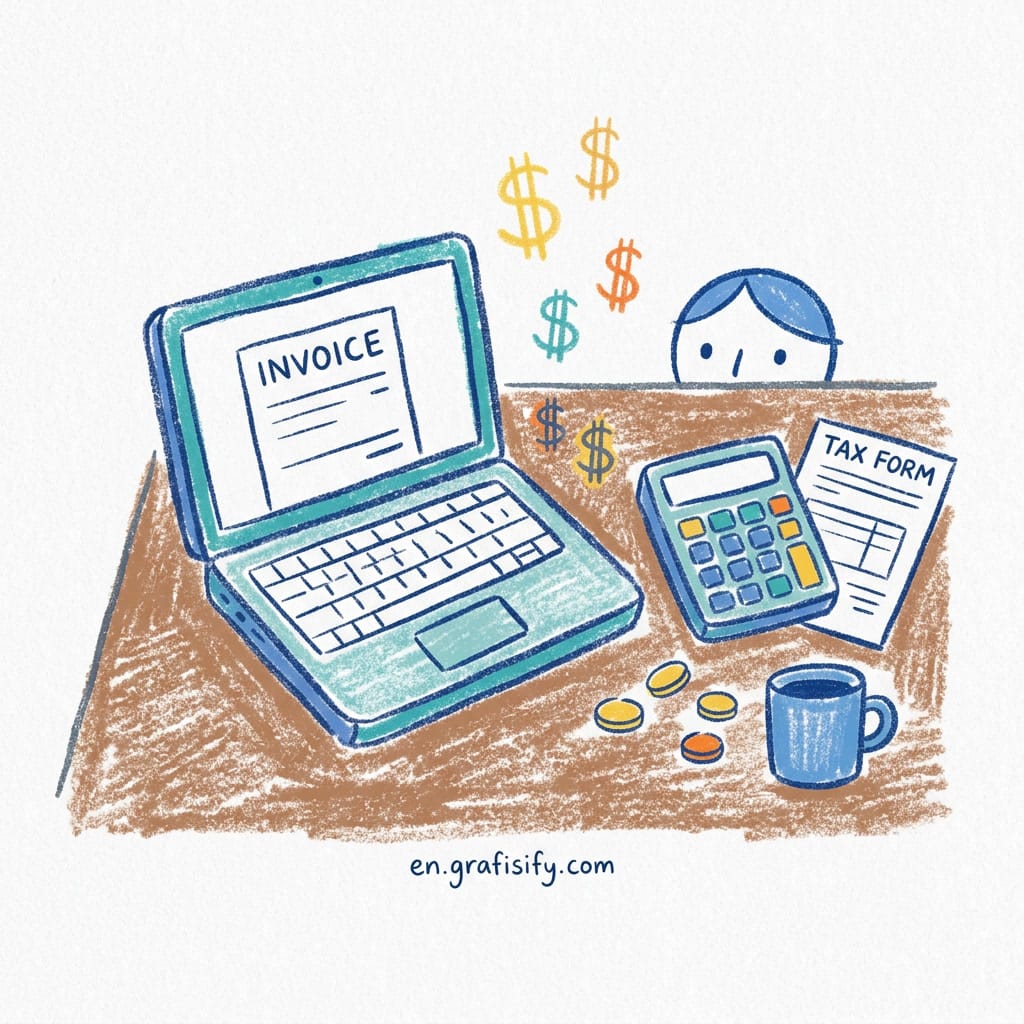
On top of self-employment tax, you owe federal income tax at your marginal rate. If you’re a single filer earning $60,000 in net income, you’re looking at the 22% bracket. The actual calculation involves deductions, credits, and adjusted figures that we’ll break down in the next section.
Quarterly Estimated Taxes for Freelancers: How to Calculate Your Payment
Here’s where the theory becomes numbers. Let’s walk through a complete worked example for a single freelancer earning $60,000 in net income for the year. This assumes no other income and no itemized deductions beyond the standard deduction.
Step 1: Determine your self-employment tax. Net earnings: $60,000. Multiply by 92.35% (the IRS adjustment): $60,000 x 0.9235 = $55,410. Apply the 15.3% SE tax rate: $55,410 x 0.153 = $8,478. The Social Security portion ($55,410 x 0.124 = $6,871) is under the $168,600 cap, so all of it applies.

Step 2: Deduct half of SE tax. That’s $8,478 / 2 = $4,239. This reduces your income for income tax purposes. So your adjusted income is $60,000 – $4,239 = $55,761.
Step 3: Subtract the standard deduction. For a single filer in 2026, the standard deduction is $15,000 (estimated, based on inflation adjustments). That brings your taxable income to $55,761 – $15,000 = $40,761.
Step 4: Calculate federal income tax. Using the 2026 brackets for single filers: the first $11,925 is taxed at 10% ($1,193), the next $35,575 at 12% ($4,269), and the remaining $3,261 at 22% ($717). Total income tax: $1,193 + $4,269 + $717 = $6,179.
Step 5: Combine SE tax and income tax. $8,478 (SE tax) + $6,179 (income tax) = $14,657 total annual tax. Divided by four quarters: $3,664 per quarter.
That’s roughly $305 a month or about 24% of gross income going to federal taxes alone. State taxes are on top of that. The table below summarizes the calculation:
| Component | Amount |
|---|---|
| Net freelance income | $60,000 |
| SE tax (15.3% x 92.35%) | $8,478 |
| Half of SE tax deduction | $4,239 |
| Standard deduction | $15,000 |
| Taxable income | $40,761 |
| Federal income tax | $6,179 |
| Total federal tax | $14,657 |
| Quarterly payment | $3,664 |
Not every freelancer will match this scenario exactly. Your numbers depend on filing status, deductions, credits, and whether you have other income. But the methodology stays the same: compute self-employment tax, compute income tax, add them, divide by four.
The Safe Harbor Rule: Three Ways to Avoid the Underpayment Penalty
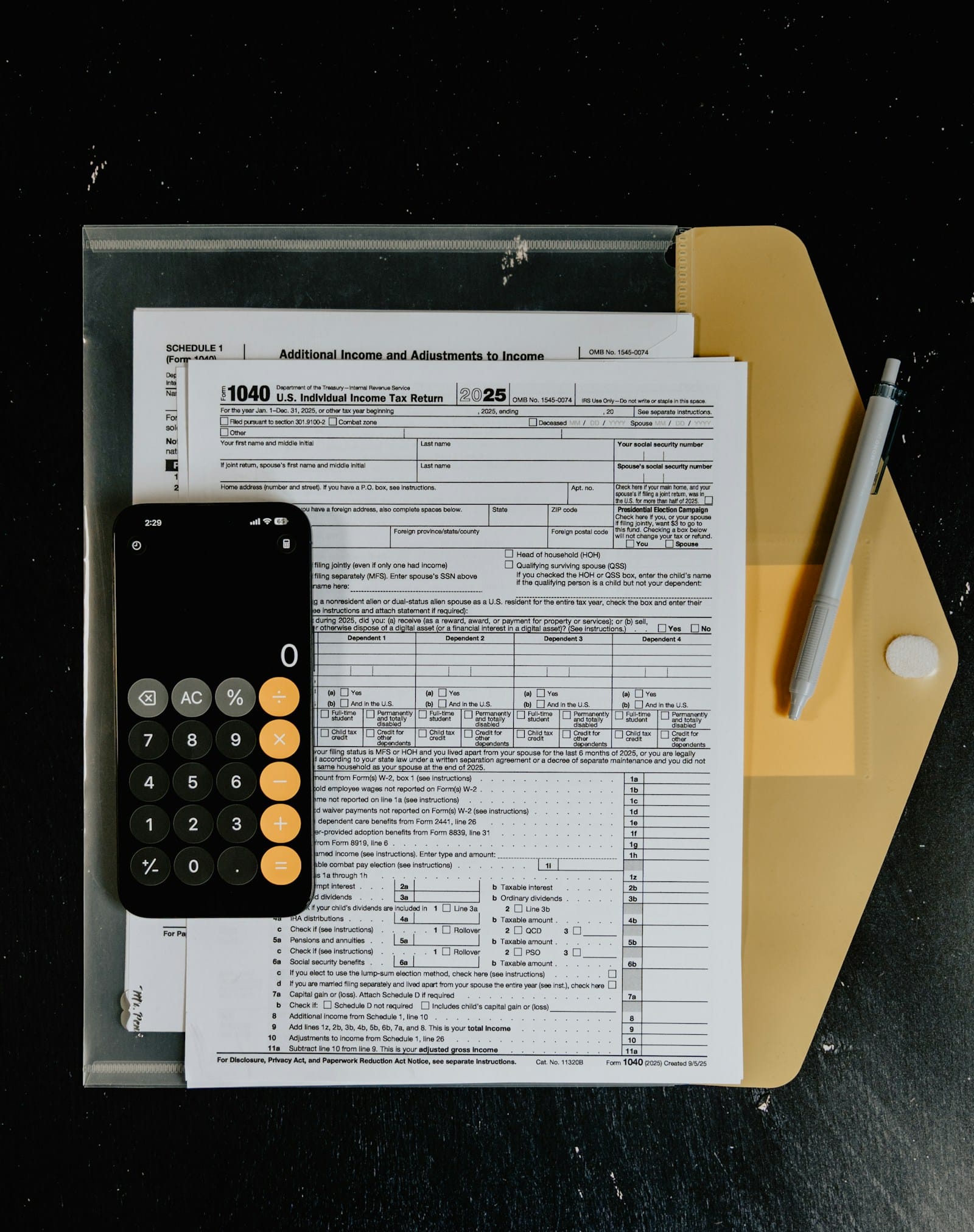
The underpayment penalty kicks in when you don’t pay enough tax throughout the year. The IRS charges interest on the shortfall, and it’s not cheap. But there’s a powerful escape hatch: the safe harbor rule. If your estimated payments meet one of three thresholds, you’re protected from penalties no matter what your actual tax liability turns out to be.
Method 1: Pay at least 100% of last year’s tax liability. If you paid $12,000 in total federal tax last year, send $3,000 per quarter this year. At filing time, even if you owe more, there’s no penalty. High earners (AGI over $150,000 single or $75,000 married filing separately) must pay 110% of last year’s liability for this safe harbor to apply.
Method 2: Pay at least 90% of this year’s tax liability. If your total tax for this year is $14,657 (like our example), you need to have paid at least $13,191 by year-end. Divide by four: $3,298 per quarter. The catch is that you need to estimate accurately. If you underestimate your income and pay less than 90%, you’ll owe the penalty on the difference.
Method 3: Use the annualized income installment method. This is the most complex option. It lets you make unequal quarterly payments based on actual income received in each period. If you earned most of your income in Q3 and Q4, you can pay more in those quarters and less in Q1 and Q2. It requires IRS Form 2210 with Schedule AI. This method is best for freelancers with uneven income throughout the year.
| Safe Harbor Method | Threshold | Best For |
|---|---|---|
| Prior year liability (100%/110%) | 100% of last year’s total tax (110% if AGI > $150K) | Predictable income, first-year freelancers who had W-2 income last year |
| Current year liability (90%) | 90% of this year’s total tax | Freelancers who can project income accurately |
| Annualized income method | Each quarter based on actual earnings | Irregular income, seasonal work, project-based billing |
I recommend the prior year safe harbor for most freelancers. It’s the simplest to implement, requires no income projections, and guarantees zero penalty even if your income jumps unexpectedly. When I first went freelance, this method saved me from a nasty penalty when a surprise client paid double what I’d projected.
Quarterly Estimated Taxes for Freelancers: 2026 Deadlines and How to Pay
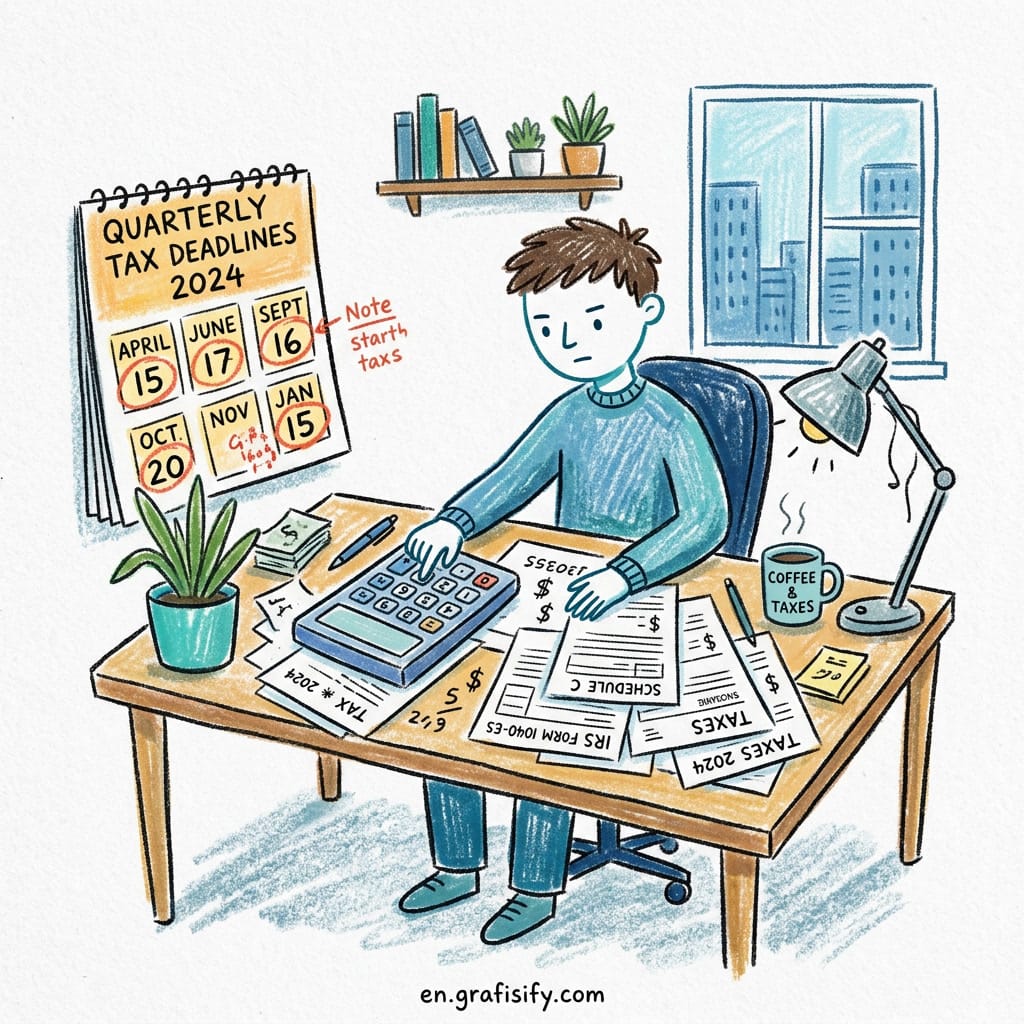
Miss a deadline and you’re paying penalties. The IRS doesn’t negotiate on these dates. The IRS publishes the official schedule on IRS.gov.
For income earned from January 1 through March 31: payment is due April 15. For April through May (Q2 is only two months in most years because the government needs its money faster): due June 16. For June through August: due September 15. For September through December: due January 15 of the following year. If any of those dates fall on a weekend or federal holiday, the deadline shifts to the next business day.
Payment is straightforward. The IRS offers several channels. The Electronic Federal Tax Payment System (EFTPS) is free and lets you schedule payments in advance. IRS Direct Pay is a free bank-transfer option that works for one-time payments.
Credit and debit card payments are accepted but come with processing fees of 1.85% to 1.98%. Many freelancers automate quarterly payments through their bookkeeping software, which calculates and files Form 1040-ES electronically.
How do you calculate quarterly estimated taxes as a freelancer?
Add up net earnings, apply 92.35% SE adjustment, multiply by 15.3%, add income tax after deductions, divide by four. See the $60K worked example in the How to Calculate section above.
What is the safe harbor rule for estimated taxes?
The safe harbor rule protects you from penalties if your payments meet one of three thresholds: 100% of last year’s liability (110% for high earners), 90% of this year’s liability, or annualized income. Pick the method that fits your income pattern.
How much should I save for taxes from each freelance payment?
Set aside 25% to 30% of every payment. For a freelancer earning $60,000 a year, that’s about $1,250 to $1,500 per month for federal taxes alone.
What happens if you don’t pay quarterly estimated taxes?
The IRS charges an underpayment penalty plus interest that can add 5% to 10% to your total tax bill. A freelancer who owes $15,000 with no quarterly payments could face $750 or more in penalties alone.
When are the 2026 quarterly estimated tax deadlines?
April 15, June 16, September 15, and January 15 of the following year. Always check the IRS’s official schedule because weekend and holiday adjustments can shift these dates by a day or two.
Common Mistakes Freelancers Make With Quarterly Taxes
Coverage from The Guardian and Wired confirms that self-employment tax catches even experienced freelancers off guard. The most common errors are predictable and avoidable.
The biggest mistake is ignoring estimated taxes entirely. Freelancers who don’t pay quarterly often face a combined hit of back taxes plus the underpayment penalty plus interest. By the time you file your annual return, you could owe 10% to 20% more than the original tax amount.
Another frequent error is not saving enough throughout the year. The most practical approach is to set aside 25% to 30% of every payment you receive into a separate high-yield savings account. When quarterly deadlines arrive, the money’s already there. This “tax envelope” method removes the temptation to spend the money before the IRS comes calling.
Freelancers also miss out on deductions because they don’t track expenses consistently. Home office deduction, business equipment, health insurance premiums, retirement contributions to a Solo 401(k) or SEP-IRA, and professional development costs all reduce your taxable income. Every dollar of legitimate deduction lowers the quarterly payment you owe. Track them from day one, not at tax time.
A fourth mistake is assuming last year’s numbers will work forever. If your income grows, your quarterly payments need to grow too. A freelancer who went from $40K to $70K between years but kept paying the same quarterly amount is building a penalty headache. Review your tax situation quarterly, not annually.

Quarterly Estimated Taxes for Freelancers: Your Action Checklist
Use this checklist every quarter to stay compliant and penalty-free:
- Calculate estimated income for the quarter. Add up all payments received minus business expenses.
- Determine SE tax at 15.3% of 92.35% of net earnings. Use one of the safe harbor methods to choose your payment amount.
- Check the current quarter deadline on the IRS schedule. Don’t rely on memory.
- Pay via EFTPS, Direct Pay, or your accounting software before the deadline. Electronic payments process faster and give you a confirmation record.
- Save 25% to 30% of each client payment in a dedicated tax savings account.
- Log all deductible expenses throughout the quarter. Don’t wait until filing season.
- Review your safe harbor number if income has changed significantly since the beginning of the year.
- File state estimated taxes on the same schedule or verify your state’s deadlines separately.
Don’t let these quarterly payments intimidate you. Once you’ve done the math for your first quarter, you have the template for every quarter after that. Adjust the numbers as income changes, pay on time, save consistently, and the annual tax filing becomes a non-event. You’ll file, see a small refund or a small amount owed, and move on. That’s exactly how it should work.

Irfan is a Creative Tech Strategist and the founder of Grafisify. He spends his days testing the latest AI design tools and breaking down complex tech into actionable guides for creators. When he’s not writing, he’s experimenting with generative art or optimizing digital workflows.
You might also like






 Artificial Intelligent
 Design & Creative
 Freelance
 Gadgets & Gear
 Insights
 Laptop
 Reviews
 Smartphone
 Tech Guides
 Vibe Coding