Why OpenAI’s New ‘Shopping Research’ Agent Could Finally Kill the Browser Tab Nightmare

The bottom line: ChatGPT isn’t just chatting anymore. With a quiet drop of “Shopping Research”—powered by the unreleased GPT-5 mini architecture—OpenAI is pivoting from a search engine alternative to a full-service personal shopper just in time for the holiday rush.
Let’s be real for a second: Online shopping has become a mess. What used to be a convenience revolution has devolved into a chaotic sprawl of SEO-spam blogs, fake five-star reviews, and a browser window so clogged with open tabs that it eats up all your RAM. We suffer from chronic decision paralysis, not because we lack options, but because we’re drowning in them.
OpenAI knows this. And with their latest rollout, they aren’t just trying to summarize Amazon reviews; they are attempting to fundamentally change the architecture of how we buy things on the internet.
Today, the company introduced Shopping Research, a dedicated agentic workflow within ChatGPT. This isn’t the standard “give me a list of laptops” prompt response. This is a deep-dive, interactive research tool that interviews you, scours the web for verified data, and compiles a comprehensive “Buyer’s Guide” tailored specifically to your neuroses, budget, and brand loyalties.
Here is the kicker: It’s rolling out right now for Plus, Team, and Pro users, and in a strategic move to capture the Black Friday chaos, OpenAI is making nearly unlimited usage available to all plans—including Free users—throughout the holiday season.
If you have been waiting for the moment AI agents actually start doing the heavy lifting rather than just talking a big game, this might be it.

The Meat: How “Shopping Research” Actually Works
To understand why this is different from a Google Search or a standard ChatGPT prompt, you have to look at the workflow. Standard Large Language Models (LLMs) are predictors; they guess the next word. Shopping Research acts more like a procurement officer.
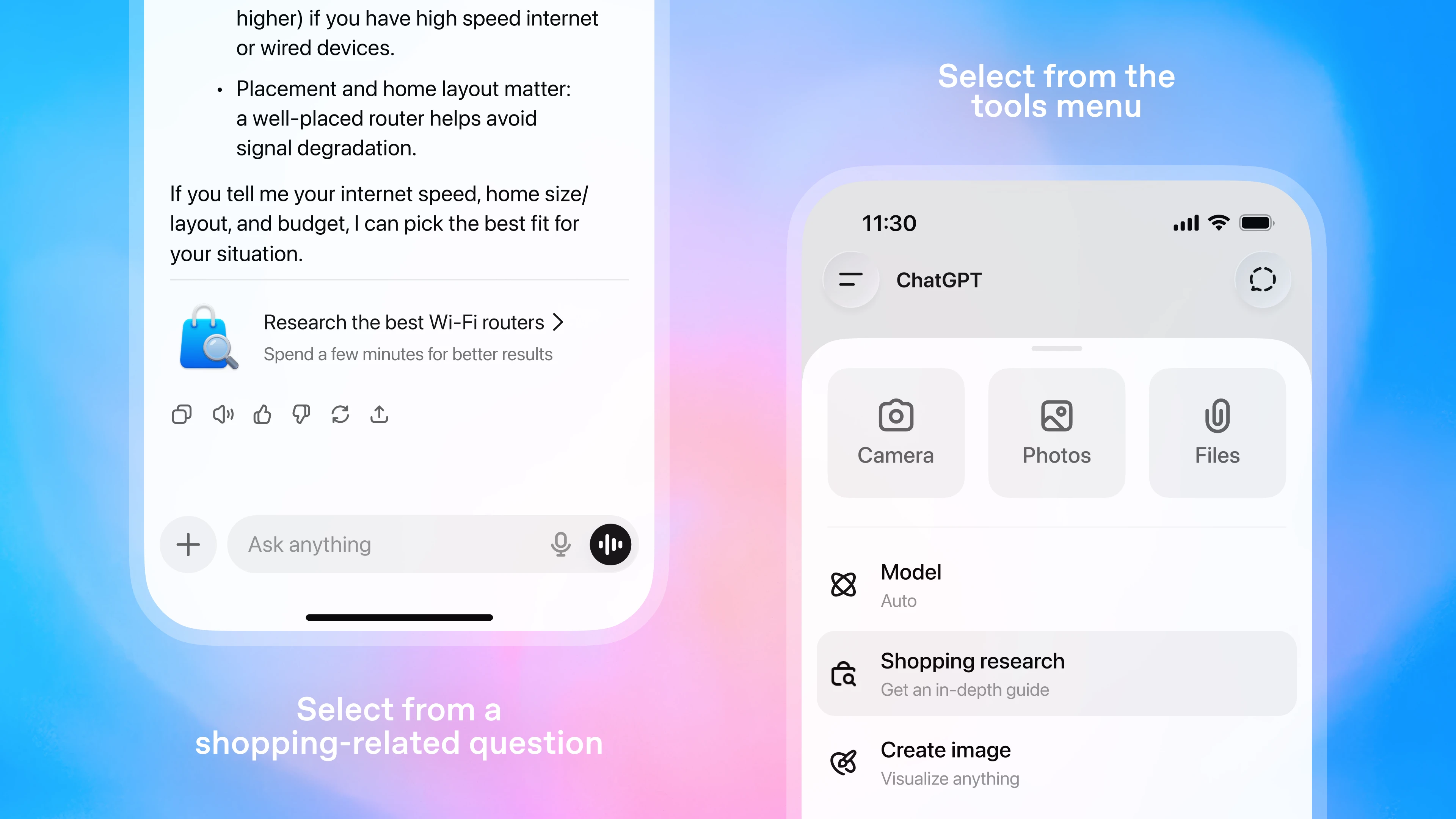
When you initiate a shopping query—something complex like “Find me a stroller that can handle Brooklyn sidewalks but fits in a tiny Uber trunk”—ChatGPT doesn’t just spit out three Amazon links. It shifts into “Research Mode.”
The Interview Phase
First, it opens a dedicated visual interface. It doesn’t guess your preferences; it asks. The system triggers a clarification loop, asking about your budget constraints, specific brand aversions, or whether you care more about aesthetics or durability. This mimics the experience of talking to a knowledgeable sales clerk at a specialty store, rather than shouting keywords into a void.

The “Deep Research” Engine
This is where the tech gets interesting. According to OpenAI’s internal specs, this feature is powered by a version of GPT-5 mini. This is one of the first public acknowledgments of the “5” series architecture being deployed for a specific utility. The model has been post-trained with reinforcement learning specifically for shopping tasks.
Unlike a standard chat response which is near-instant, Shopping Research takes a few minutes. It goes out to the live web, reading product pages, cross-referencing specs, and filtering out what it deems “low-quality” sources. It’s performing the grunt work—opening those 15 tabs, reading the specs, and closing the ones that don’t match—so you don’t have to.
The Living Buyer’s Guide
The output isn’t a static block of text. It is a dynamic, interactive “Buyer’s Guide.” It presents top contenders with side-by-side comparisons of trade-offs. You can interact with the results in real-time:
- “More like this”: If it nails the vibe with one product, you can tell it to pivot the entire search in that direction.
- “Not interested”: Mark a product as a dud, and the system learns instantly, removing similar items from the pool.
- Memory Integration: If you have ChatGPT’s Memory feature enabled, it already knows you prefer mechanical keyboards or that you have a child who loves art. It factors this historical context into the fresh search without you needing to repeat yourself.
“It turns product discovery into a conversation: asking smart questions to understand what you care about, pulling accurate, up-to-date details from high-quality sources, and bringing options back to you to refine the results.”
Context: The Battle for the Wallet
To see the bigger picture, we have to look at the battlefield. For the last two decades, Google has been the undisputed king of “Top of Funnel” (discovery), while Amazon has owned “Bottom of Funnel” (transaction). Recently, however, that dynamic has fractured.
Google’s search results have become increasingly cluttered with sponsored slots and SEO-optimized affiliate content that often buries genuine advice. This degradation of search quality created an opening for AI-first competitors.
The Perplexity Factor
OpenAI isn’t the only shark in these waters. Perplexity AI has been aggressively courting shoppers with its “Pro Search” feature, which also performs multi-step reasoning to find products. However, Perplexity is positioned more as a research engine for everything. OpenAI is carving out a specific, verticalized UI for shopping.
The Shift to Agentic Web
We are witnessing a transition from the “Informational Web” to the “Agentic Web.” In the old world, you searched for information and synthesized it yourself. In the new world, you assign a task to an agent, and it returns a synthesized result.
Shopping Research is a prime example of an asynchronous AI task. The fact that OpenAI explicitly states it “takes a few minutes” is a feature, not a bug. It signals to the user that work is being done in the background. It resets user expectations: good research takes time, even for a machine.
Expert Analysis: What’s Under the Hood of GPT-5 Mini?
The mention of GPT-5 mini is the technological headline buried in the consumer news. While OpenAI has been tight-lipped about the timeline for a full GPT-5 release, deploying a “mini” version for a high-stakes, high-hallucination vertical like shopping is a massive confidence vote.
Shopping is notoriously difficult for LLMs because of “drift.” A model might know what an iPhone 15 is, but does it know the exact price at Best Buy right now? Does it know that the “Space Gray” model is out of stock?
By using a model trained specifically to “read trusted sites and cite reliable sources,” OpenAI is trying to solve the hallucination problem that has plagued AI shopping assistants in the past. If the AI recommends a vacuum that doesn’t exist or quotes a price from 2021, the user trust evaporates instantly.
The Data: OpenAI claims this specific model architecture outperforms their previous models (including GPT-4o) on internal benchmarks for product accuracy. In their tests, “Shopping Research” scored a 64% on product accuracy, compared to just 37% for the standard GPT-5-Thinking-mini model without the shopping-specific post-training.
The Implications: The “Zero-Click” Economy
This rollout has profound implications for the digital economy, specifically for publishers and e-commerce merchants.
For Publishers and Affiliates
If ChatGPT generates a perfect Buyer’s Guide that summarizes the top 10 reviews from The Wirecutter, CNET, and Rtings, does the user ever click through to the original articles? OpenAI says they “cite sources,” but as the summaries get better, the incentive to click diminishes. This accelerates the trend toward a “Zero-Click” internet, forcing media companies to rethink their entire business models.
For Merchants
OpenAI mentions an “allowlisting process” for merchants who want to ensure they appear in results. This is the seed of a new ad network. Right now, it’s organic. But fast forward 18 months: Will we see “Sponsored Products” inside your personalized Buyer’s Guide? Almost certainly.
Furthermore, the integration of Instant Checkout hints at the endgame. OpenAI doesn’t just want to be the research assistant; they want to be the point of sale. If they can keep the user inside the ChatGPT interface from discovery to payment, they effectively cut Google out of the loop entirely.
Future Outlook: The Holiday Stress Test
Making this feature available to Free users for the holidays is a stress test of epic proportions. Millions of queries about air fryers, gaming laptops, and obscure toys will flood OpenAI’s servers. This will generate an unprecedented amount of data on how humans actually shop when they aren’t constrained by keywords.
The “Pulse” integration for Pro users is also noteworthy. Proactive suggestions—where the AI nudges you, “Hey, you bought that e-bike last week, do you need a helmet?”—moves the interaction from reactive to predictive.
“The bottom line is that the search bar is dying. It’s being replaced by the prompt box. And with Shopping Research, OpenAI is ensuring that when you ask ‘What should I buy?’, you aren’t just getting text—you’re getting a strategy.”
The technology isn’t perfect yet. OpenAI admits it might still fumble prices or availability. But for anyone dreading the 40-tab Black Friday browser session, having a GPT-5 powered agent do the legwork is a compelling pitch. The mall is closed; the agent is open for business.
Are you ready to let an AI decide which TV you buy this year, or do you still trust your own research skills? The shift is happening, whether we’re ready or not.
Tagged with:
AI AgentsArtificial IntelligenceBlack FridayChatGPTE-commerceGPT-5 MiniOnline ShoppingOpenAIShopping ResearchTech News
Irfan is a Creative Tech Strategist and the founder of Grafisify. He spends his days testing the latest AI design tools and breaking down complex tech into actionable guides for creators. When he’s not writing, he’s experimenting with generative art or optimizing digital workflows.
You might also like




 Artificial Intelligent
 Design & Creative
 Freelance
 Gadgets & Gear
 Insights
 Laptop
 Reviews
 Smartphone
 Tech Guides
 Vibe Coding