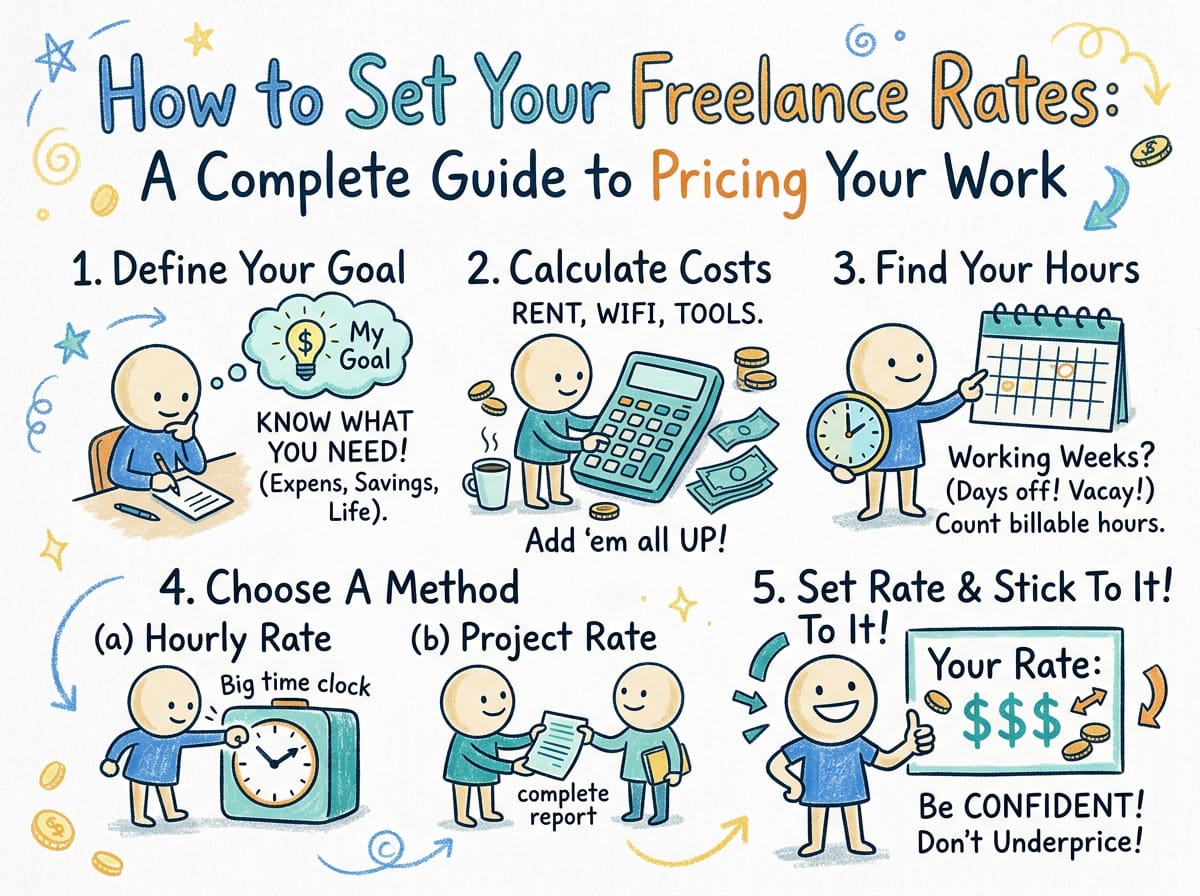
Freelance Taxes 101: Understanding 1099 Forms and Quarterly Payments

The Verdict: Transitioning from a salaried employee to a freelancer is liberating until April 15th hits. While the IRS tax code is a labyrinth designed to confuse even the brightest minds, mastering Freelance Taxes 101 isn’t just about compliance—it’s about keeping your hard-earned cash from vanishing into the void of penalties and interest.
Let’s be real for a second. The first time you land a big freelance check, the dopamine hit is real. You see that full amount hitting your bank account—no withholding, no Social Security deduction, just pure, unadulterated cash. It feels gacor, right? A total win. But here is the cold, hard truth that usually hits new independent contractors like a freight train about six to twelve months later: that money isn’t all yours.
Uncle Sam always wants his cut. And unlike your W-2 days, where your employer played the role of tax collector, you are now the CEO, the CFO, and the payroll department. If you ignore the mechanics of Freelance Taxes 101, you aren’t just looking at a bill; you’re looking at a financial disaster. Today, we are tearing down the complexity of 1099 forms, deciphering the enigma of quarterly payments, and ensuring you don’t go boncos (broke) when tax season rolls around.
The W-2 vs. 1099 Paradigm Shift
To understand why freelance taxes feel so punishing, you have to understand the system you just left. As a W-2 employee, your employer pays half of your FICA taxes (Social Security and Medicare) and withholds your income tax automatically. You barely notice it happening.
Welcome to the 1099 life. As an independent contractor, the IRS views you as a business entity. This brings us to the dreaded Self-Employment Tax. This is a flat 15.3% tax on your net earnings that covers Social Security and Medicare. That is on top of your standard income tax bracket. If you aren’t setting aside roughly 25-30% of every invoice, you are walking into a trap.
Decoding the Alphabet Soup: 1099-NEC vs. 1099-K
If you’re reading a guide on Freelance Taxes 101, you’ve likely heard of the “1099.” But which one? The IRS loves to change forms just when you get used to them. Let’s break down the paper trail that tracks your income.
The 1099-NEC (Non-Employee Compensation)
This is the big one. Previously, freelancers received a 1099-MISC, but the IRS revived the 1099-NEC specifically for independent contractors. Here is the rule: if a client paid you $600 or more during the tax year via direct deposit, check, or cash, they are required by law to file this form and send you a copy.

Does this mean if you earned $599 you don’t have to report it? absolutely not. You must report every single dollar of income, regardless of whether a form was generated. The form is just the IRS’s way of double-checking your math.
The 1099-K (The Digital Wallet Curveball)
This is where things get messy. If you accept payments via PayPal, Venmo, or Stripe, you might receive a 1099-K. The thresholds for this have been fluctuating wildly due to recent legislation changes, but the intent is clear: the IRS is cracking down on the “gig economy.” If you are selling services or goods online, these platforms report your gross volume directly to the government.
Pro Tip: Never double-count your income. If a client pays you via PayPal, and they issue you a 1099-NEC, but PayPal also issues a 1099-K for the same transaction, you need to be meticulous with your bookkeeping to ensure you aren’t taxed twice on the same gig.
The Nightmare of Estimated Quarterly Payments
This is the part of Freelance Taxes 101 that catches 90% of rookies off guard. The US tax system is “pay-as-you-go.” They don’t want to wait until April to get their money. If you owe more than $1,000 in taxes when you file your return, the IRS will slap you with an underpayment penalty. To avoid this, you must pay estimated taxes four times a year.
The dates are generally:
- April 15 (for income earned Jan 1 – Mar 31)
- June 15 (for income earned Apr 1 – May 31)
- September 15 (for income earned Jun 1 – Aug 31)
- January 15 (of the following year, for Sept 1 – Dec 31)
Notice the uneven intervals? Yeah, it’s annoying. June 15th usually sneaks up on people because it’s only two months after the previous deadline. Missing these deadlines results in interest charges that accrue daily. It’s not a game-changer if you miss one by a few days, but habitually ignoring them is a surefire way to erode your profit margins.

How do you calculate this? You can use the IRS Form 1040-ES worksheet. Or, for a simpler method, look at what you owed last year and pay 100% of that amount divided by four (or 110% if you’re a high earner). This is called the “Safe Harbor” rule, and it protects you from penalties even if you end up owing more later.
Deductions: The Freelancer’s Best Friend
Enough doom and gloom. Let’s talk about how to lower that bill. The beauty of being a business owner is that you are taxed on profit, not revenue. This means expenses are deductible. However, don’t get too creative—the IRS has sophisticated algorithms to flag “lifestyle” expenses masquerading as business costs.
The Home Office Deduction
This is the holy grail for remote workers. If you use a portion of your home exclusively and regularly for business, you can deduct a percentage of your rent/mortgage, utilities, and insurance. The key word is “exclusive.” If you work from your dining table where you also eat dinner, technically, that doesn’t count. But if you have a dedicated desk or a spare room? That’s a write-off.

Equipment and Software
Need a new MacBook Pro to edit videos? That’s deductible. Paying for Adobe Creative Cloud, Zoom, or hosting for your portfolio? All deductible. For more on tech tools that might be tax-deductible for your business setup, check out our insights in Tech Guides.
Pass-Through Deduction (QBI)
Under current tax laws (Tax Cuts and Jobs Act), many sole proprietors and LLCs can deduct up to 20% of their qualified business income from their taxes. This is a massive deduction that requires no spending on your part—it’s just a reward for being a business owner. Do not miss this.
Pros and Cons of the Freelance Tax Structure
Understanding Freelance Taxes 101 requires weighing the freedom against the administrative burden.
The Pros
- Control: You decide when to buy equipment to lower your taxable income.
- Deductions: W-2 employees cannot deduct commuting or home offices; you can.
- Retirement Options: Access to SEP-IRAs or Solo 401(k)s often allows for higher contribution limits than standard 401(k)s.
The Cons
- Self-Employment Tax: Paying the full 15.3% FICA tax hurts.
- Complexity: You need to be an accountant or hire one.
- Audit Risk: Schedule C filers are audited at a higher rate than standard W-2 employees.
Tools to Keep You Sane
Do not try to do this in a spreadsheet unless you are an Excel wizard. In the modern era, automation is key. Tools like QuickBooks Self-Employed, FreshBooks, or Wave can link to your bank accounts, categorize expenses automatically, and even estimate your quarterly tax payments in real-time. It’s a small monthly fee to avoid a massive headache.
Another option is hiring a CPA. While TurboTax is fine for simple returns, once you start depreciating assets or dealing with multiple income streams, a human professional is worth their weight in gold. They can often find deductions you didn’t even know existed.
Final Thoughts: Don’t Let the IRS Win
Look, taxes are never going to be fun. They are the price of admission for a civilized society and, more specifically, the price of admission for the freedom of freelancing. But they shouldn’t be terrifying. By understanding the flow of 1099s, respecting the quarterly deadlines, and aggressively (but legally) claiming your deductions, you turn a scary monster into a manageable chore.
The goal of mastering Freelance Taxes 101 isn’t to cheat the system—it’s to pay exactly what you owe and not a penny more. So, organize those receipts, set aside that 30%, and get back to work. The hustle doesn’t stop for tax season.
Tagged with:
freelance taxesindependent contractor guideIRS 1099-NECquarterly taxesself-employment taxtax deductions
Irfan is a Creative Tech Strategist and the founder of Grafisify. He spends his days testing the latest AI design tools and breaking down complex tech into actionable guides for creators. When he’s not writing, he’s experimenting with generative art or optimizing digital workflows.
You might also like





 Artificial Intelligent
 Design & Creative
 Freelance
 Gadgets & Gear
 Insights
 Laptop
 Reviews
 Smartphone
 Tech Guides
 Vibe Coding