DeepSeek V4 Flash 0731 Is Official: The Small Model Ships Before the Flagship
DeepSeek V4 Flash 0731 Is Official: The Small Model Ships Before the Flagship
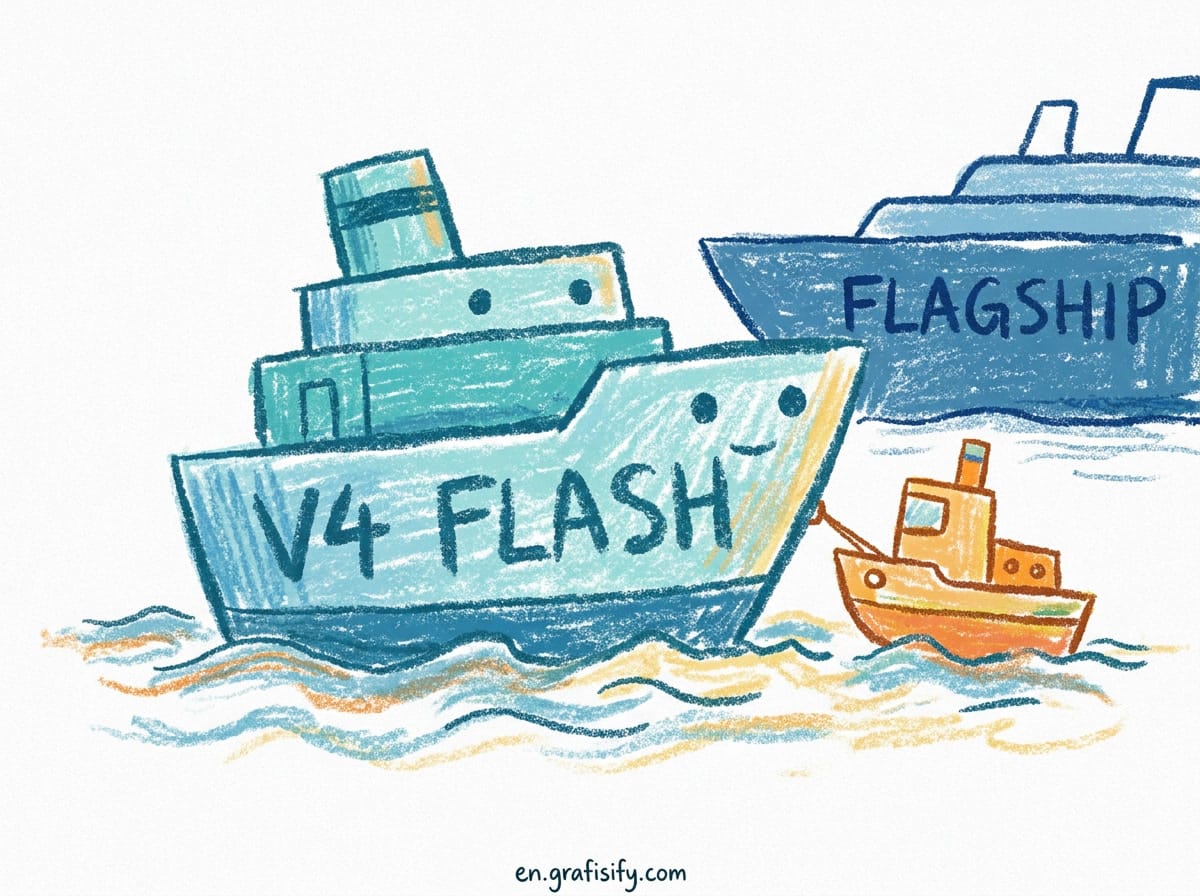
DeepSeek officially released DeepSeek V4 Flash 0731 on July 31, 2026, moving the model from preview to public beta. What stands out is that the Flash variant, not the V4 Pro flagship, shipped first. With 284 billion total parameters and just 13 billion active, this model posts agent benchmark scores above V4 Pro Preview, a far lower price point, and native Responses API support.
This article breaks down what is new in DeepSeek V4 Flash 0731, the claimed benchmark numbers, the pricing structure, how to access it, and an honest take on whether it deserves a spot in your AI pipeline.
What Is DeepSeek V4 Flash 0731?
DeepSeek V4 Flash is the lightweight variant in the V4 lineup, built for cost-efficient deployment. The 0731 release marks its exit from preview into public beta under the model identifier deepseek-v4-flash. The architecture is unchanged from the April build: a sparse mixture-of-experts model with 284 billion total parameters and 13 billion active at inference.
What changed is re-post-training. DeepSeek says the 0731 build focuses more heavily on agentic capabilities, with claimed benchmark scores that far exceed V4 Pro Preview across several evaluations.

Context matters here. DeepSeek built its reputation on open-weight models like V3 and V3.2 that rivaled GPT-5. With V4, the company is taking a different direction. V4 Flash 0731 ships as a proprietary model available only through the API. That is a meaningful shift from DeepSeek’s historical open-source stance.
Architecture and Technical Specs
V4 Flash 0731 uses a sparse mixture-of-experts architecture. Although total parameters reach 284 billion, only 13 billion are active when processing each token. This keeps the model responsive and cost-effective while retaining broad knowledge coverage.
Full specifications are as follows:
| Spec | Value |
|---|---|
| Total parameters | 284 billion |
| Active parameters | 13 billion |
| Context length | 1 million tokens |
| Max output | 384,000 tokens |
| Thinking mode | Non-thinking and thinking (default) |
| JSON output | Yes |
| Tool calls | Yes |
| Responses API | Yes |
| Anthropic API | Yes |
| FIM completion | Non-thinking mode only |
The 1 million token context is among the largest in its class. It places V4 Flash in a strong position for long-document workloads, large codebase analysis, and multi-step agent flows that need extensive context.
A 384,000 token maximum output is also unusual. Most competitor models offer far shorter generation limits. This capability suits tasks that produce very long documents, large code outputs, or extended agent response sequences.
DeepSeek V4 Flash 0731 Benchmarks
DeepSeek reports four headline benchmarks focused on agentic ability. Note that these are vendor-stated figures, not independently verified. The scores are:
Also Read:
| Benchmark | V4 Flash 0731 Score |
|---|---|
| Terminal-Bench 2.1 | 82.7% |
| CyberGym | 76.7% |
| Toolathlon-Verified | 70.3% |
| AutomationBench | 25.1% |
Terminal-Bench 2.1 measures how well a model completes real terminal-based tasks. An 82.7 percent score is strong for this category. CyberGym evaluates agent performance in cybersecurity environments. Toolathlon-Verified assesses precise and verified tool use. AutomationBench measures broader task automation.
Artificial Analysis also assigns V4 Flash 0731 a score of 50 on its Intelligence Index. That is a 10-point jump over the April V4 Flash and 6 points ahead of V4 Pro. The score trails GPT-5.6 Luna max, which sits at 51, by just one point.
The comparison with competitors is compelling. On Terminal-Bench 2.1, V4 Flash 0731 posts 82.7 while Anthropic Opus-4.8, which leads most benchmarks, reaches 85.0. That is a gap of only 2.3 points, at a fraction of the price.
Also Read:
DeepSeek V4 Flash 0731 Pricing
Official pricing splits into three buckets: uncached input, cached input, and output. This split matters, especially for agents that resend the same context on every turn.
| Component | Price per 1M tokens |
|---|---|
| Uncached input (cache miss) | $0.14 |
| Cached input (cache hit) | $0.0028 |
| Output | $0.28 |
The 98 percent cache hit discount is far more aggressive than the industry standard of around 90 percent. For agent workloads that resend conversation history, file contents, and tool outputs at every step, this makes operating costs extremely low.
For comparison, V4 Pro runs at 0.025 yuan for cached input, 3 yuan for uncached input, and 6 yuan for output. V4 Flash costs a third of Pro on both uncached input and output. That is the real basis for the price-performance argument.
Artificial Analysis also notes that V4 Flash 0731’s cost per task lands about 60 percent lower than GPT-5.6 Luna max, despite comparable intelligence. GPT-5.6 Luna cut its price 80 percent the same day, yet V4 Flash remains cheaper.
It is important to understand that the often-cited $0.28 per million tokens refers only to output. The full cost of a request combines all three categories. For agents resending large amounts of context, this split is the deciding factor.
Responses API and Codex Support
One of the biggest changes in the 0731 release is a third wire protocol for the DeepSeek API: native support for the OpenAI Responses API. For developers, this may matter more than any benchmark row.
Teams already building on the OpenAI ecosystem can switch to V4 Flash with minimal code changes. Instead of rewriting an entire integration, you swap the endpoint and model identifier. This lowers the adoption barrier significantly.
DeepSeek has also adapted the model for Codex, extending its reach into agentic coding workflows that are growing in popularity. The combination of Responses API and Codex support makes V4 Flash a practical choice for modern development teams.
V4 Flash also supports the Anthropic API format plus JSON output and tool calls. Multi-protocol support means teams can use V4 Flash across different stacks without major architectural changes.
Thinking Mode and Things to Watch
Several details deserve attention before running this model in production.
Thinking mode is on by default. It activates automatically and bills at the output rate, even though the reasoning tokens are not visible in the final response. For cost-sensitive pipelines, this can inflate the bill unexpectedly if not managed carefully.
API-only release with no open weights. Unlike earlier DeepSeek releases such as V3 and V3.2 that shipped open weights, V4 Flash 0731 is available only through the API. No weights were published on Hugging Face at release, and the platform still carried the April build on launch day.
V4 Pro stays in preview. The 1.6 trillion parameter flagship remains in preview. DeepSeek chose to ship the lightweight variant first, an uncommon decision in the industry.
Benchmark scores need verification. All benchmark figures in this release are DeepSeek’s own claims. No independent evaluation has confirmed these scores in real-world conditions yet.
How to Access DeepSeek V4 Flash 0731
V4 Flash 0731 is available through the DeepSeek API at base URL https://api.deepseek.com. For the OpenAI format, use that endpoint directly. For the Anthropic format, use https://api.deepseek.com/anthropic.
The model is also listed on third-party platforms such as OpenRouter and DeepInfra. On OpenRouter, input is priced at $0.14 per million tokens and output at $0.28 per million tokens, consistent with DeepSeek’s official pricing.
To get started, create an API key, select the deepseek-v4-flash model, and send a standard OpenAI-compatible request. Because it supports the Responses API, integration with existing tools and frameworks in the OpenAI ecosystem runs smoothly.
My Take
As someone running multi-model AI agent pipelines, several things stand out about this release.
First, DeepSeek shipping Flash before Pro is a clear signal about where the market is heading. The industry is moving from general chatbot score contests toward agent efficiency. DeepSeek is optimizing the model for what developers actually pay for, not for winning a single benchmark.
Second, the cache-hit-focused pricing is a smart design. Agents almost always resend the same context, so a 98 percent discount on cached input is not a marketing gimmick. It genuinely changes the operating economics of agent pipelines, especially for long-running and repetitive workloads.
Third, an API-only release with no open weights marks a strategic shift for DeepSeek. The company built its reputation on open-weight models. If this pattern carries into V4 Pro, the open-source community will need to rethink its reliance on DeepSeek for local deployment.
My biggest concern is the thinking mode that defaults to on and bills as output. For large-scale pipelines, hidden reasoning tokens can become an invisible cost line. My advice is to test real usage patterns before committing to production.
Despite that concern, V4 Flash 0731 holds a strong position. It offers agent scores close to premium models at a far lower cost, plus a 1 million token context and multi-protocol support. For many teams, that combination is hard to pass up.
Quick Comparison With Competitors
| Metric | V4 Flash 0731 | Opus-4.8 | GPT-5.6 Luna |
|---|---|---|---|
| Terminal-Bench 2.1 | 82.7 | 85.0 | Not available |
| Intelligence Index | 50 | Not available | 51 |
| Output per 1M tokens | $0.28 | Significantly higher | ~60% higher |
| Context | 1M tokens | Version dependent | Version dependent |
| Open weights | No | No | No |
Is It Worth Using?
For high-throughput agent and coding workloads with tight budgets, DeepSeek V4 Flash 0731 is a very strong candidate. Its agent scores approach Opus-4.8 with a small gap, while costing a fraction as much.
Responses API support makes adoption easy for teams already in the OpenAI ecosystem. The 1 million token context and 384,000 token output also cover long-document and multi-step workflow needs.
However, if your priority is heavy chain-of-thought reasoning or dependence on open-weight models for local deployment, this model may not fit. V4 Pro, while still in preview, remains the option for those tasks.
Best-fit use cases include coding assistants, agent pipelines, multi-step task automation, long-document analysis, and large-scale data processing under tight budgets.
Frequently Asked Questions
Is DeepSeek V4 Flash 0731 open source?
No. Unlike V3 and V3.2, which shipped open weights, V4 Flash 0731 is a proprietary model available only through DeepSeek’s API or partner platforms. The weights are not published.
How much does V4 Flash 0731 cost?
Uncached input costs $0.14 per million tokens, cached input $0.0028 per million tokens, and output $0.28 per million tokens. The 98 percent cache hit discount makes it very cheap for agent workloads that resend context.
Is V4 Flash 0731 better than V4 Pro?
On certain agent benchmarks, V4 Flash 0731 outperforms V4 Pro Preview. On the Artificial Analysis Intelligence Index, Flash scores 50 versus a lower V4 Pro score. However, V4 Pro remains the choice for heavy reasoning tasks and is still in preview.
How do I switch from an OpenAI model to V4 Flash?
Because V4 Flash natively supports the Responses API, the move from the OpenAI ecosystem is straightforward. Swap the endpoint and model identifier to deepseek-v4-flash with base URL https://api.deepseek.com.
Can thinking mode be turned off?
Yes. V4 Flash supports both non-thinking and thinking modes. Thinking mode is on by default and billed at the output rate. For cost savings, non-thinking mode can be selected for tasks that do not need deep reasoning.
Conclusion
DeepSeek V4 Flash 0731 matters for several reasons. First, it proves that a small, efficient architecture can compete with premium models on agent tasks. Second, its pricing is designed around the modern agent economy. Third, the API-only release signals a shift in DeepSeek’s business model.
If you are evaluating models for an agent pipeline or coding assistant, V4 Flash 0731 deserves a spot on your shortlist. Start by testing real scenarios, watch the thinking mode billing, and compare it directly against your current model. The final call still depends on your specific usage patterns.

Irfan is a Creative Tech Strategist and the founder of Grafisify. He spends his days testing the latest AI design tools and breaking down complex tech into actionable guides for creators. When he’s not writing, he’s experimenting with generative art or optimizing digital workflows.




 Artificial Intelligent
 Design & Creative
 Freelance
 Gadgets & Gear
 Insights
 Laptop
 Reviews
 Smartphone
 Tech Guides
 Vibe Coding