AI Tools That Clean Messy Spreadsheets
The Quick Verdict
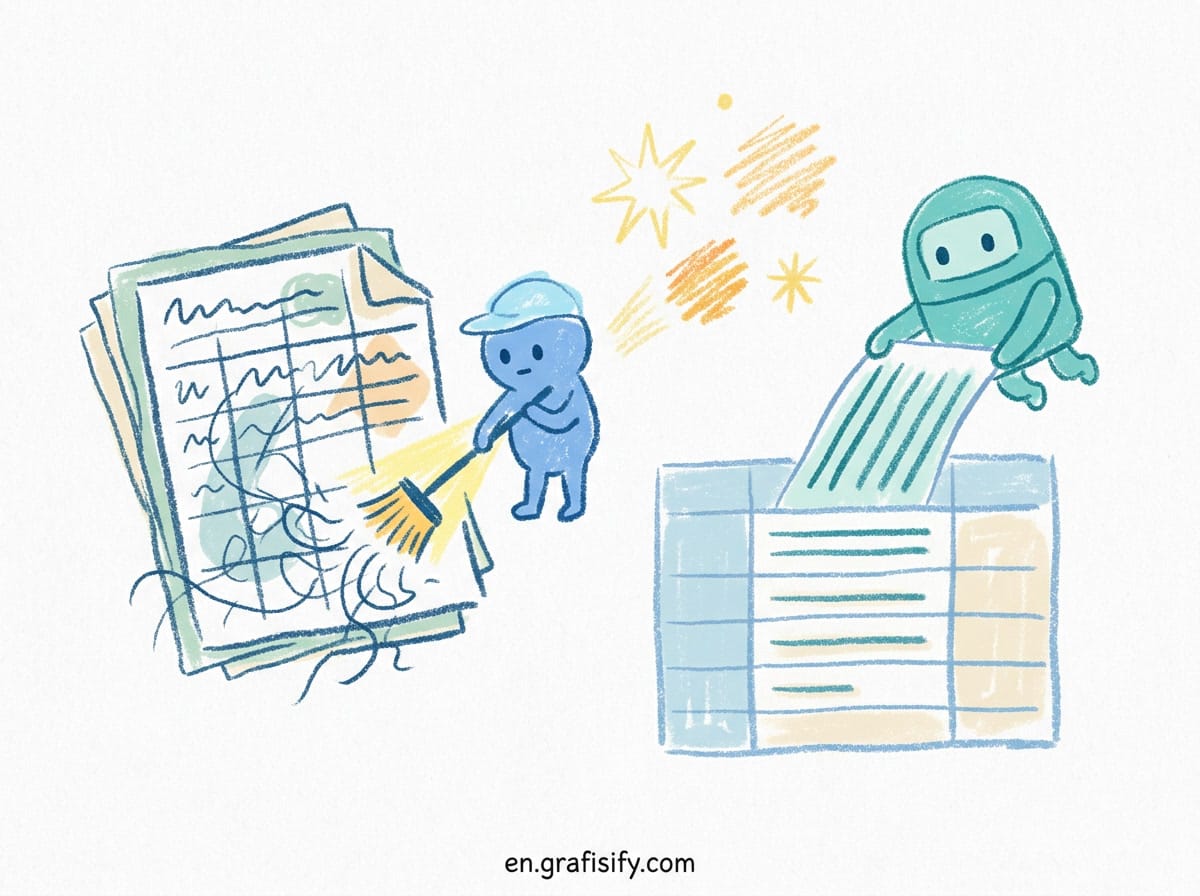
Messy spreadsheets waste more time than most people admit. Duplicate rows, inconsistent date formats, stray currency symbols, and typo-riddled categories are the daily tax on anyone who works in Excel or Google Sheets. You can fix a small sheet by hand, but once a file crosses a few thousand rows, manual cleanup turns into a weekend.
AI spreadsheet tools cut that work down to a few prompts. They sit inside your existing sheet as add-ins or web apps, read the columns you point them at, and rewrite the data in place. The catch is that they are not all built for the same job. Some are fast at bulk text cleaning, others shine at analysis and charts, and a few just write formulas you could have written yourself.
This guide compares the tools that actually earn a place in a working spreadsheet workflow: GPT for Work, Numerous.ai, Julius AI, and Rows. I tested the kinds of messes real teams hit: merged headers, mixed date formats, and free-text categories that should have been a dropdown.
Why Manual Cleanup Breaks at Scale
A 200-row sheet is a 20-minute chore. A 40,000-row export from a CRM is a different problem entirely. The errors repeat in patterns, but finding every instance by eye is impossible, and a single missed duplicate can skew a forecast.
Also Read:
The standard fixes, like Excel’s Text to Columns or Find and Replace, need you to already know the pattern. AI tools flip that. You describe the result you want in plain English and the model infers the rule across every row. Tell it “standardize all dates to YYYY-MM-DD” and it handles the ten variants your export produced.

The trade-off is judgment. A model will confidently apply a rule that is wrong for five percent of your rows. The workflow that works is AI for the bulk pass, then a human spot-check on the exceptions.

GPT for Work: AI as a Spreadsheet Function
GPT for Work installs as an add-on for Excel and Google Sheets and exposes AI as a callable function, =GPT(), inside the cell. You write a prompt once and drag it down a column. It cleans, classifies, translates, or generates content across thousands of rows without leaving the sheet.
For cleanup, it is the most direct option. Point it at a column of messy company names and ask it to match them to a canonical list. Give it a column of support tickets and ask for a one-word category. Because the prompt lives in the formula, the logic is reusable and auditable later.
The cost model is pay-as-you-go per token, which means a heavy pass across a huge range adds up fast. Use it for targeted columns, not for reprocessing the entire file on a whim. If you want the bigger picture on what these agents can do beyond sheets, our piece on AI agents for personal finance covers the same bulk-processing mindset.

Numerous.ai: Prompts Inside the Cell
Numerous.ai takes a similar in-sheet approach but leans harder on bulk content tasks. You run a prompt directly inside a cell and it fills the whole range. The strength is repetitive classification and enrichment: tag rows, summarize text, rewrite product descriptions at scale.
Where it differs from GPT for Work is the workflow feel. Numerous treats the spreadsheet as the interface and keeps the prompt close to the data. For teams prototyping AI features or testing prompt structures against real rows, that tightness helps. For pure data cleaning on numeric columns, it is comparable but slightly less ergonomic than a dedicated function.
One practical note: both tools send your row content to a model, so sensitive data needs a review of the vendor’s handling before you point them at customer records.
Julius AI: Analysis and Visualization
Julius AI is a web app you hand a file and ask questions in plain English. It reads CSVs and sheets, runs the analysis, and returns charts and written summaries. It is less of a cell-level cleaner and more of a desk analyst you query.
For the messes that need understanding before cleaning, Julius is strong. Upload a messy export, ask “which columns have the most missing values” or “show me outliers in the revenue column,” and you get both the answer and the visual. That diagnostic step is where most cleanup projects should start, because you cannot fix what you have not measured.
The weak spot is the round trip. Julius analyzes outside your sheet, so getting the cleaned result back into the exact format you need takes an export step. If you want to go deeper on local, private analysis without sending files to a web app, our guide to running local LLMs on your laptop is the privacy-first path.
Rows: The AI-Native Spreadsheet
Rows rebuilt the spreadsheet around integrations and AI from the start. Instead of bolting AI onto Excel, it treats prompts as a native feature and pulls live data from sources like LinkedIn, Clearbit, and Google Analytics straight into cells.
For cleanup, Rows works best when the mess is really an enrichment gap. You have names and want company sizes, or you have emails and want domain data. Its AI builds the model and fetches the missing fields. It is less suited to rescuing a corrupted legacy file, but excellent for turning a thin table into a rich one.
The learning curve is real if your team lives in Excel keyboard shortcuts. The payoff is a sheet that behaves like an app rather than a grid.
Head to Head Comparison
The right pick depends on where the mess lives. Here is how the four stack up on the dimensions that matter for cleanup work.
| Tool | Where It Runs | Best For | Bulk Cleaning | Learning Curve |
|---|---|---|---|---|
| GPT for Work | In Excel and Google Sheets | Reusable column rules via =GPT() | Yes, scalable | Low |
| Numerous.ai | In Excel and Google Sheets | Classification and enrichment at scale | Yes, per range | Low |
| Julius AI | Web app, file upload | Diagnosis, analysis, charts | Partial, via export | Medium |
| Rows | Browser, AI-native | Enrichment from live sources | Partial | Medium |
No single tool wins every column. GPT for Work and Numerous.ai own the in-sheet bulk pass. Julius owns the understand-it-first step. Rows owns the turn-a-thin-table-rich step. Most teams end up combining two.
A Cleanup Workflow That Actually Holds
Start by measuring. Open the file in Julius or just scan it, and list the specific problems: merged cells, mixed formats, dupes, free-text categories. You cannot fix a sheet you have not profiled.
Next, structure it. One header row, one record per row, no notes in the margins. AI tools assume a clean table shape as input, and feeding them a wrecked layout produces wrecked output. This discipline matters as much as the model does, and it connects to the broader problem of context engineering for AI agents: garbage structure in means garbage logic out.
Then run the bulk pass with an in-sheet tool. Point GPT for Work or Numerous.ai at the worst column, prompt the rule, and drag down. Spot-check fifty random rows before you trust the whole range.
Finally, lock it. Convert cleaned columns to validated dropdowns so the mess cannot creep back on the next import. A cleaned sheet that accepts typos again is not cleaned, it is postponed.
Common Mistakes
The first mistake is trusting the model on every row. AI cleanup is a bulk pass with a human review gate, not a one-click miracle. Always sample the output.
The second is skipping the profile step and throwing the whole file at a tool. You get plausible-looking garbage because the model guessed at columns it did not understand. Measure first.
The third is ignoring data sensitivity. These tools send row content to a model. Customer names, health data, and financial records need a vendor review before they leave your machine. Our writeup on AI transcription tools makes the same point about sending audio to third parties, and the caution applies here too.
How Each Tool Handles Real Messes
Theory is easy. The test is a real export. Take a support-log dump with a “priority” column holding values like High, high, HIGH-, and urgent. A human merges those into three buckets in minutes on a small file and in hours on a large one. An in-sheet tool does it in one prompt: “normalize this column to Low, Medium, High; map urgent to High.” The model handles the casing and the stray dash, then you verify the count of each bucket.
Date columns are the next common disaster. Exports mix 09/16/26, 16 Sep 2026, and 2026-09-16 in the same field. A single prompt to standardize to ISO format fixes all three, and the result sorts correctly for the first time. The same approach cleans currency strings with symbols and thousands separators before any math runs.
Free-text categories are where Julius earns its keep. Ask it to list the top ten inconsistent labels in a column and it returns the offenders with counts, which tells you exactly what rule to write before you run the bulk pass. Skipping that diagnostic step is how teams end up with a “cleaned” sheet that silently merged two different products.
Vendor depth matters too. GPT for Work’s own guide walks through the prepare, prompt, verify loop in detail, and Julius AI’s platform benchmarks add-ins on bulk tasks like classification. Numerous.ai documents the in-cell prompt pattern, while Rows shows the enrichment-from-live-sources model. Reading those before you commit saves a wrong purchase.
Final Thoughts
AI spreadsheet tools do not replace the analyst. They remove the hours of mechanical row-by-row fixing that stop analysts from doing the actual analysis. Pick the tool that matches where your mess lives: in-sheet functions for bulk rules, a web analyst for diagnosis, an AI-native sheet for enrichment.
Start small. Clean one column with a clear prompt, check the result, then expand. The teams that get value are the ones treating these tools as a fast first pass with a human at the end, not as a button that makes data trustworthy on its own.

Irfan is a Creative Tech Strategist and the founder of Grafisify. He spends his days testing the latest AI design tools and breaking down complex tech into actionable guides for creators. When he’s not writing, he’s experimenting with generative art or optimizing digital workflows.



 Artificial Intelligent
 Design & Creative
 Freelance
 Gadgets & Gear
 Insights
 Laptop
 Reviews
 Smartphone
 Tech Guides
 Vibe Coding