5 Reasons DeepSeek-Math-V2 Is a Game Changer for AI Reasoning
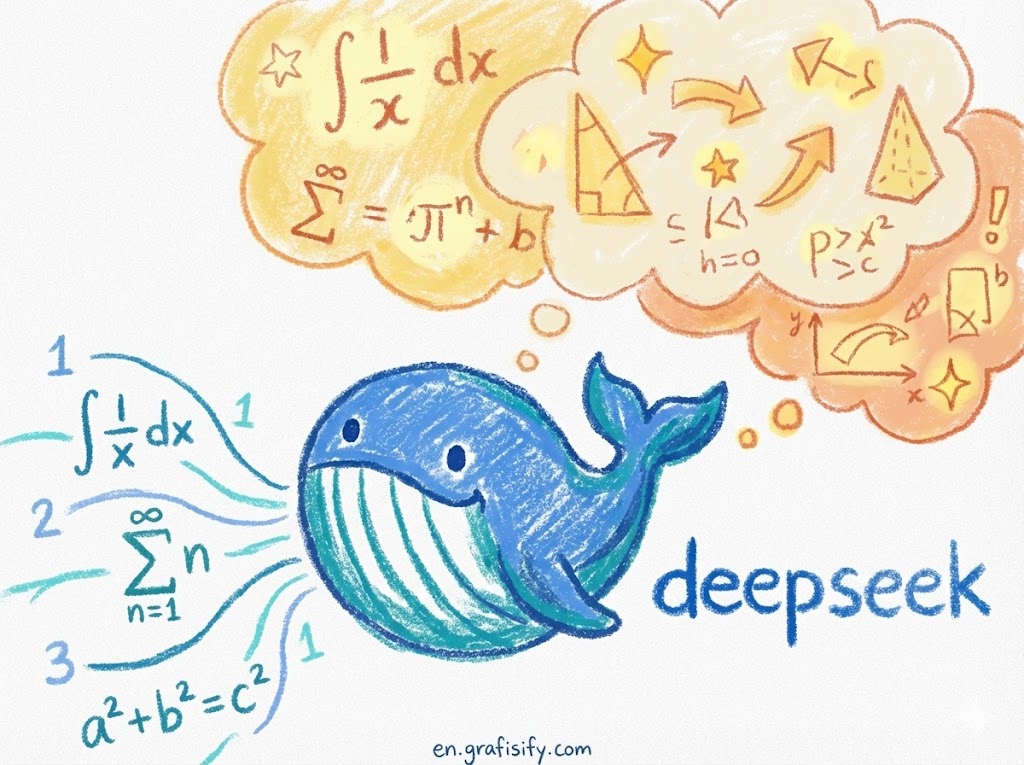
Quick Summary: DeepSeek has disrupted the AI landscape by open-sourcing a mathematical model that outperforms proprietary giants like GPT-5 in reasoning benchmarks. By utilizing a unique generator-verifier system, DeepSeek-Math-V2 achieves gold-medal standards at the International Mathematical Olympiad, offering a blueprint for self-correcting AI agents in engineering and science.
What is DeepSeek-Math-V2?
DeepSeek-Math-V2 is an open-source Mixture-of-Experts (MoE) AI model specifically engineered for advanced mathematical reasoning and logic. Unlike traditional LLMs, it employs a dual-process architecture where a “generator” proposes solutions and a “verifier” critiques them, allowing the model to achieve human-level precision on complex benchmarks like the IMO 2025.
5 Revolutionary Features of DeepSeek-Math-V2
1. Shattering the Proprietary Monopoly
For years, “research-level” mathematical reasoning was locked behind the closed doors of tech giants like Google and OpenAI. DeepSeek-Math-V2 changes the narrative completely by being open-source. This democratization means that universities, independent developers, and smaller tech firms can now access a model that rivals Google’s specialized Gemini Deep Think without paying exorbitant enterprise fees.
By releasing this technology to the public, DeepSeek is accelerating the pace of innovation. We aren’t just looking at a new tool; we are looking at a foundational shift where high-level reasoning is accessible to everyone. This move forces competitors to rethink their “walled garden” strategies.
2. The Generator-Verifier Architecture
Standard language models often hallucinate because they are rewarded for the final answer rather than the logic used to get there. DeepSeek-Math-V2 utilizes a generator-verifier system, which is essentially a digital version of “peer review” happening in real-time.
One part of the model proposes a mathematical proof, while a secondary component acts as a critic. This critic assigns confidence scores to each step of the logic. If a step seems weak, the generator is forced to go back and refine it. This mimics human cognitive processes much better than a standard next-token prediction model. For a deeper dive into how this feedback loop works, check out this overview on Reinforcement Learning.
3. Gold-Standard Performance on IMO 2025
The numbers here are genuinely staggering. In the 2024 Putnam competition, DeepSeek-Math-V2 scored 118/120, effectively beating the top human score. Furthermore, it solved 5 out of 6 problems at the IMO 2025 (International Mathematical Olympiad), hitting the gold standard threshold.
To put this in perspective, on the IMO ProofBench, this model hit a success rate of 61.9%. In comparison, GPT-5 reportedly scored only 20% on similar tasks. This massive gap highlights that general-purpose models are struggling to keep up with specialized reasoning engines like DeepSeek-Math-V2.

4. Self-Debugging and Logic Refinement
One of the most frustrating aspects of using AI for coding or math is that it often doubles down on mistakes. DeepSeek-Math-V2 introduces a capability that many developers have been dreaming of: step-by-step self-debugging.
Because the verifier assigns confidence scores to individual steps, the model can identify exactly where its logic is failing before outputting a final result. This allows it to “debug” its own thought process, correcting errors dynamically. This is a massive leap forward from the “one-shot” generation we are used to.
5. A Blueprint for Engineering Reliability
While solving math problems is impressive, the implications for the real world are even bigger. This model provides a blueprint for building agents that can handle high-stakes domains where mistakes are costly, such as structural engineering, financial modeling, or aerospace coding.

By prioritizing the verification of logic over the speed of generation, DeepSeek-Math-V2 proves that AI can be trusted with precision tasks. You can read more about the technical specifications on the official DeepSeek GitHub repository.
Future Implications: Beyond the Classroom
The release of DeepSeek-Math-V2 isn’t just about helping students cheat on their calculus homework. It signals a shift toward “System 2” thinking in AI—slow, deliberate, and logical reasoning.
We are likely to see this architecture adapted for legal analysis, medical diagnosis, and complex software architecture generation. The era of the “confident but wrong” chatbot is ending; the era of the “self-critical” agent is just beginning.

Pros & Cons of DeepSeek-Math-V2
✅ The Good
- Open Source: Democratizes access to frontier-level mathematical reasoning.
- Self-Correction: The verifier system significantly reduces logical hallucinations.
- Benchmark Crushing: Outperforms proprietary models like GPT-5 on math tasks.
❌ The Bad
- Resource Intensive: Running MoE models locally requires significant VRAM and compute power.
- Niche Focus: While brilliant at math, it may not be suitable for creative writing or general chat.
- Academic Integrity: poses a significant challenge to traditional testing methods in education.
Final Thoughts
DeepSeek-Math-V2 is more than just a high score on a leaderboard; it is a declaration that open-source AI is not only catching up to proprietary models but is actively overtaking them in specific domains. By prioritizing self-verification and logical consistency, DeepSeek has created a tool that will fundamentally change how we approach automated reasoning.
If you are a developer, researcher, or engineer, now is the time to start integrating these types of verifier-based models into your workflow. The barrier to entry for high-level AI reasoning has never been lower.
For more insights on optimizing your workflow with the latest tools, read our related guide on AI productivity tools.
Tagged with:
Artificial IntelligenceDeepSeekDeepSeek-Math-V2IMO 2025Logic VerificationMachine LearningMath AIOpen SourcePutnam CompetitionTech News
Irfan is a Creative Tech Strategist and the founder of Grafisify. He spends his days testing the latest AI design tools and breaking down complex tech into actionable guides for creators. When he’s not writing, he’s experimenting with generative art or optimizing digital workflows.
You might also like


 Artificial Intelligent
 Design & Creative
 Freelance
 Gadgets & Gear
 Insights
 Laptop
 Reviews
 Smartphone
 Tech Guides
 Vibe Coding