7 Revolutionary Claude Opus 4.5 Features That Redefine Enterprise AI

Quick Summary: Claude Opus 4.5 has arrived as Anthropic’s most intelligent model to date, boasting superior coding skills and agentic capabilities at a significantly reduced price point of $5/$25 per million tokens. With new features like the “effort” parameter, deep desktop integration, and enhanced resistance to prompt injection, it sets a new standard for enterprise-grade AI.
What is Claude Opus 4.5?
Claude Opus 4.5 is Anthropic’s latest frontier AI model, engineered to deliver state-of-the-art performance in software engineering, complex reasoning, and autonomous agentic workflows. It introduces novel developer controls like variable effort settings and context compaction, making it a highly efficient and robust solution for demanding enterprise tasks.
7 Revolutionary Features of Claude Opus 4.5
1. Unmatched Software Engineering Capabilities
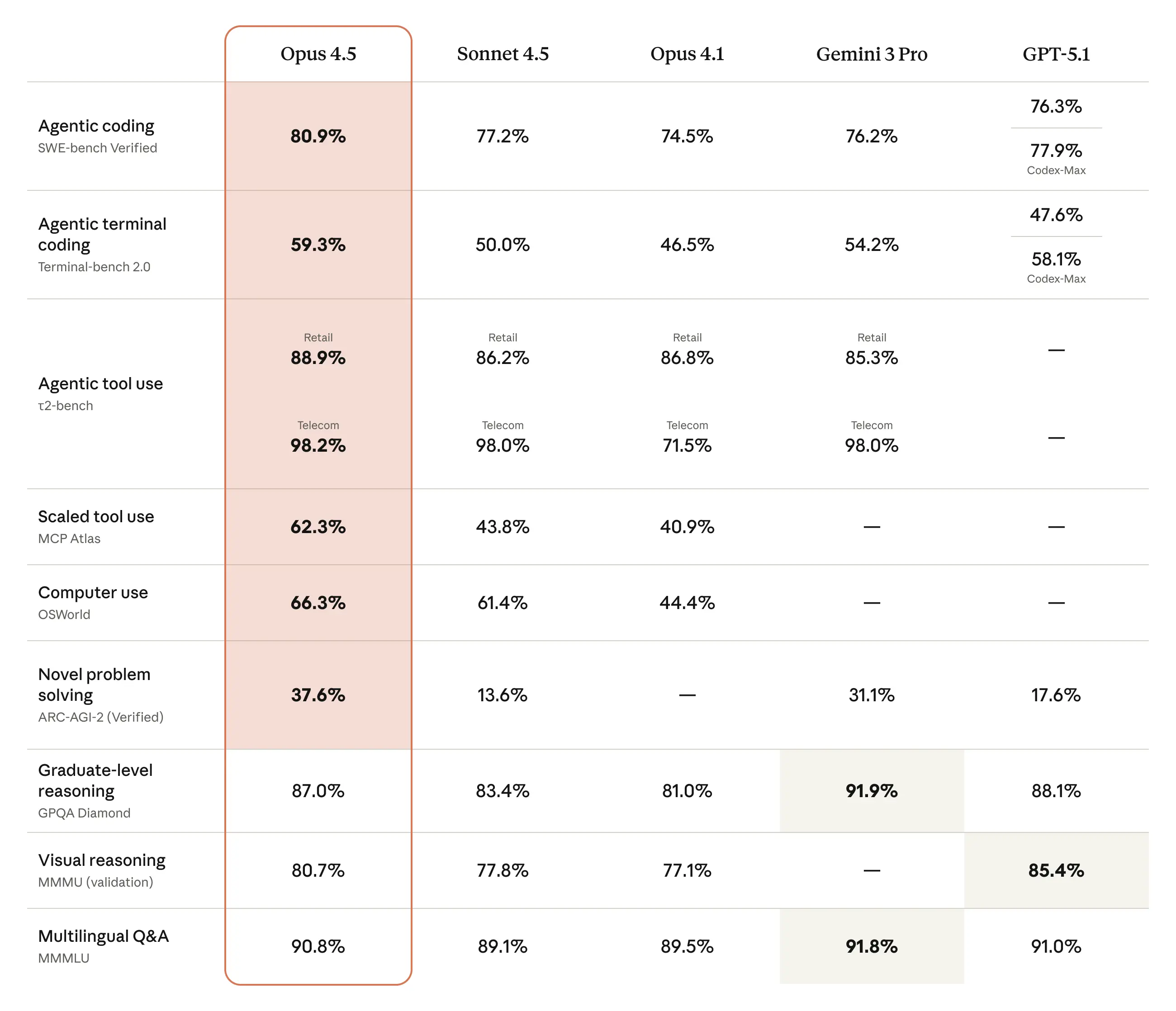
Claude Opus 4.5 has taken the crown in the realm of AI-assisted programming. According to internal and external benchmarks, including the rigorous SWE-bench Verified, this model outperforms its predecessors and competitors by handling complex, multi-system bugs without needing constant hand-holding. It is designed to reason through trade-offs and navigate ambiguity, making it an indispensable tool for senior developers.

This leap in performance suggests a shift in how software development lifecycles will be managed, moving from simple code generation to autonomous problem solving. For a deeper understanding of the benchmarks used to measure these feats, you can explore the methodology behind SWE-bench.

2. Next-Generation Agentic Workflows
One of the standout improvements in Claude Opus 4.5 is its ability to function as a high-level agent. It doesn’t just answer questions; it plans and executes long-running tasks. Whether it’s managing a team of sub-agents or executing multi-step research, the model demonstrates a level of foresight and planning that was previously unattainable. This is crucial for automating complex business processes that require sustained attention.
The model’s architecture allows it to handle “dead-ends” more effectively, backtracking and correcting its course without user intervention. This aligns with the broader industry movement towards autonomous intelligent agents capable of performing independent work.
3. Cost-Efficient “Effort” Control
In a brilliant move for developer flexibility, Anthropic has introduced an “effort” parameter in the API. This allows users to dictate how much “thinking” the model should apply to a given problem. You can set it to low for speed and cost savings on simpler tasks, or crank it up to high for maximum reasoning capability on complex challenges.

This feature directly addresses the “overthinking” problem common in large models, giving engineers control over the token budget. It represents a significant maturity in AI resource management, similar to cloud compute optimization strategies used in DevOps.
4. Fortified Enterprise Security
Security remains a top priority for enterprise adoption, and Claude Opus 4.5 is built to be the most robustly aligned model yet. It has demonstrated exceptional resistance to prompt injection attacks—a common vulnerability where malicious inputs trick the AI into bypassing its safety protocols. By securing the model against these “jailbreaks,” Anthropic ensures it can be safely deployed in critical environments.
This robustness is verified through extensive “red teaming” exercises. For more on the standards of securing large language models, the OWASP LLM Top 10 provides an excellent framework for understanding these risks.

5. Seamless Desktop and Browser Integration
Breaking out of the chatbox, Claude Opus 4.5 powers the new “Claude for Chrome” and desktop applications. This allows the AI to interact directly with your web browser and local files, enabling it to perform tasks like researching across multiple tabs or updating documentation locally. This level of integration transforms the AI from a consultant into an active coworker.
By bridging the gap between the model and the user’s operating environment, it streamlines workflows significantly. This evolution mirrors the trend seen in modern productivity tools that seek to unify disparate software ecosystems.
6. Advanced Financial Modeling in Excel
Finance professionals have a new ally with the specialized Claude for Excel integration. Opus 4.5 excels at interpreting complex spreadsheets, identifying trends, and automating financial modeling tasks that typically require hours of manual work. Its improved reasoning capabilities allow it to spot anomalies and suggest strategic adjustments with high accuracy.

This integration brings the power of frontier LLMs directly into the world’s most popular spreadsheet software. You can read more about how AI is transforming spreadsheet data analysis on Microsoft’s official blog.
7. Intelligent Memory and Context Compaction
Finally, Claude Opus 4.5 introduces sophisticated memory capabilities and context compaction. For long conversations or massive projects, the model can now summarize and “forget” irrelevant details while retaining critical context. This prevents the model from hitting context walls and ensures that performance remains consistent even during extended coding sessions or research deep dives.
This technique mimics human short-term vs. long-term memory processing. Understanding context awareness in computing helps explain why this feature is vital for maintaining coherence over time.
Practical Application: Optimizing for the “Effort” Parameter
To get the most out of Claude Opus 4.5, you need to master the new “effort” parameter. A common mistake is leaving this on high for every request, which burns through your token budget unnecessarily. For routine code refactoring or simple email drafting, set the effort to ‘medium’ or ‘low’. Only reserve ‘high’ effort for complex architectural planning or debugging obscure errors.
Additionally, utilize the new “Plan Mode” in Claude Code. Instead of asking the model to fix a bug immediately, ask it to generate a plan.md file first. This allows you to review the AI’s proposed strategy before it writes a single line of code, saving time on revisions.
Pros & Cons
✅ The Good
- State-of-the-art coding and reasoning performance outperforms competitors.
- New pricing ($5/$25) makes Opus-tier intelligence much more accessible.
- “Effort” parameter gives developers granular control over cost and speed.
- Superior resistance to security threats and prompt injections.
❌ The Bad
- Specialized usage limits apply specifically to Opus 4.5.
- Advanced features like agentic planning have a steeper learning curve.
- High-effort queries can still be slower than lighter models like Haiku.
Final Thoughts
Claude Opus 4.5 represents a maturation of generative AI, moving from impressive demos to reliable, work-ready infrastructure. With its price reduction and efficiency tools, it is poised to become the default engine for complex enterprise applications. Whether you are a developer looking to automate testing or a financial analyst crunching quarterly numbers, this model offers a tangible upgrade in capability.
We highly recommend testing the new “effort” parameter on your most difficult tasks to see the difference firsthand. The future of work is agentic, and Opus 4.5 is leading the charge.
Read our related guide on how to integrate AI agents into your legacy workflows.
Tagged with:
AI AgentsAI EfficiencyAnthropicDeveloper ToolsEnterprise Securitygenerative aiLarge Language Modelsprompt engineeringSoftware EngineeringTech News
Irfan is a Creative Tech Strategist and the founder of Grafisify. He spends his days testing the latest AI design tools and breaking down complex tech into actionable guides for creators. When he’s not writing, he’s experimenting with generative art or optimizing digital workflows.





 Artificial Intelligent
 Design & Creative
 Freelance
 Gadgets & Gear
 Insights
 Laptop
 Reviews
 Smartphone
 Tech Guides
 Vibe Coding