8 Smart Freelance Client Retainer Agreement Templates to Guarantee Stable Monthly Income

Let’s be real for a second: the “feast or famine” cycle is the absolute worst part of freelancing. One month, you’re drowning in work, buying organic avocados, and feeling like the Wolf of Wall Street. The next? You’re staring at an empty inbox, refreshing your email like a maniac, wondering if your internet connection is broken. It’s exhausting. It’s stressful. And honestly? It’s entirely avoidable.
Enter the holy grail of the gig economy: Freelance Client Retainer Agreement Templates.
If you aren’t trying to move your best clients onto a retainer model, you are leaving massive amounts of stability (and cash) on the table. A retainer isn’t just a contract; it’s a mindset shift from “vendor” to “partner.” But here’s the kicker—not all retainers are created equal. Pitching the wrong model can scare a client off faster than a missed deadline.
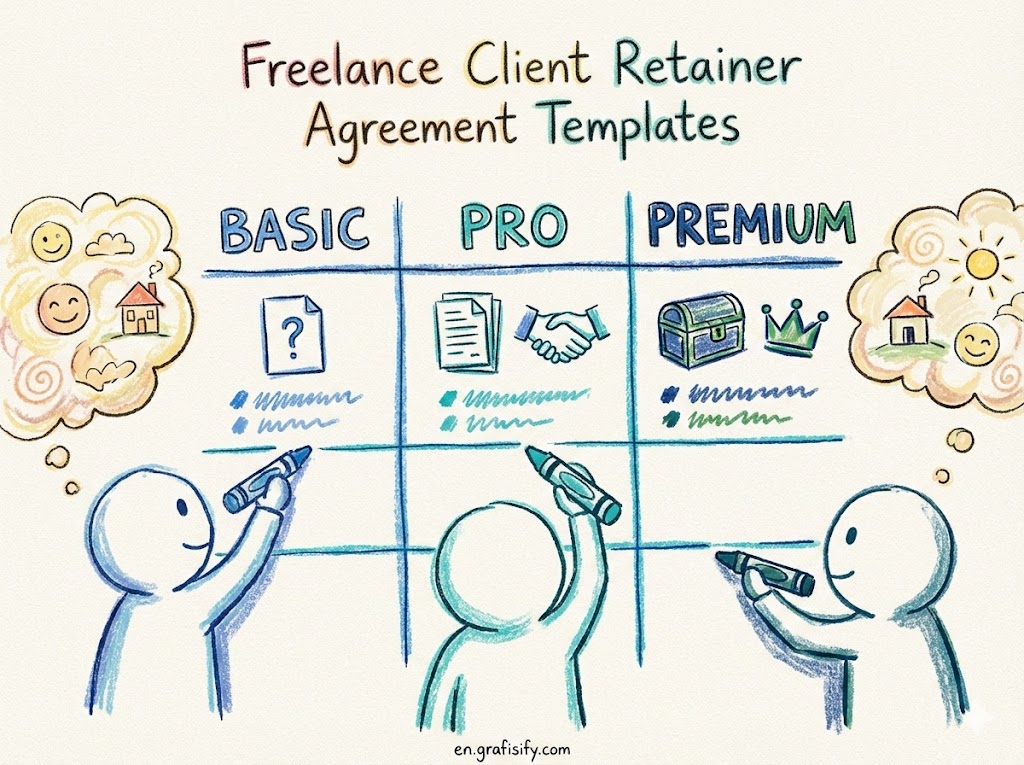
In this deep dive, we are ditching the fluff. I’m going to walk you through 8 specific, battle-tested retainer structures that turn sporadic gigs into predictable, recurring revenue. We’re talking about securing that bag, monthly.
The Verdict: Why You Need a Retainer Strategy Yesterday
Before we dissect the templates, let’s clarify what we are actually building. A retainer agreement is a contract where a client pays you a set monthly fee for a reserved amount of your time, a specific set of deliverables, or ongoing access to your expertise.
Why is this a game-changer? Because it kills the hustle. Instead of spending 50% of your week chasing leads, you spend it doing deep work. For the client, it guarantees they have a “mumpuni” (capable) expert on speed dial without the overhead of a full-time employee. It’s a win-win, provided you set the boundaries right.
If you are looking for more ways to optimize your gig life, check out our resources on freelance strategies and growth.
1. The “Use It or Lose It” Classic (Hours-Based)
This is the bread and butter of freelance client retainer agreement templates. It’s simple, clean, and effective for beginners.
How It Works
The client purchases a block of hours (e.g., 20 hours/month) at a slightly discounted rate compared to your hourly fee. The catch? If they don’t use those hours by the 30th, they vanish. Poof.
Why It Works
It guarantees your income. You know exactly how much is hitting your bank account. For the client, it secures your availability. However, you must track your time religiously. Tools like Harvest or Toggl are non-negotiable here.

The Pitch: “To ensure I can prioritize your urgent requests, let’s reserve 10 hours a month. This way, you skip the queue, and I can dedicate specific slots just for your projects.”
2. The Roll-Over Bank (The Client Favorite)
Clients often hesitate with the “Use It or Lose It” model because they fear wasting money. Enter the Roll-Over.
How It Works
Similar to the classic model, but unused hours roll over to the next month. To protect yourself from a sudden 80-hour work month down the line, you cap the rollover (e.g., max 5 hours roll over, and they expire after 60 days).

The Risk
Be careful. If a client hoards hours and dumps them on you during the holidays, you’re going to have a bad time. Always set a “redemption cap” per month.
3. The Deliverable-Based Retainer (Value-Focused)
Stop trading time for money. It’s a trap. The most lucrative freelance client retainer agreement templates focus on output, not the clock.
How It Works
You agree to a fixed set of items every month. For a writer, this might be “4 Blog Posts + 1 Newsletter.” For a designer, “8 Social Media Assets + 1 Ad Creative.”
Why It’s Superior
If you get faster, your effective hourly rate skyrockets. If it takes you 2 hours to do what used to take 5, you keep the profit. This rewards efficiency.
4. The “On-Call” Consultant (Access Retainer)
This is for the heavy hitters—strategists, senior developers, and consultants. You aren’t getting paid to type; you’re getting paid to know things.
How It Works
The client pays a flat fee just to have the ability to call you, email you, or book a meeting to pick your brain. You are selling peace of mind. It’s often a smaller fee, but the workload is minimal.
Pro Tip: This pairs perfectly with high-level corporate clients who need a “fixer” available but don’t have daily execution work. See more on pricing expert services at Forbes.
5. The Maintenance & Security Guard
Web developers and IT pros, this is your zone.
How It Works
You charge a monthly fee to keep the lights on. Updating plugins, backing up databases, monitoring security, and fixing minor bugs.
Why It’s “Gacor” (Effective)
It’s passive-ish income. Most months, nothing breaks, and you just run your routine checks. When something does break, you’re the hero. It creates a very sticky relationship with the client because detaching you feels risky to them.
6. The Tiered Package Model (Gold/Silver/Bronze)
Psychology 101: People love choices, but not too many. Offering three tiers anchors the price and nudges them toward the middle option.
The Structure
- Bronze ($500): Basic maintenance + 2 hours support.
- Silver ($1,500): Maintenance + 10 hours support + Monthly Report. ( The Sweet Spot)
- Gold ($3,000): Priority support + 20 hours + Strategy calls.
This forces the client to choose how to work with you, rather than if they should work with you.
7. The Content Mill Loop
Content is a beast that needs constant feeding. Social media managers and SEO writers can thrive here.
How It Works
A recurring agreement to populate a content calendar. The scope is rigid. “12 Instagram posts and 4 LinkedIn articles per month.”
The Trap
Scope creep is real here. “Can you just quickly add a TikTok video?” No, Karen, I can’t. Your contract needs to be bulletproof regarding revisions and platform additions.
8. The Hybrid Performance Model
Risk-takers, step up. This model combines a lower base retainer with performance bonuses.
How It Works
Base fee covers your costs. Bonuses trigger when KPIs are hit (e.g., leads generated, sales closed, traffic milestones).
The Upside
If you are confident in your skills, this can double your income. It aligns your incentives with the client’s business goals, making you indispensable. However, ensure the tracking metrics are objective and transparent.
Drafting the Agreement: What Must Be Included
Writing the actual contract scares people, but it doesn’t have to be legalese gibberish. According to the Freelancers Union, clear terms prevent lawsuits. Ensure your freelance client retainer agreement templates include:
- Scope of Work (SOW): Be painfully specific. What is IN and what is OUT.
- Payment Terms: Retainers are paid upfront. Never at the end of the month. You don’t pay Netflix after you watch the movies.
- Termination Clause: 30 days’ notice is standard. You don’t want to be fired overnight.
- Rollover Policy: Explicitly state if hours expire.
Pros and Cons of the Retainer Life
The Pros
- Stability: You can finally budget for rent and taxes without panic attacks.
- Efficiency: You know the brand voice and style, so work takes less time.
- Relationship: You become a trusted advisor, not a commodity.
The Cons
- Schedule Tetris: Managing three retainer clients who all want something on Monday morning is stressful.
- Boredom: Doing the same work for the same brand for a year can get stale.
- The “Boncos” (Loss) Factor: If you miscalculate your hours, you might end up working for pennies.
Final Thoughts: Making the Switch
Moving to a retainer model isn’t just about changing a contract; it’s about changing your posture. You have to believe your availability is a premium asset. Start with your happiest current client. Propose a small trial retainer—say, a 3-month pilot.
Don’t overcomplicate it. Use these freelance client retainer agreement templates as a baseline, tweak them to fit your niche, and stop living invoice-to-invoice. Your sanity will thank you.

Irfan is a Creative Tech Strategist and the founder of Grafisify. He spends his days testing the latest AI design tools and breaking down complex tech into actionable guides for creators. When he’s not writing, he’s experimenting with generative art or optimizing digital workflows.



 Artificial Intelligent
 Design & Creative
 Freelance
 Gadgets & Gear
 Insights
 Laptop
 Reviews
 Smartphone
 Tech Guides
 Vibe Coding