The Syntax Era is Over: Why ‘Vibe Coding’ Killed the Code Monkey (And Saved the Architect)

Let’s rip the band-aid off: The days of getting paid six figures to memorize syntax and Center a Div are effectively over. If your value proposition as a developer is tied to your ability to write boilerplate code faster than the guy next to you, you are officially an endangered species.
For the last decade, the tech industry has been screaming for more bodies. Bootcamps sprang up like weeds, promising that three months of JavaScript tutorials could land you a seat at the table. And for a long time, they were right. But the ground has shifted beneath our feet with terrifying speed. We aren’t just seeing a new tool; we are witnessing a fundamental rewriting of the engineering social contract.
Enter “Vibe Coding”—a term popularized by former Tesla AI chief Andrej Karpathy—which has rapidly evolved from a Silicon Valley meme to the dominant workflow for the next generation of software engineering. It’s messy, it’s fast, and it relies less on knowing how to write the code and more on knowing what code needs to be written.
Here is the brutal truth that Computer Science departments are terrified to admit: The industry no longer needs bricklayers. We have infinite digital bricklayers now. What we need—desperately—are architects.
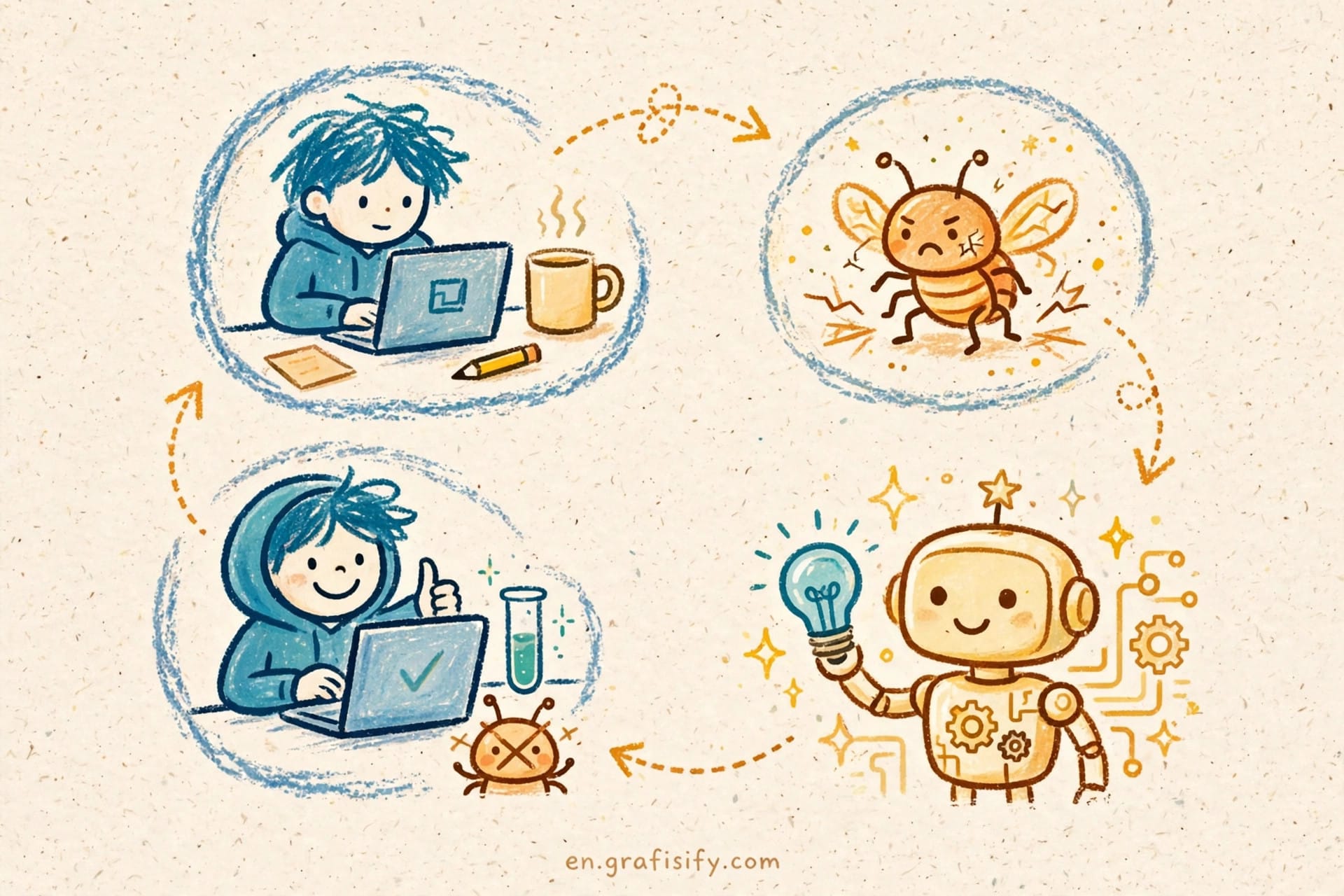
The Rise of the “Vibe” Economy
To understand why the junior developer role is facing an existential crisis, you have to look at the mechanics of modern development. In the traditional model—let’s call it the “Stack Overflow Era”—a developer’s loop was deterministic. You wrote a function, you knew exactly what the inputs and outputs were, and if it broke, you spent three hours hunting for a missing semicolon or a logic error.
Vibe Coding flips this paradigm on its head.
It’s a workflow where the developer delegates the actual writing of the code to an Large Language Model (LLM) like Claude 3.5 Sonnet or GPT-4o, often integrated into IDEs like Cursor or Windsurf. You aren’t typing; you are prompting. You are managing intent.

“I just write the code. I don’t look at the code. I just look at the diffs. I look at the tests. I look at the error messages. And I just keep vibing.” — Andrej Karpathy (Paraphrased from X/Twitter)
This isn’t about laziness; it’s about velocity. In this new reality, a developer might generate 500 lines of Python in seconds. The code might be 90% correct, or it might be hallucinating a library that doesn’t exist. The developer’s job shifts from “author” to “editor.” You run the code, watch it fail, feed the error back to the AI, and iterate.
This loop is wildly productive for senior engineers who can glance at a block of AI-generated code and smell the “code smell” immediately. But for a junior developer who doesn’t understand the underlying principles? It’s a trap. They are handed a Ferrari without knowing how to drive stick shift.

The Commoditization of Syntax
Let’s back up and look at the historical trajectory here. This isn’t the first time the industry has panicked about automation.
- In the 1950s, developers wrote in Binary/Assembly. It was brutal.
- Then came Compilers (COBOL, Fortran). Purists said real programmers didn’t use English words.
- Then came High-Level Languages (Python, Ruby). Purists said real programmers managed their own memory.
- Then came Frameworks (React, Django). Purists said real programmers didn’t need bloat.
Every single step of this ladder was an abstraction layer. “Vibe Coding” is simply the next logical layer: Natural Language. The syntax itself has become an implementation detail that the machine handles.
However, the difference this time is the nature of the abstraction. Previous abstractions were deterministic—if you wrote valid Python, it always compiled the same way. LLMs are probabilistic. They are guessing the next token. This introduces a chaotic element into the codebase that requires a higher level of scrutiny, not lower.
The “Code Monkey”—the developer whose primary skill is translating requirements into syntax—is the role that is being automated away. If an AI can turn a Jira ticket into a Pull Request in 30 seconds, why would a company hire a junior dev to do it in three days?
The “Hollow Senior” and The Crisis of Competence
Here is where the rubber meets the road, and it’s creating a massive headache for CTOs across the US. If juniors can’t get hired to do the grunt work (because AI does it better and cheaper), how do they ever become seniors?
We are facing the “Empty Suit” problem. We are about to see a wave of developers who can prompt an AI to build a React app but have absolutely no idea how the React lifecycle actually works under the hood. When the AI hits a wall—and it always hits a wall eventually—these “Vibe Coders” will be stranded.
The New Skill Set: Architecture Over Algorithms
This is why I argue that the future belongs to the Architects. The value in the marketplace is shifting aggressively toward:
- System Design: Understanding how microservices talk to each other, how databases scale, and where the bottlenecks live. AI is terrible at holding the context of a million-line codebase in its head. Humans are still essential here.
- Debugging & Security: When the AI generates a SQL injection vulnerability (and it will), do you have the expertise to catch it?
- Product Intuition: Can you translate a vague business problem into a technical solution? AI is a yes-man; it will build exactly what you ask for, even if what you asked for is stupid.
“The 10x Engineer is real now, but not because they type faster. It’s because they can leverage AI to operate as a 100x Engineer, doing the work of an entire startup department solo.”
The Bottom Line: Adapt or Die
We are moving toward a future where “Software Engineer” looks less like a writer and more like a construction site foreman. You aren’t laying the bricks anymore; you are directing a team of infinite, tireless, slightly drunk robot bricklayers.
For the senior engineers reading this: This is your golden age. You can now prototype ideas in an afternoon that used to take months. You can build entire SaaS products on a weekend.
For the aspiring juniors: The bar has been raised. Just knowing JavaScript isn’t enough. You need to understand systems. You need to understand deployment. You need to be able to look at AI-generated code and know why it works, not just that it works.
The “Junior Developer” role isn’t dead, but the “Junior Coder” role is buried six feet under. Stop learning how to memorize syntax. Start learning how to build cathedrals.
Tagged with:
Andrej KarpathyArtificial IntelligenceCareer AdviceDeveloper JobsFuture of WorkProductivitySilicon ValleySoftware Engineeringtech trendsvibe coding
Irfan is a Creative Tech Strategist and the founder of Grafisify. He spends his days testing the latest AI design tools and breaking down complex tech into actionable guides for creators. When he’s not writing, he’s experimenting with generative art or optimizing digital workflows.






 Artificial Intelligent
 Design & Creative
 Freelance
 Gadgets & Gear
 Insights
 Laptop
 Reviews
 Smartphone
 Tech Guides
 Vibe Coding