DeepSeek-V3.2 Review: Why This Open Source Breakthrough Is the “GPT-5 Killer” We’ve Been Waiting For

By the time you finish reading this sentence, the gap between open-source AI and the walled gardens of Silicon Valley will have shrunk a little more. Actually, scratch that. With the release of DeepSeek-V3.2, that gap hasn’t just shrunk—in some critical areas, it has completely vanished.
For the past few months, the narrative in the AI space has been grim for the open-source community. While proprietary giants like Google’s Gemini-3.0-Pro and OpenAI’s GPT-5 have been racing ahead with massive reasoning capabilities, open models seemed to be hitting a glass ceiling. We were told that without a trillion-dollar compute budget, you simply couldn’t compete on the hard stuff—math Olympiads, complex coding agents, and deep logical reasoning.
DeepSeek just proved that narrative wrong.
Released this week, DeepSeek-V3.2 isn’t just an iterative update. It represents a fundamental architectural shift that brings “System 2” thinking and massive reinforcement learning (RL) scaling to an efficient, open-weight model. But here is the kicker: their high-compute variant, DeepSeek-V3.2-Speciale, doesn’t just match the competition. According to benchmarks, it outperforms GPT-5-High and stands toe-to-toe with Gemini-3.0-Pro, securing gold medals in the International Mathematical Olympiad (IMO) and the International Olympiad in Informatics (IOI).
Also Read:
If you are a developer, an enterprise CTO, or just an AI enthusiast tired of paying API fees for “good enough” reasoning, you need to pay attention. This is the moment the playing field leveled out.
The Core Story: Efficiency Meets “Gold Medal” Intelligence
The headline here is twofold: efficiency and reasoning density. Historically, you had to pick one. You could have a fast, cheap model that hallucinated on complex math, or a massive, slow, expensive model that could solve physics problems. DeepSeek-V3.2 harmonizes these by introducing two major technical breakthroughs: DeepSeek Sparse Attention (DSA) and a Scalable Reinforcement Learning Framework.
Let’s break down the “Meat” of this release.

The “Speciale” Variant: The New King of Open Weights?
While the standard V3.2 model is a workhorse designed for efficiency, the DeepSeek-V3.2-Speciale is the showstopper. This variant was trained by relaxing length constraints, allowing the model to “over-think” problems—generating massive chains of thought to arrive at the correct answer.
The results are frankly startling. In the 2025 IOI (International Olympiad in Informatics), the Speciale model ranked in the top tier, achieving gold-medal performance. It did the same for the IMO (Math Olympiad). To put this in perspective, passing these exams requires a level of rigorous logical consistency that usually breaks Large Language Models (LLMs). Most models can guess; DeepSeek-V3.2-Speciale reasons.
“DeepSeek-V3.2-Speciale surpasses GPT-5 and exhibits reasoning proficiency on par with Gemini-3.0-Pro… achieving gold-medal performance in both the 2025 IMO and IOI.”
For enterprise users, this means the “reasoning gap”—the primary reason companies still lock themselves into OpenAI or Google ecosystems—is effectively closed for high-complexity tasks.
DeepSeek Sparse Attention (DSA): Speed Without the Lobotomy
The Achilles’ heel of long-context models has always been the attention mechanism. Standard “vanilla” attention has a computational complexity of O(L²). In plain English? As your document gets longer, the computational cost explodes exponentially. This is why running a 128k context window on local hardware usually turns your GPU into a space heater while producing tokens at a snail’s pace.
DeepSeek-V3.2 introduces DeepSeek Sparse Attention (DSA). This architecture uses a “lightning indexer” and a fine-grained token selector to fundamentally change how the model reads data. Instead of paying attention to every single token equally (the O(L²) problem), DSA selects only the most relevant “top-k” tokens for the current query.
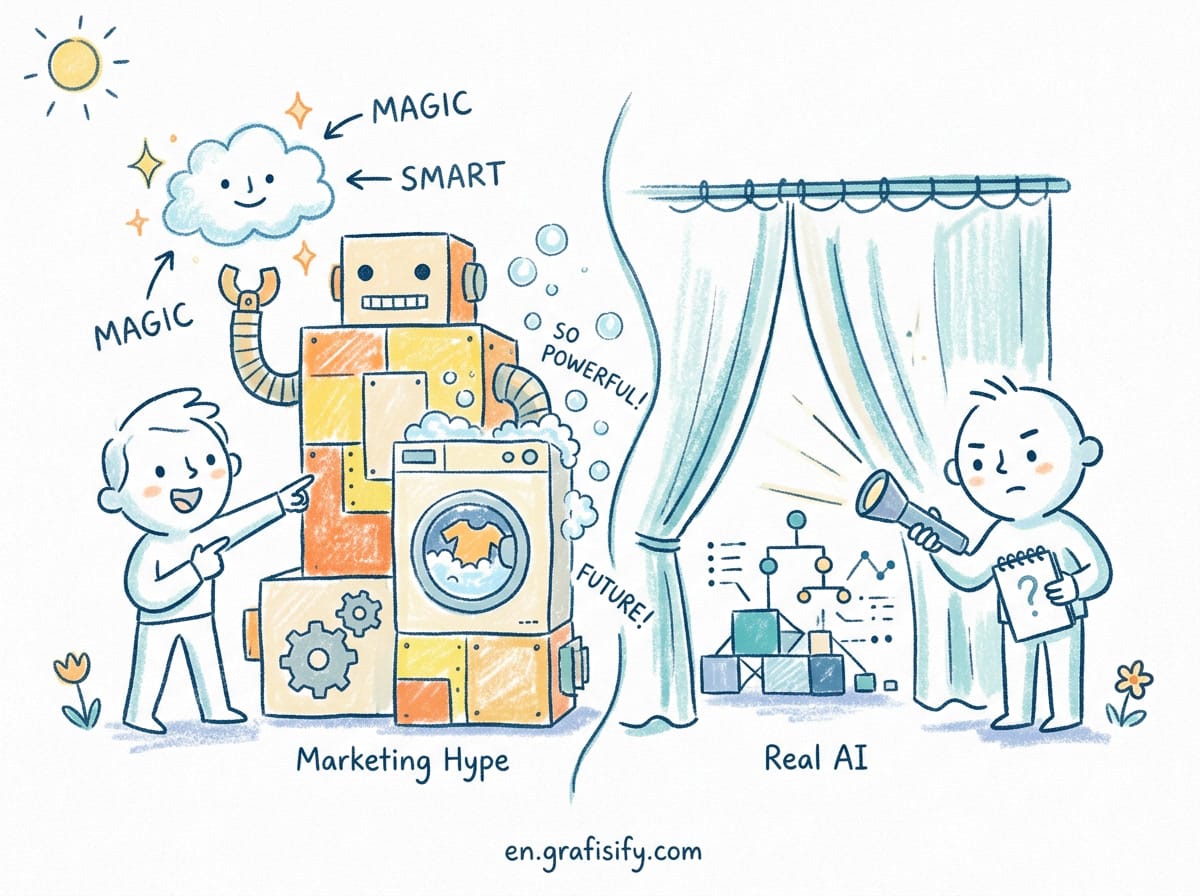
The result is a reduction in core attention complexity to O(Lk), where k is significantly smaller than the sequence length L. This allows DeepSeek-V3.2 to handle massive contexts (up to 128k tokens) with significantly lower latency and cost compared to its predecessors, without the performance degradation usually seen in sparse attention techniques.
Context & Background: The “Widening Gap” Crisis
To understand why this release matters, we have to look at the state of the industry leading up to December 2025. The paper itself opens with a stark admission: while open-source models (like MiniMax, Qwen, and previous DeepSeek iterations) were improving, the proprietary models were accelerating faster.
The “Reasoning Era” kicked off by OpenAI’s o1 and Google’s Gemini updates created a bifurcation. We had “Chat models” (great for talking, bad at thinking) and “Reasoning models” (proprietary, expensive, slow, but brilliant). Open source was largely stuck in the “Chat” category. They lacked the post-training compute budget—the massive amount of processing power used after the base model is trained to refine its logic via Reinforcement Learning (RL)—to compete.
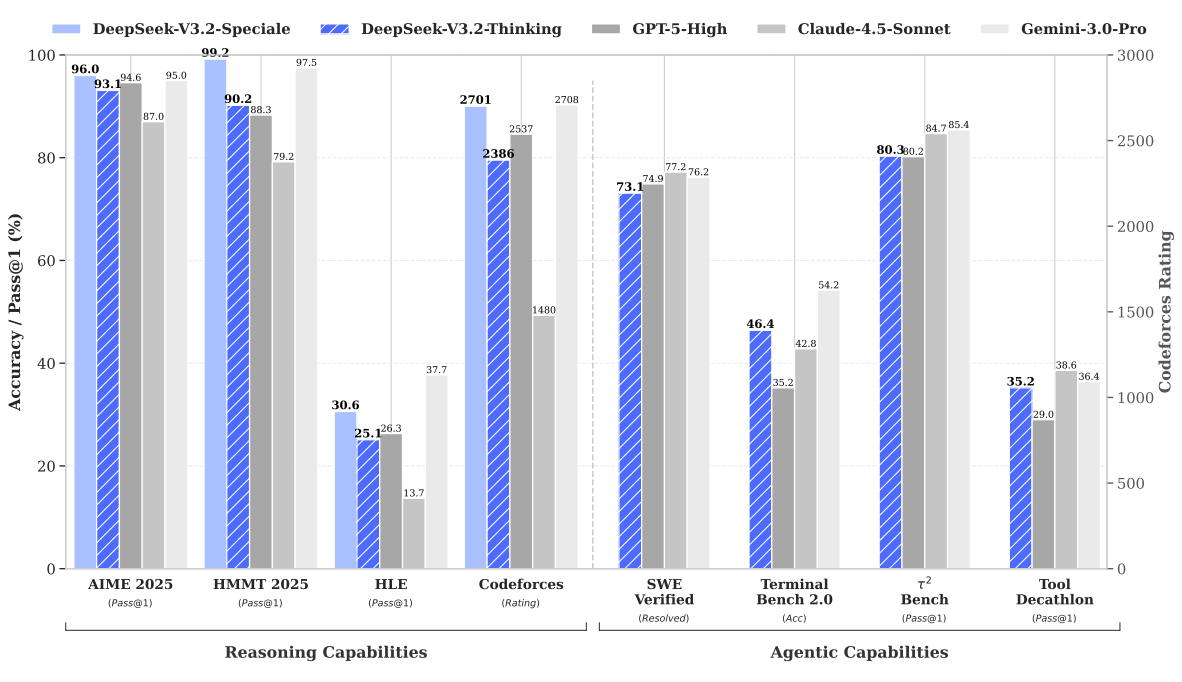
February competition, consistent with the baselines. For HLE, we report the text-only subset
DeepSeek identified three critical deficiencies in the open landscape:
- Inefficient Architectures: Vanilla attention was too heavy for long-context reasoning.
- Resource Starvation: Open models weren’t spending enough compute on post-training (RL).
- Agentic Lag: Open models were terrible at following complex instructions in multi-step “agent” environments (like using a web browser or coding tools).
DeepSeek-V3.2 is a direct surgical strike against these three weaknesses.
Deep Dive: The Agentic Revolution and “Thinking” Tools
This is the part of the report that should make developers sit up straight. We aren’t just talking about a model that answers questions better; we are talking about a model that can act better.
Synthesis Pipeline: Building a Better Brain
One of the biggest hurdles for training AI Agents is data. How do you train a model to use a search engine or a Python interpreter if you don’t have millions of examples of humans doing exactly that perfectly? DeepSeek solved this by building a Large-Scale Agentic Task Synthesis Pipeline.
They didn’t just scrape the web; they synthesized over 85,000 complex prompts and 1,800 distinct environments. They created a “Cold-Start” phase where they used the V3 methodology to unify reasoning and tool-use. Essentially, they taught the model to “think” (generate a Chain of Thought) before it decides to call a tool (like a Python script), and then retain that context while the tool runs.
Thinking in Tool-Use: A UX Breakthrough
Most agentic frameworks are clunky. If an agent calls a tool, it often forgets why it called it by the next turn, or it wastes tokens re-analyzing the whole history. DeepSeek introduced a new Thinking Context Management system.
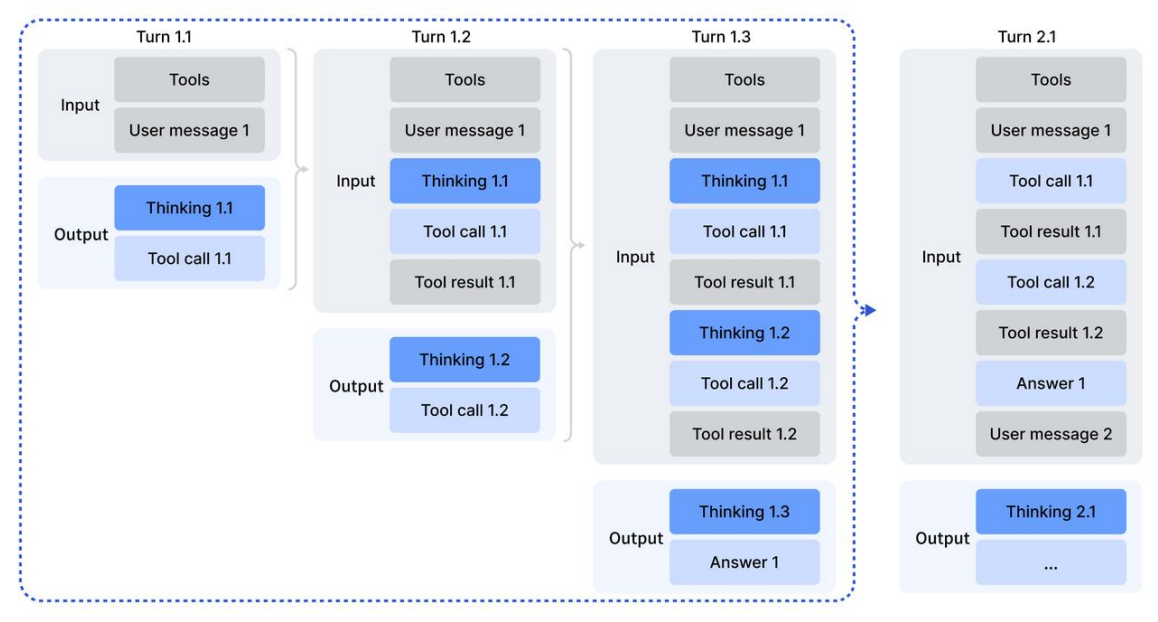
Here is how it works:
- Smart Retention: The model retains its “reasoning trace” (its inner monologue) while interacting with tools. It only discards this heavy context when a new user message arrives.
- Token Economy: This prevents the model from having to “re-reason” through the entire problem every time a tool returns a result, significantly speeding up complex coding or research tasks.
- Cold-Start Capability: Even without massive real-world data, the model can “cold start” agentic tasks by following explicit “thinking” instructions, bridging the gap between pure reasoning and practical application.
Expert Analysis: The Cost of Intelligence
Let’s talk about the elephant in the room: Compute Cost.
The paper reveals a fascinating metric: DeepSeek allocated a post-training computational budget exceeding 10% of the pre-training cost. This is a massive shift in resource allocation. Historically, 99% of the budget went into the base model (pre-training), and fine-tuning was a cheap afterthought. DeepSeek is adopting the “OpenAI Strategy”—spending heavily on RL to refine the model’s behavior.
However, this comes with a trade-off. The DeepSeek-V3.2-Speciale model is brilliant, but it is “token hungry.” To achieve that gold-medal performance, it generates long, winding chains of thought. In a production environment where you are paying per output token, this gets expensive fast. The standard V3.2 is the compromise—balanced efficiency using DSA, but perhaps not quite reaching the “Speciale” heights of reasoning.
“The bottom line: DeepSeek-V3.2-Speciale proves that open weights can beat GPT-5, but it requires a ‘thinking’ runtime that might be too slow for real-time customer chatbots. It is an engine for deep work, not quick chat.”
From an SEO and Content Strategy perspective, this model is a game-changer for automated workflows. The ability to handle long-tail agent tasks (like “research this topic, verify facts, and write a summary”) with high reliability means we are moving closer to truly autonomous content agents.
Future Outlook: What’s Next?
So, where does this leave us? The release of DeepSeek-V3.2 forces the proprietary giants into a corner. They can no longer claim that “reasoning” is a premium feature reserved for closed APIs. The open-source community now has a blueprint for:
- Efficient Long-Context: Using Sparse Attention to run massive contexts on cheaper hardware.
- Post-Training Scaling: Investing heavy compute into RL to unlock “System 2” capabilities.
- Synthetic Data: Generating their own training worlds to solve the data shortage.
The gap hasn’t just narrowed; the definition of the race has changed. It is no longer about who has the biggest cluster of H100s; it is about who can use them the most efficiently. DeepSeek just showed the world that you don’t need to be in Mountain View or San Francisco to set the state of the art.
The verdict? If you are building on LLMs in 2026, and you aren’t testing DeepSeek-V3.2, you are voluntarily fighting with one hand tied behind your back. Download the weights, spin up the container, and see for yourself.
Tagged with:
AI AgentsArtificial IntelligenceDeepSeekDeepSeek-V3.2GPT-5llmMachine LearningOpen Source AIReinforcement LearningTech News
Irfan is a Creative Tech Strategist and the founder of Grafisify. He spends his days testing the latest AI design tools and breaking down complex tech into actionable guides for creators. When he’s not writing, he’s experimenting with generative art or optimizing digital workflows.
You might also like



 Artificial Intelligent
 Design & Creative
 Freelance
 Gadgets & Gear
 Insights
 Laptop
 Reviews
 Smartphone
 Tech Guides
 Vibe Coding